Monumental Visionary Fine Art exploring mythology, consciousness, sacred light, and timeless visual storytelling.

Monumental Visionary Fine Art exploring mythology, consciousness, sacred light, and timeless visual storytelling.

Surreal Paintings

Between Strength and Surrender

Between Strength and Surrender

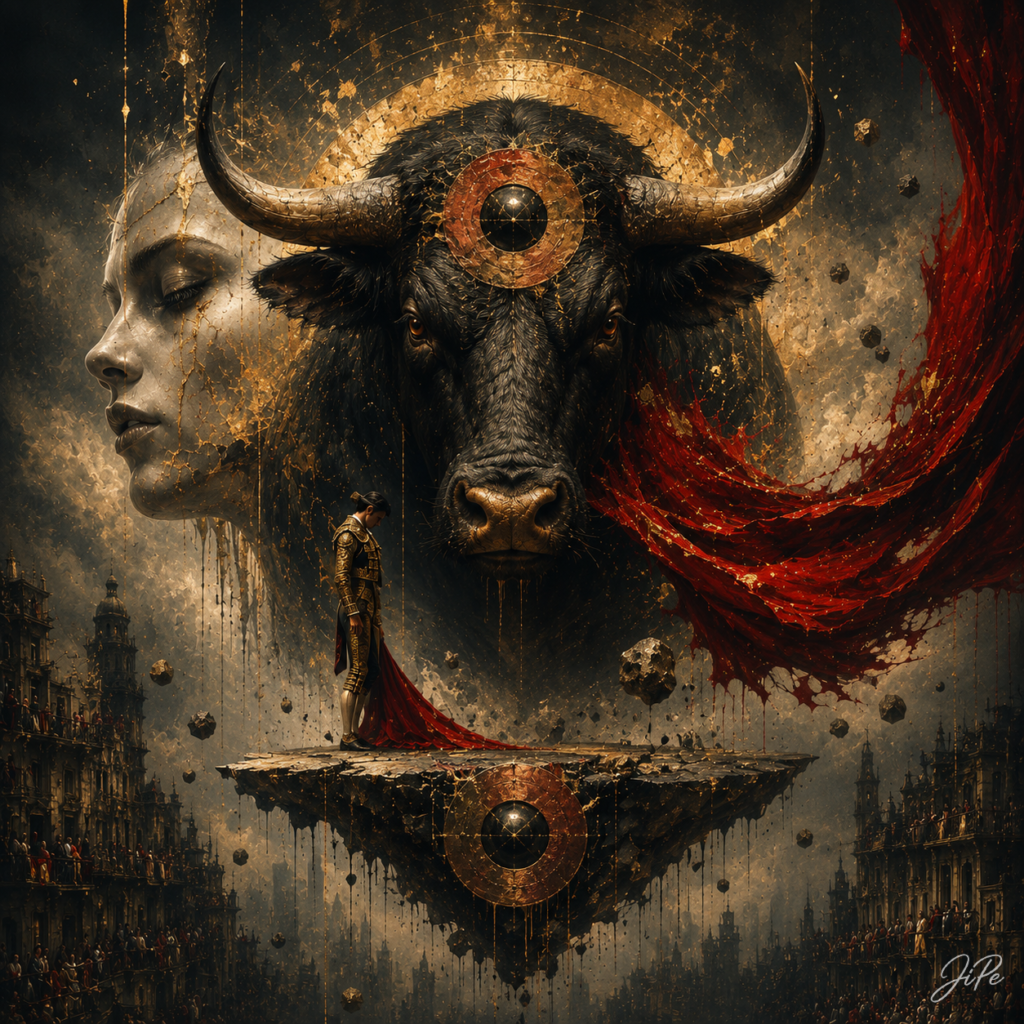
Between Strength and Surrender is a monumental allegory of the human condition, exploring the fragile equilibrium between power and vulnerability, instinct and consciousness, dominance and humility. Rooted in the visual traditions of symbolic realism and contemporary visionary art, the painting transcends narrative illustration to become a philosophical meditation on the forces that shape identity. Every element within the composition functions as both image and metaphor, inviting viewers to contemplate the inner conflicts that define personal transformation.

The composition unfolds as a carefully orchestrated symbolic architecture, where monumental scale and intimate emotion coexist. At its centre stands the imposing presence of a black bull, confronting the viewer with unwavering intensity. The animal is rendered not merely as wildlife but as an archetypal force—an embodiment of primal energy, resilience, courage, and the instinctive dimensions of human nature. Throughout history, the bull has symbolised vitality, sacrifice, sovereignty, and spiritual endurance. Here, it becomes the silent guardian of an invisible threshold between the material and the metaphysical.

Positioned directly before this immense presence is a solitary human figure dressed in ceremonial attire, standing with head gently bowed. The contrast in scale immediately establishes the psychological tension that defines the work. Although physically small, the figure becomes emotionally monumental through the act of surrender. This gesture does not imply defeat; rather, it represents conscious humility—the recognition that genuine strength often emerges through acceptance rather than domination. The encounter becomes less a confrontation than a moment of profound inner dialogue.

To the left of the composition appears the serene profile of a woman with closed eyes, her face partially dissolving into luminous fractures of gold. She exists beyond portraiture, functioning instead as an embodiment of memory, intuition, and inner awareness. Her peaceful expression introduces a contemplative counterbalance to the raw physicality of the bull. Together they represent complementary aspects of existence: instinct and reflection, action and stillness, external power and internal wisdom. Their coexistence creates a visual harmony that echoes ancient philosophical concepts of duality without reducing them to simple opposites.

Suspended above the bull’s forehead is a striking circular symbol centred upon a dark sphere. This celestial emblem functions simultaneously as halo, eclipse, sacred geometry, and cosmic eye. It becomes the metaphysical centre of the painting—a symbol of perception beyond ordinary sight. The black circle suggests mystery rather than absence, reminding the viewer that the deepest truths often remain concealed beneath appearances. Rather than illuminating the world through brightness alone, the work proposes that wisdom frequently emerges through encounters with uncertainty and the unknown.

Echoing this motif, a second circular form appears embedded within the floating stone platform below, visually linking the earthly and celestial realms. These repeated geometries establish an invisible vertical axis running throughout the composition, connecting human consciousness, instinctive force, and cosmic order into a unified symbolic system. The circles imply continuity, eternity, and the cyclical nature of transformation, suggesting that every internal struggle participates in a larger universal rhythm.

The floating platform itself reinforces the painting’s dreamlike atmosphere. Detached from the architectural city below, it occupies a liminal space between earth and sky, reality and imagination. It becomes a symbolic stage upon which psychological rather than physical events unfold. Gravity appears suspended, allowing fragments of stone to drift through the surrounding space like remnants of collapsing certainties. These floating elements evoke the dissolution of rigid structures—both external and internal—as new forms of understanding gradually emerge.

Surrounding the central encounter is an immense city whose architecture recalls fragments of forgotten civilizations. Towers rise through atmospheric haze while distant crowds gather along balconies, becoming silent witnesses to the unfolding drama. Yet despite the monumental setting, the city remains strangely detached from the protagonists. It functions less as a geographical location than as a collective memory of humanity itself—a civilisation built upon ambition, tradition, ritual, and history. Against this vast backdrop, the solitary act of surrender acquires universal significance.

Perhaps the most visually striking gesture within the composition is the flowing crimson fabric that sweeps dramatically across the right side of the image. Rich in movement and painterly expression, it immediately recalls the ceremonial language of the bullring while simultaneously transcending literal reference. Rather than symbolising conflict alone, the crimson form becomes an embodiment of passion, sacrifice, destiny, and life’s emotional intensity. Its dynamic movement contrasts with the stillness of the central figures, introducing rhythm into an otherwise meditative composition. The red cloth appears almost alive, dissolving into abstract gestures that blur the boundary between material fabric and pure emotional energy.

The painting’s restrained palette of charcoal black, weathered ivory, deep crimson, muted earth tones, and luminous gold contributes significantly to its symbolic depth. Gold is used not as decoration but as a visual language of transcendence. Flowing through fractured surfaces and textured passages, it recalls the philosophy of kintsugi, where cracks are honoured rather than concealed. These luminous fissures suggest that transformation leaves visible traces, and that wholeness is achieved not despite our fractures, but through them.

The richly layered surface reinforces this narrative of becoming. Thick painterly textures, distressed passages, subtle abrasions, dripping pigments, and expressive brushwork create an archaeological quality, as though the image has gradually emerged through centuries of memory and erosion. Realism continually dissolves into abstraction, allowing the viewer to move seamlessly between physical representation and symbolic interpretation. This tactile complexity rewards prolonged observation, revealing new relationships between texture, form, and meaning over time.

From an art historical perspective, Between Strength and Surrender occupies a compelling intersection between contemporary figurative painting, surreal realism, symbolic portraiture, and visionary art. Echoes of Renaissance monumentality, Baroque theatricality, modern abstraction, and mythological storytelling coexist within a distinctly contemporary visual language. Yet the work ultimately resists belonging to any single tradition. Instead, it constructs its own symbolic vocabulary—one in which emotional truth takes precedence over literal narrative.

The title serves as the conceptual key to the entire composition. Between Strength and Surrender does not present these ideas as opposing forces but as interdependent states of being. The painting proposes that authentic strength is inseparable from the willingness to relinquish control, while genuine surrender requires extraordinary courage. It is within this delicate balance that transformation becomes possible. The work challenges conventional notions of power, suggesting that the greatest victories often occur not through conquest, but through reconciliation with the deepest parts of oneself.

Ultimately, Between Strength and Surrender invites viewers into a contemplative space where myth, psychology, and spirituality converge. It encourages reflection on the invisible negotiations that shape every human life—the continual movement between instinct and wisdom, certainty and mystery, resilience and vulnerability. In this timeless encounter between the human figure and the monumental bull, the painting reveals that true mastery is not achieved by overcoming the forces within us, but by learning to stand before them with humility, courage, and profound inner peace.

Lämna ett svar