
The King Returns
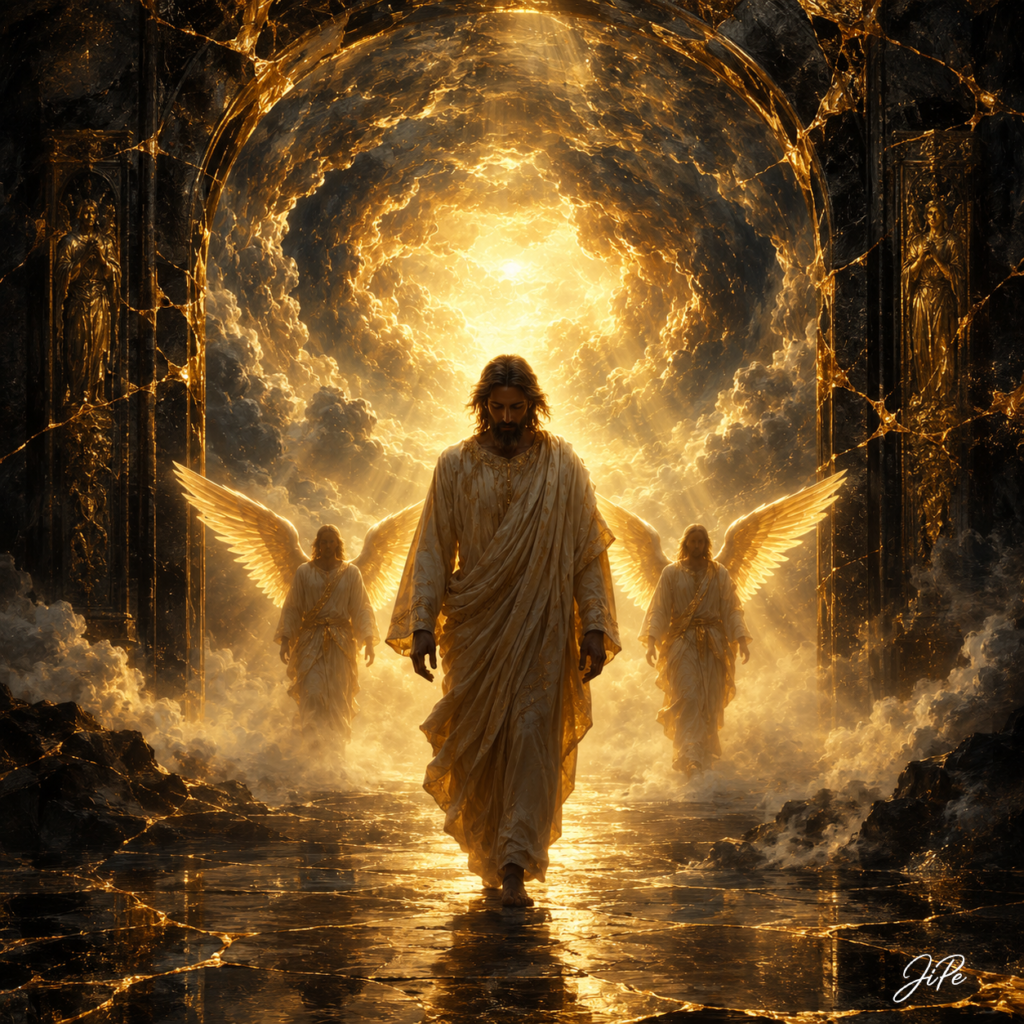
The King Returns is a monumental contemporary vision of the Second Coming of Christ, presenting one of Christianity’s most profound eschatological themes through a language of radiant symbolism, sacred architecture, and transcendent light. Rather than depicting a literal scene from the Book of Revelation, the artwork offers a timeless meditation on Christ’s promised return as the victorious King, righteous Judge, and eternal Redeemer. It is an image that speaks simultaneously of majesty and mercy, divine authority and compassionate love, inviting viewers to contemplate not only the culmination of biblical history but the enduring hope that lies at the heart of Christian faith.
At the center of the composition, Christ emerges from an immense portal of celestial light, walking calmly yet purposefully toward the viewer. His posture is neither theatrical nor confrontational. Instead, He advances with profound serenity, embodying absolute authority expressed through humility. His lowered gaze conveys reflection rather than judgment, suggesting a King whose sovereignty is inseparable from compassion. Every movement is deliberate, emphasizing that His return is not one of uncertainty but the fulfillment of a promise extending across centuries of faith and expectation.
The composition deliberately places Christ at the intersection of heaven and earth. Behind Him unfolds an immense heavenly realm filled with radiant clouds and overwhelming golden illumination, while beneath His feet stretches a reflective earthly surface that mirrors the divine light above. This visual dialogue symbolizes the reconciliation of the celestial and the terrestrial—the long-awaited moment when eternity enters history and the Kingdom of God is revealed in its fullness. The artist presents Christ not as a distant figure descending from inaccessible heights, but as One who crosses the threshold between worlds to dwell once more among humanity.
Accompanying the central figure are two radiant angels whose luminous wings expand into the surrounding atmosphere like living extensions of the divine light itself. Positioned slightly behind Christ, they do not compete for attention but reinforce His centrality. Their presence evokes the biblical descriptions of the heavenly host accompanying the Messiah at His return while simultaneously symbolizing divine protection, justice, and the fulfillment of God’s eternal purposes. They serve as silent witnesses to the unfolding revelation, their calm expressions mirroring the peace that radiates from the central figure.
The monumental gateway from which Christ emerges forms one of the painting’s most significant symbolic elements. Constructed of ancient architectural forms that appear simultaneously earthly and celestial, the portal recalls the imagery of sacred temples, heavenly sanctuaries, and the ”gates of the New Jerusalem” described in the Book of Revelation. Unlike doors that separate, this gateway stands completely open, signifying unrestricted access between heaven and earth. It represents the removal of every barrier between God and humanity, transforming the threshold into a symbol of reconciliation, restoration, and eternal communion.
The extraordinary treatment of light defines the entire visual experience. Brilliant gold floods every dimension of the composition, illuminating clouds, architecture, garments, and reflective surfaces with breathtaking intensity. The light appears not merely to fall upon the figures but to originate from within them, suggesting the divine glory traditionally associated with Christ’s resurrected and exalted nature. Drawing upon the rich history of Christian iconography, the artist employs gold as the visual language of holiness, eternity, and divine presence. Yet the luminosity is rendered with a distinctly contemporary sensibility, surrounding the viewer in an atmosphere that feels both cosmic and deeply intimate.
The artist masterfully balances this overwhelming radiance with carefully preserved areas of darkness. The surrounding stone architecture, fractured rock formations, and shadowed recesses create dramatic contrast, allowing the light to emerge with even greater force. Rather than symbolizing evil or despair, the darkness represents the mystery of creation before the full revelation of divine glory. It is transformed by the advancing light, reflecting the biblical affirmation that ”the light shines in the darkness, and the darkness has not overcome it.”
Subtle golden fractures extend throughout the architectural framework surrounding the heavenly portal. These glowing veins evoke themes of transformation and redemption, suggesting that the very fabric of creation has begun to participate in the renewal inaugurated by Christ’s return. What appears ancient, weathered, or broken is infused with living light, recalling theological visions of a restored heaven and earth in which all creation is reconciled through the reign of the Messiah.
The composition is carefully organized around a powerful central axis established by the figure of Christ. Every architectural line, every ray of light, and every surrounding form directs the eye toward His presence. This visual structure echoes the theological conviction that Christ is the center of both history and creation. The symmetry of the composition reinforces a sense of divine order while allowing subtle asymmetries in the surrounding clouds and landscape to preserve a feeling of organic movement and living reality.
Stylistically, The King Returns synthesizes several major artistic traditions into a unified contemporary vision. The monumental scale and emotional intensity recall the grandeur of Baroque religious painting, while the luminous atmosphere reflects the sacred gold of Byzantine iconography. The carefully rendered anatomy and flowing drapery evoke Renaissance ideals of beauty and proportion, yet the expansive celestial environment, cinematic lighting, and immersive visual depth firmly place the work within the language of contemporary visionary art. The result is neither historical reconstruction nor abstract symbolism alone, but a compelling synthesis that speaks to modern audiences while remaining deeply rooted in centuries of sacred artistic tradition.
From an art historical perspective, the painting belongs to the enduring lineage of representations of Christ in Majesty and the Second Coming. Throughout Christian art, these themes have often emphasized divine judgment, royal enthronement, or apocalyptic spectacle. The King Returns offers a distinctive reinterpretation by emphasizing Christ’s peaceful authority rather than overwhelming power. The victorious King approaches not with visible instruments of conquest but with the quiet certainty of fulfilled promise. His majesty is revealed through presence rather than display, inviting contemplation rather than fear.
Theologically, the work resonates with biblical passages found throughout both the Old and New Testaments, particularly the prophetic visions of Isaiah, Daniel, the Gospels, and the Book of Revelation. Yet rather than illustrating any single scriptural text, the artist distills these traditions into a universal visual meditation on hope. The return of Christ is presented not merely as an event at the end of history but as the ultimate fulfillment of God’s covenant with creation—a restoration in which justice, peace, mercy, and truth are perfectly united.
Symbolically, every element contributes to this central vision. The open gateway represents eternal access to God’s presence. The angels embody heavenly witness and divine service. The radiant clouds signify the glory of heaven, while the fractured yet illuminated architecture reflects the renewal of creation itself. The reflective ground beneath Christ suggests that heaven is already touching the earth, transforming the ordinary into the sacred. Even His flowing white garment, rendered with remarkable softness and luminosity, symbolizes purity, resurrection, and the eternal priesthood of the Messiah.
Emotionally, The King Returns evokes both awe and reassurance. The immense scale of the heavenly vision inspires reverence before the mystery of divine majesty, yet Christ’s calm expression and measured stride communicate profound peace. The viewer is not positioned as a spectator to an overwhelming supernatural event but as one awaiting the arrival of a long-expected King whose presence fulfills the deepest hopes of the human spirit.
For visitors, collectors, theologians, and art historians alike, the artwork offers a rich field of contemplation. It may be experienced as a devotional image rooted in Christian eschatology, as a philosophical reflection on humanity’s longing for ultimate justice and restoration, or as a contemporary masterpiece that reimagines one of sacred art’s most enduring themes through the expressive possibilities of modern visual language. Its layered symbolism, architectural complexity, and luminous atmosphere invite sustained study, revealing new theological and artistic insights with each viewing.
Ultimately, The King Returns stands as a profound affirmation of hope. It proclaims that history is not governed by chaos or despair, but directed toward the fulfillment of divine promise. Through its extraordinary synthesis of biblical symbolism, monumental composition, radiant light, and contemplative beauty, the artwork presents the return of Christ not merely as the conclusion of time but as the beginning of a renewed creation. It is a vision of eternity entering the world with quiet majesty, reminding every viewer that beyond the uncertainties of the present lies the enduring promise of the King who comes not only in glory, but also in perfect justice, boundless mercy, and everlasting peace.