
The Infinite Witness
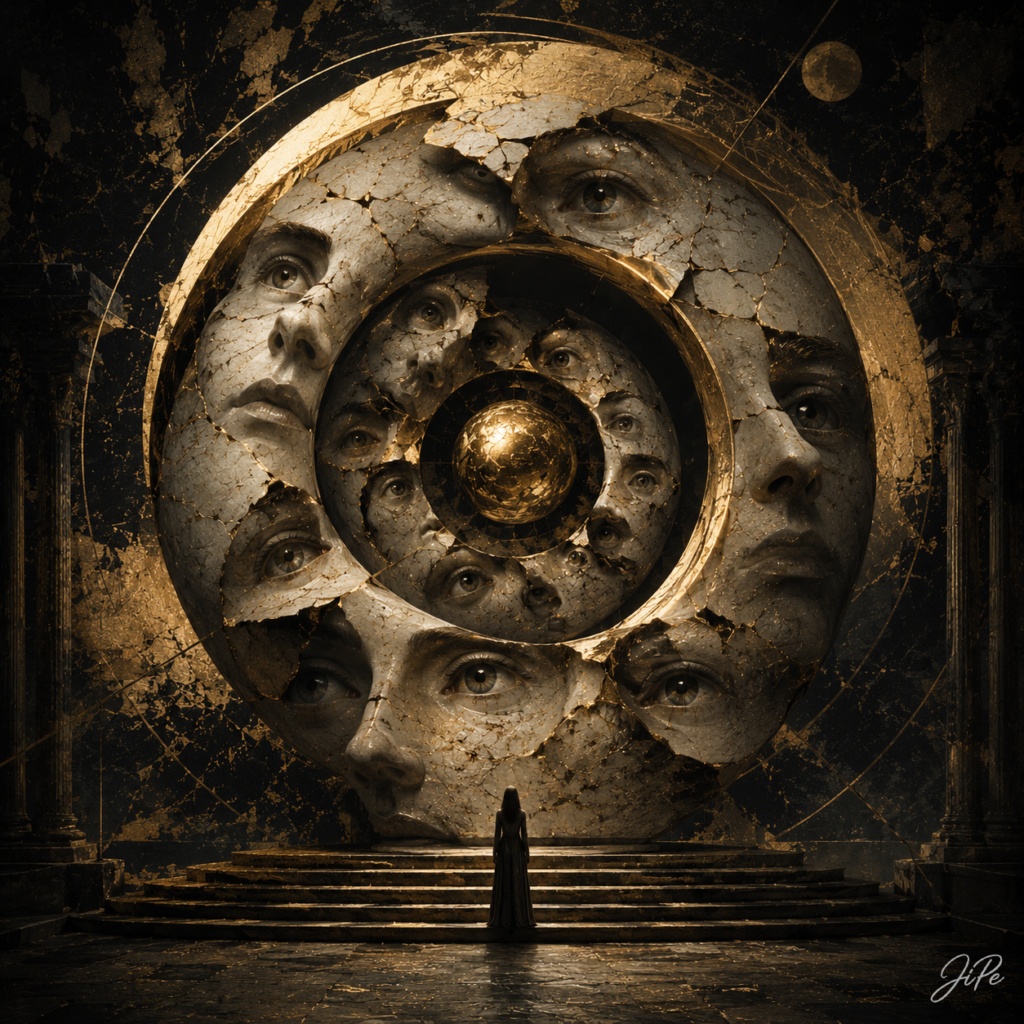
The Infinite Witness is a profound meditation on consciousness, perception, and the enduring mystery of identity. Blending contemporary visionary symbolism with monumental figurative abstraction, the work explores one of humanity’s oldest philosophical questions: Who is the observer behind every thought, memory, and experience? Rather than offering a definitive answer, the painting creates a visual language through which viewers are invited to contemplate the infinite nature of awareness itself.
Dominating the composition is a colossal fractured sphere composed of countless human faces and watchful eyes, layered within one another like concentric realities unfolding toward an unseen centre. The monumental form appears simultaneously ancient and alive—part sculpture, part celestial body, part psychological landscape. Standing before it is a solitary human figure whose scale emphasizes both the immensity of the structure and the humility required when confronting questions that extend beyond ordinary perception.
The title, The Infinite Witness, refers not to an external observer but to the timeless awareness that exists beneath every changing identity. Throughout life, the body changes, memories accumulate, emotions rise and disappear, yet something remains constant—a silent witness that experiences every moment without itself being altered. The painting transforms this invisible philosophical concept into monumental visual form, suggesting that consciousness is not singular but layered, multidimensional, and eternal.
At first glance the sphere appears fragmented, its cracked surfaces exposing hidden faces beneath weathered stone. These fractures are among the painting’s most significant symbolic elements. Rather than representing destruction, they suggest revelation. Every crack allows another level of perception to emerge, implying that identity is never fixed but composed of countless hidden dimensions waiting to be discovered. The apparent damage therefore becomes a metaphor for spiritual awakening: what appears broken may simply be opening.
The repeated faces create a hypnotic visual rhythm that draws the eye inward. Each expression differs subtly from the next, suggesting different emotional states, different lifetimes, or different versions of the self. Together they evoke the idea that human identity is never singular. We are simultaneously shaped by memory, imagination, history, hope, fear, and possibility. The work proposes that beneath every outward face lies another, and beneath that another still, extending infinitely beyond conscious understanding.
The eyes play an equally essential role within the composition. They appear embedded throughout the monumental structure, observing from every direction. Some gaze directly toward the viewer while others seem absorbed in distant contemplation. This multiplicity transforms the painting into an active dialogue rather than a passive image. One is never entirely certain whether they are observing the artwork—or whether the artwork is observing them.
This inversion of perspective recalls philosophical traditions stretching from Plato to Carl Jung, Eastern contemplative practices, and modern phenomenology. The painting quietly asks whether perception flows in only one direction. Perhaps consciousness is not merely something we possess, but something within which we already exist. In this sense the countless eyes become symbols of universal awareness rather than individual vision.
At the centre of the concentric faces rests a luminous golden sphere. Visually it functions as the gravitational heart of the composition, around which every surrounding element appears to revolve. Symbolically, however, it carries multiple interpretations. It may represent divine consciousness, the soul, the origin of creation, the hidden self, or the singular point from which all realities emerge. Its polished brilliance contrasts dramatically with the weathered textures surrounding it, suggesting an eternal perfection concealed beneath the fractured surfaces of existence.
Circular geometry dominates every aspect of the painting. The concentric rings surrounding the sphere evoke sacred geometry, astronomical orbits, mandalas, and cosmological diagrams. Throughout history the circle has symbolised eternity, unity, completeness, and the cyclical nature of existence. Here it becomes a visual metaphor for consciousness itself—without beginning, without end, endlessly expanding while remaining centred within itself.
The monumental architecture surrounding the central form contributes further layers of meaning. Dark columns frame the composition like the remains of an ancient temple, suggesting that the search for self-knowledge has always occupied a sacred place within human civilisation. Yet these structures never fully enclose the space. Instead they imply that true understanding cannot be contained by physical architecture or institutional doctrine. The greatest sanctuary exists within consciousness itself.
Light serves as the painting’s primary emotional language. Warm golden illumination radiates from the central sphere, softly revealing the surrounding faces while allowing vast areas to remain immersed in shadow. This careful orchestration of chiaroscuro reflects one of the central themes of JiPe’s artistic language: illumination does not eliminate mystery—it reveals it. Every area touched by light simultaneously makes the surrounding darkness more profound, reminding viewers that knowledge and mystery are inseparable companions.
The restrained palette of black, ivory, weathered stone, and luminous gold strengthens this philosophical atmosphere. Gold has historically symbolised transcendence, divine presence, incorruptibility, and enlightenment. Within this work it becomes something more subtle. Rather than decorative luxury, gold represents awareness itself—an inner light quietly persisting beneath every fracture, every memory, and every changing appearance.
Materiality plays an equally significant role. Rich painterly textures, cracked surfaces, aged plaster effects, and layered mixed-media finishes create the impression that the monument has endured across countless centuries. Time appears etched directly into the surface. Yet despite this weathering, the eyes remain vividly alive. This juxtaposition between decay and awareness suggests that while material forms inevitably erode, consciousness itself transcends physical impermanence.
The solitary figure standing before the monument introduces the painting’s human dimension. Unlike the monumental sphere, the traveller possesses no identifiable features, functioning instead as an archetype representing every viewer. The encounter becomes deeply personal. Standing before infinite consciousness, the individual is confronted not with answers but with profound questions regarding identity, existence, and perception.
The scale relationship between the figure and the sculpture creates a powerful emotional tension. Human life appears fragile and temporary when measured against the timeless monument, yet the very act of witnessing transforms the traveller into an equal participant within the composition. Awareness recognises awareness. The observer and the observed become inseparable.
From an art historical perspective, The Infinite Witness synthesises influences from Symbolism, Surrealism, Renaissance monumentality, metaphysical painting, and contemporary visionary realism. Echoes of classical sculpture coexist with psychological symbolism, while sacred geometry merges seamlessly with contemporary digital painterly techniques. The resulting visual language feels simultaneously ancient and futuristic, existing outside conventional historical categories.
Psychologically, the painting resonates strongly with Jungian concepts of the collective unconscious. The multitude of faces may be understood as archetypal identities emerging from shared human experience, while the golden centre functions as an image of the integrated Self toward which individuation continually moves. At the same time, viewers from spiritual traditions may recognise echoes of mystical teachings describing the eternal witness beyond ego and personality.
Within JiPe’s broader body of work, The Infinite Witness represents a mature exploration of recurring themes that define his artistic philosophy: monumental symbolism, transcendent light, sacred geometry, fractured surfaces, and the search for inner transformation. Yet this painting shifts emphasis from external journeys toward interior landscapes. The pathway has become psychological rather than physical. The destination lies not beyond the horizon but within consciousness itself.
The work also reflects contemporary existential concerns. In an age saturated with fragmented identities, digital personas, and constant external distraction, The Infinite Witness offers a quiet invitation to rediscover stillness beneath perpetual activity. It suggests that beneath every role we perform and every identity we construct exists something infinitely deeper—a silent presence untouched by circumstance.
Perhaps the painting’s greatest achievement lies in its extraordinary ambiguity. Every symbolic element remains intentionally open. The sphere may be interpreted as the universe, the human psyche, memory, divinity, or existence itself. The countless faces may represent reincarnation, collective consciousness, alternate selves, ancestral memory, or simply the many perspectives through which reality is experienced. The painting refuses to limit interpretation because its subject transcends language itself.
Ultimately, The Infinite Witness is not a portrait of infinite vision but an invitation to infinite contemplation. It asks viewers to pause before the endless complexity of consciousness and recognise that the deepest mysteries cannot be solved through analysis alone. They must be experienced.
Standing before this monumental work, one gradually becomes aware that the painting is not merely depicting the eternal witness—it is quietly awakening it within the viewer. Every eye embedded within the fractured monument becomes a mirror reflecting the observer back upon themselves, revealing that the true centre of the composition has never been the golden sphere, the colossal faces, or the silent traveller.
It has always been the consciousness standing before the painting, recognising itself within the infinite gaze that has watched from the beginning of time.