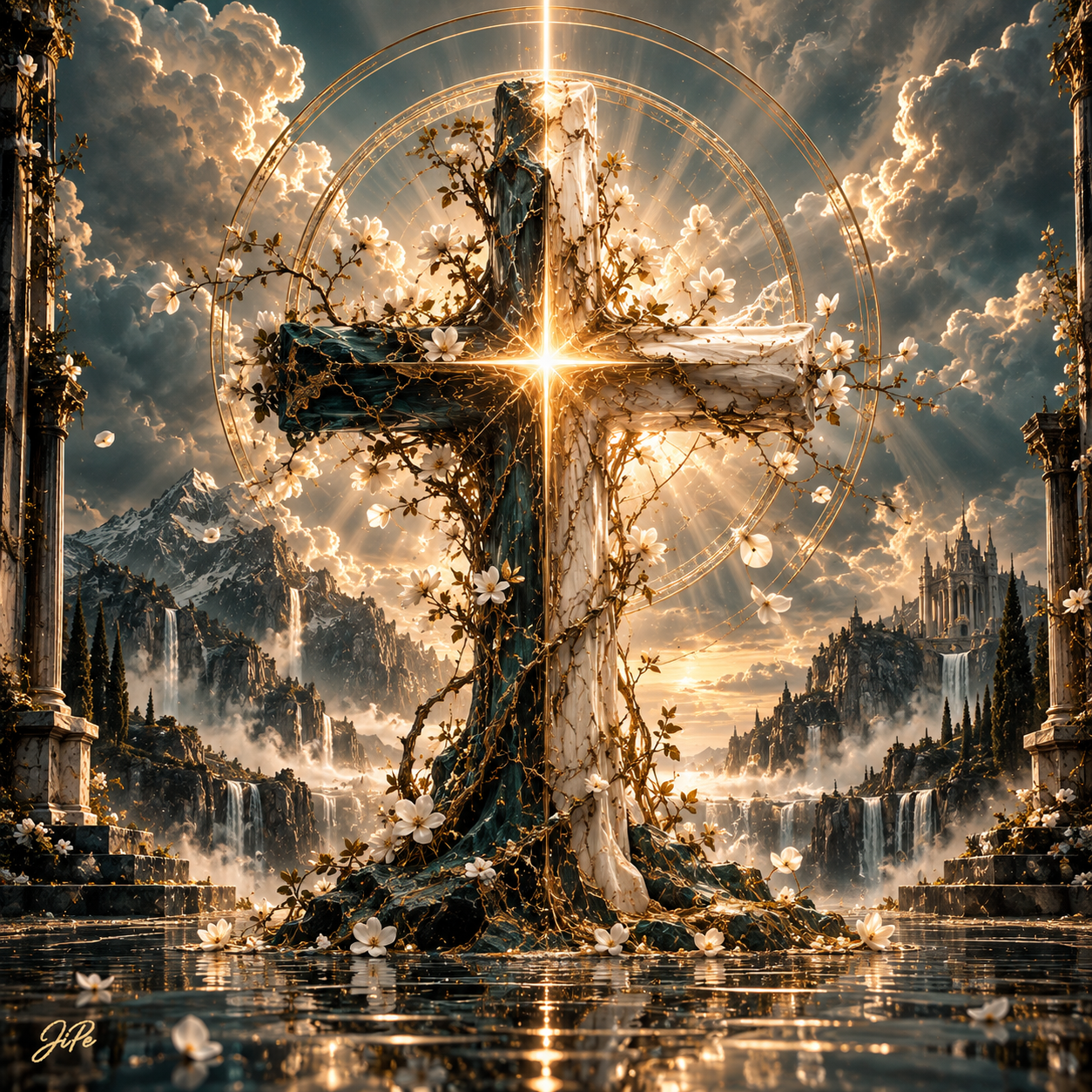
The Gate Beyond Time

The Gate Beyond Time is a contemplative vision of transcendence, inviting the viewer into a realm where time no longer governs existence and where the human spirit stands before the infinite. Suspended between the physical and the metaphysical, the painting presents a moment that feels both ancient and eternal—a solitary journey toward a radiant threshold that exists beyond chronology, beyond memory, and beyond the limits of ordinary perception.
Rather than illustrating a destination, the work explores the universal human longing to reach what lies beyond understanding. It speaks to the eternal search for meaning, enlightenment, and inner awakening. Every element within the composition contributes to the feeling that the viewer is witnessing not merely a landscape, but a profound spiritual event unfolding outside the boundaries of measurable time.
At the center of the composition stands a lone traveler ascending a fractured staircase carved into a floating mass of stone. Draped in flowing robes that seem to dissolve into wind and light, the figure moves toward an immense circular gateway suspended within the heavens. The identity of the traveler is deliberately undefined. Neither hero nor saint, neither king nor pilgrim, this solitary presence becomes an archetype—an embodiment of every individual who has ever sought answers beyond the visible world.
The figure does not hurry.
There is no struggle.
Only quiet certainty.
This stillness transforms the ascent into something deeply symbolic. The staircase does not merely elevate the body; it represents the gradual evolution of consciousness. Every step becomes an act of faith, every elevation a movement away from limitation and toward understanding. The fragmented architecture suggests that true spiritual growth is never achieved through perfectly constructed paths. Instead, enlightenment often emerges through uncertainty, brokenness, and the willingness to continue despite incomplete knowledge.
Dominating the upper portion of the composition is an immense radiant circle composed of luminous gold, concentric rings, and celestial geometry. This magnificent form immediately evokes associations with solar symbolism, sacred mandalas, cosmic gateways, and the eternal cycle of existence. Yet the circle refuses to settle into a single interpretation. It functions simultaneously as a sun, a portal, a divine eye, and a symbol of infinity.
Its perfection contrasts with the fragmented world below.
Its silence speaks louder than words.
Its light transforms everything it touches.
From the very center of this celestial structure descends an overwhelming column of golden light. Unlike ordinary sunlight, this illumination possesses extraordinary density and presence. It appears almost tangible—as though light itself has become substance. The beam connects heaven and earth, eternity and mortality, spirit and matter, creating a visual axis that unites every element of the painting.
This vertical alignment forms the spiritual heart of the composition. It suggests that transcendence is not achieved by escaping the world but by entering into alignment with a deeper universal order. The traveler does not create the path toward the light.
The light has always been waiting.
The traveler simply chooses to answer its call.
Floating throughout the surrounding atmosphere are enormous fragments of rock, suspended impossibly within the sky. These monumental forms seem liberated from gravity, existing in a state where conventional physical laws no longer apply. They introduce a dreamlike quality that recalls visionary symbolism rather than literal landscape.
These floating masses may be understood as fragments of forgotten worlds, shattered beliefs, abandoned certainties, or remnants of previous identities. They represent everything left behind on the journey toward transcendence. Their suspension suggests that nothing is truly lost.
Everything continues to exist.
Only in another form.
The expansive landscape below reinforces this sense of timelessness. Water reflects the celestial glow with remarkable stillness, creating an almost perfect mirror between earth and sky. In the far distance, ancient cities and monumental architecture emerge through atmospheric haze, appearing less like inhabited places than memories preserved within eternity itself.
These distant structures evoke civilizations both real and imagined. They remind us that every culture throughout history has sought to understand humanity’s relationship with the infinite. Yet in this painting, those civilizations become quiet witnesses rather than destinations.
The true destination lies beyond them all.
Gold serves as the painting’s defining visual language. Rather than functioning merely as decorative brilliance, it becomes the physical manifestation of revelation itself. Delicate golden fractures spread across the celestial circle, luminous particles drift through the atmosphere, and subtle veins of radiant light trace the contours of stone and sky alike.
This use of gold recalls the ancient philosophy of kintsugi, where fractures become sites of beauty and renewal. Here, however, the symbolism expands beyond restoration. Gold becomes the visible evidence that eternity is already present within the imperfect world.
The broken reveals the eternal.
The fractured becomes sacred.
The incomplete becomes whole.
The contrast between darkness and illumination is equally significant. Much of the composition is immersed in deep charcoal blues, weathered stone grays, and expansive shadow. These darker passages are not hostile or oppressive. Instead, they provide the necessary silence from which light can emerge with extraordinary emotional force.
Light does not erase darkness.
It gives it meaning.
Together they create a harmony that reflects the dual nature of human existence—uncertainty and faith, limitation and possibility, mortality and transcendence.
From an art historical perspective, The Gate Beyond Time draws upon a rich lineage of Symbolism, Romanticism, sacred landscape painting, and contemporary visionary art. Monumental architectural forms recall classical ruins while the cosmic geometry suggests influences ranging from medieval cosmology to Renaissance concepts of divine proportion. Yet the work avoids direct historical quotation, instead creating its own visual mythology that feels simultaneously ancient and entirely contemporary.
The painting also resonates deeply on a psychological level. The staircase represents personal growth, the floating rocks symbolize detached memories and limiting beliefs, and the radiant gate embodies the unknown future toward which every life inevitably moves. Rather than presenting spiritual awakening as an extraordinary miracle reserved for a chosen few, the work suggests that transcendence begins with a single decision—to continue walking toward the light despite not knowing what lies beyond.
The traveler never looks back.
There is nothing left to prove.
Only something greater to discover.
The title, The Gate Beyond Time, encapsulates the painting’s central philosophical idea. Time governs change, aging, memory, and history. Beyond time lies a reality untouched by these conditions—a realm where identity is no longer defined by past or future but exists entirely within eternal presence.
The gate therefore represents more than passage.
It represents awakening.
It is the threshold between becoming and simply being.
Perhaps the most remarkable quality of the work is its atmosphere of profound silence. Despite its monumental scale, celestial energy, and dramatic composition, the painting never feels overwhelming. Instead, it radiates tranquility. The viewer is invited not merely to observe the image but to enter its stillness, to pause alongside the solitary traveler, and to contemplate what lies beyond the luminous threshold.
This silence becomes one of the painting’s greatest strengths. It transforms spectacle into meditation and grandeur into intimacy.
Ultimately, The Gate Beyond Time is a reflection on humanity’s timeless search for truth. It reminds us that every life is a journey toward deeper awareness, that every obstacle may become another step upward, and that beyond the countless measures of clocks, calendars, and history exists a dimension where the soul recognizes its eternal nature.
The gate is not waiting at the end of life.
It is waiting at the end of fear.
Through its masterful balance of monumental symbolism, atmospheric light, sculptural textures, and visionary composition, The Gate Beyond Time stands as an invitation rather than a conclusion. It asks the viewer to consider that the greatest journey is not across landscapes or through civilizations, but through consciousness itself—and that beyond every known horizon lies not emptiness, but light without beginning, without ending, and beyond time itself.