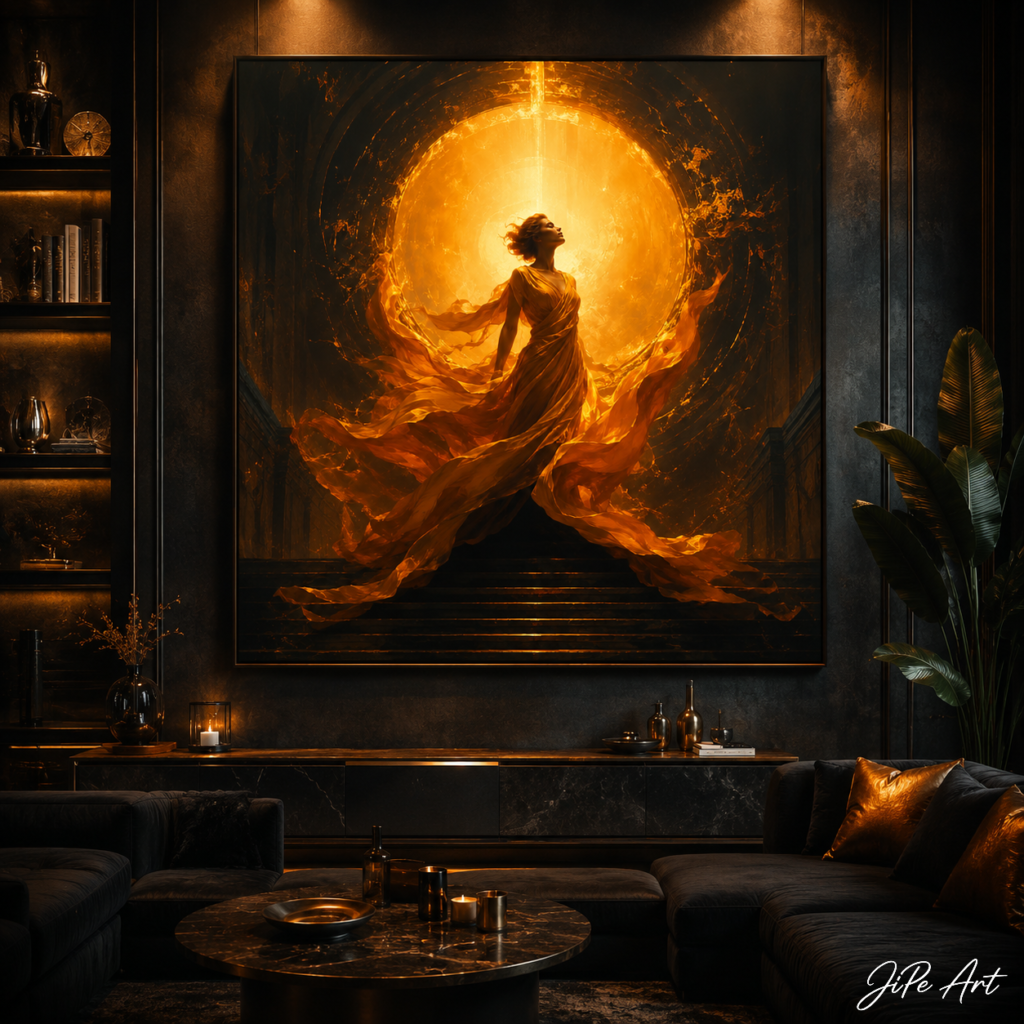
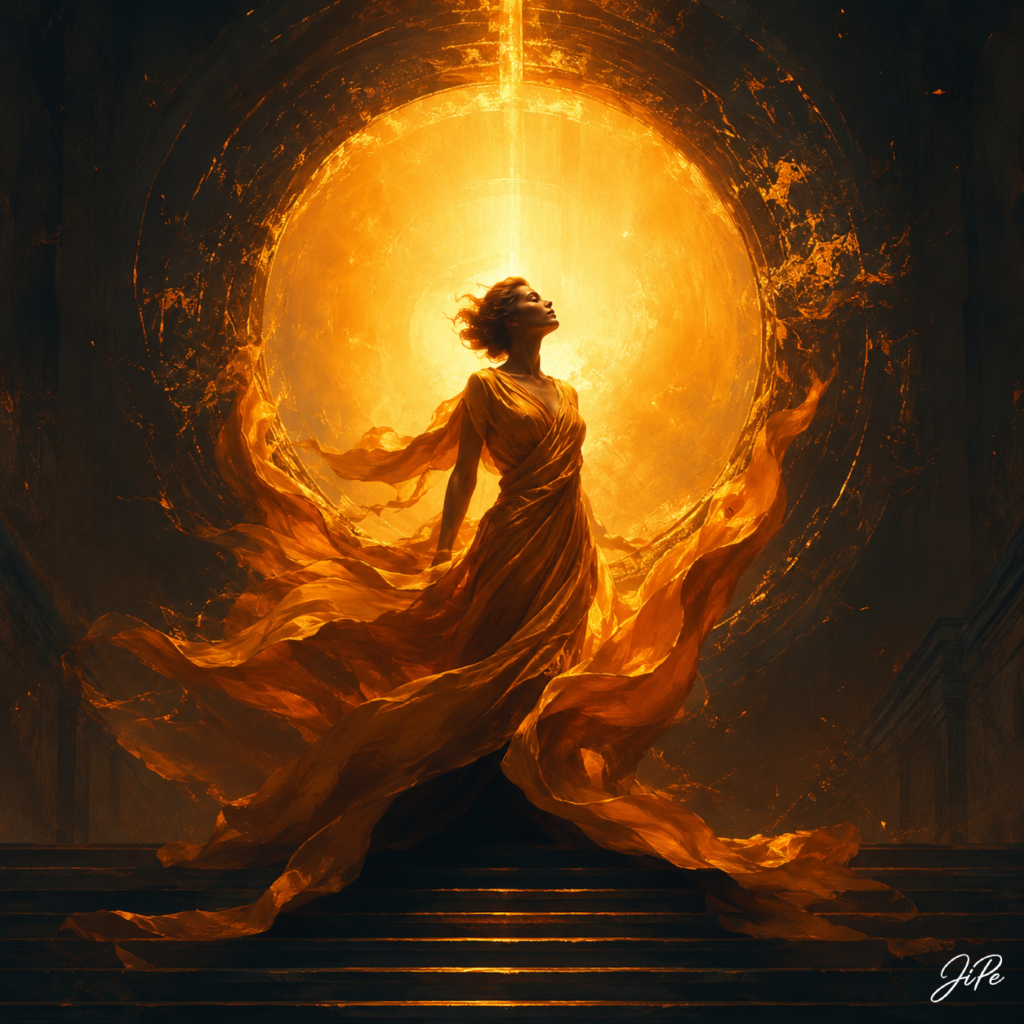
The Flame of the Golden Gate

The Flame of the Golden Gate is a monumental meditation on spiritual awakening, transformation, and the luminous threshold between the finite and the eternal. Combining the visual language of contemporary visionary realism with the symbolic depth of sacred art, the painting presents not merely a figure illuminated by light, but an embodiment of transcendence itself. Through its masterful orchestration of movement, radiance, architectural space, and flowing form, the work becomes an allegory of the human soul as it encounters the divine moment of becoming.
Rather than depicting a specific narrative, the painting invites viewers into an experiential space where symbolism replaces literal storytelling. Every visual element—the radiant circular portal, the ascending figure, the flowing golden fabric, and the descending pillar of celestial light—functions as part of an interconnected symbolic vocabulary. The result is a work that speaks simultaneously to spirituality, philosophy, psychology, mythology, and the universal human search for inner illumination.
At the centre of the composition stands a solitary female figure whose posture conveys complete surrender to an invisible force beyond the material world. Her upward gaze, relaxed expression, and graceful extension through the body suggest neither triumph nor struggle, but acceptance. She appears suspended between earth and heaven, as though the ordinary laws of gravity have quietly dissolved in the presence of something infinitely greater. The painting therefore depicts transformation not as an act of conquest, but as an act of openness.

The title, The Flame of the Golden Gate, introduces the work’s central metaphor. Throughout history, gates have symbolised moments of transition—thresholds between one state of existence and another. They appear in religious traditions, mythological journeys, sacred architecture, and philosophical allegories as places where identity is transformed rather than merely relocated. Here, the ”Golden Gate” is not an architectural structure but a metaphysical passage. It represents the invisible point at which consciousness expands beyond fear, limitation, and separation.
The word Flame deepens this symbolism. Fire has long been understood as one of humanity’s most powerful transformative elements. It destroys but also purifies, illuminates, and gives birth to new life. In this painting, however, the flame is not destructive. Instead, it manifests as radiant golden energy flowing through both the environment and the figure herself. It becomes the visible expression of inner awakening—the light that is ignited when the soul recognises its own eternal nature.
Dominating the composition is the immense circular halo of brilliant gold surrounding the central figure. This luminous form functions on several symbolic levels simultaneously. It recalls the solar discs of ancient civilizations, the halos of Byzantine icons, the mandalas of Eastern philosophy, and the sacred geometry found throughout religious architecture. Yet rather than referencing any single tradition, the painting synthesises these visual histories into a universal symbol of wholeness. The perfect circle suggests eternity, unity, and the cyclical nature of existence, while its overwhelming brilliance transforms it into a portal rather than merely a source of light.
The descending shaft of radiant illumination reinforces the painting’s vertical axis. It appears to connect heaven and earth in a continuous flow, making the figure not simply illuminated by divine presence but integrated within it. The beam suggests revelation, grace, inspiration, and the descent of spiritual consciousness into the material world. It functions as the invisible thread linking the human experience with the transcendent.
One of the work’s most remarkable achievements lies in its extraordinary treatment of movement. The flowing garments expand outward in sweeping arcs that resemble flames, clouds, rivers, or streams of living energy. Their movement extends beyond naturalistic representation, becoming an external manifestation of the figure’s internal transformation. The fabric no longer behaves simply as cloth; it becomes light made visible. These elegant ribbons create a powerful visual rhythm that fills the composition with vitality while maintaining remarkable harmony.
The architecture surrounding the figure remains intentionally subdued. Monumental walls dissolve into darkness, allowing the radiant centre to dominate the visual experience. This restraint is essential to the work’s emotional impact. The vast interior suggests an ancient sanctuary or timeless temple, yet no identifiable culture or historical period is specified. Instead, the architecture becomes symbolic space—a sacred interior that exists as much within human consciousness as within physical reality.
Colour functions as one of the painting’s primary expressive forces. Deep charcoal blacks, muted umbers, and warm shadows establish an atmosphere of profound stillness, while luminous golds, glowing ambers, and molten yellows radiate from the centre with breathtaking intensity. The absence of unnecessary colour creates exceptional visual coherence. Gold is never employed as ornament alone; it becomes the physical embodiment of transcendence itself.
The surface treatment reveals a refined painterly sensibility. Soft atmospheric textures dissolve hard edges, while luminous layers create extraordinary depth within the radiant circle. The translucent quality of the flowing fabric suggests both oil painting traditions and contemporary mixed-media aesthetics, producing a surface that feels simultaneously tactile and ethereal. This delicate balance between material texture and immaterial light contributes significantly to the painting’s emotional resonance.
Art historically, The Flame of the Golden Gate occupies a fascinating position between classical sacred imagery and contemporary visionary art. Its commanding central figure recalls Renaissance ideals of harmonious proportion, while its overwhelming treatment of light echoes the dramatic spirituality of Baroque masters. At the same time, the abstraction of space, the symbolic architecture, and the emphasis on psychological transformation firmly situate the work within a modern visual language that prioritises contemplation over narrative certainty.
From a psychological perspective, the painting may be interpreted as an image of individuation—the moment in which fragmented aspects of the self become unified through inner awakening. The radiant gate symbolises expanded consciousness, while the ascending figure embodies the courage required to embrace transformation. The work therefore speaks not only to religious belief but also to universal human experiences of renewal, healing, and personal evolution.
The absence of external conflict is particularly significant. There are no adversaries, dramatic events, or visible obstacles. Instead, the transformation unfolds in complete silence. This stillness distinguishes the work from conventional heroic imagery. It proposes that the greatest revolutions occur inwardly and that genuine transcendence often emerges not through force but through surrender.
The painting also explores the relationship between light and identity. The figure does not merely stand before illumination; she gradually becomes inseparable from it. The boundaries between body, fabric, atmosphere, and radiance dissolve until the distinction between individual and light itself becomes beautifully ambiguous. This visual fusion reflects one of the oldest philosophical ideas shared across many spiritual traditions—that enlightenment is not the acquisition of something external, but the revelation of what has always existed within.
The composition demonstrates exceptional control over visual hierarchy. Every line, fold, movement, and beam of light converges naturally toward the luminous centre, while the flowing garments create circular rhythms that continuously return the viewer’s gaze to the figure. This compositional discipline gives the painting a meditative quality, encouraging prolonged observation rather than immediate consumption.
The emotional atmosphere remains profoundly hopeful without becoming sentimental. Although the painting is undeniably majestic, its grandeur never overwhelms the viewer. Instead, it communicates quiet assurance. The gate is open. The light is welcoming. The journey is already underway. These subtle emotional choices transform the work from spectacle into invitation.
Ultimately, The Flame of the Golden Gate is a painting about the moment when human existence becomes illuminated from within. It suggests that every individual carries the potential to pass through invisible thresholds of consciousness, compassion, wisdom, and spiritual awakening. The gate is neither distant nor inaccessible—it exists wherever courage meets surrender and wherever the inner flame is allowed to rise.
In its masterful fusion of symbolic depth, monumental composition, radiant colour, and timeless elegance, The Flame of the Golden Gate transcends the boundaries of figurative painting to become a contemporary icon of transformation. It reminds viewers that the greatest journeys are not measured by distance but by the expansion of the soul, and that every true passage into light begins with the quiet ignition of an inner flame that has always been waiting to burn.