
The Gates of Heaven
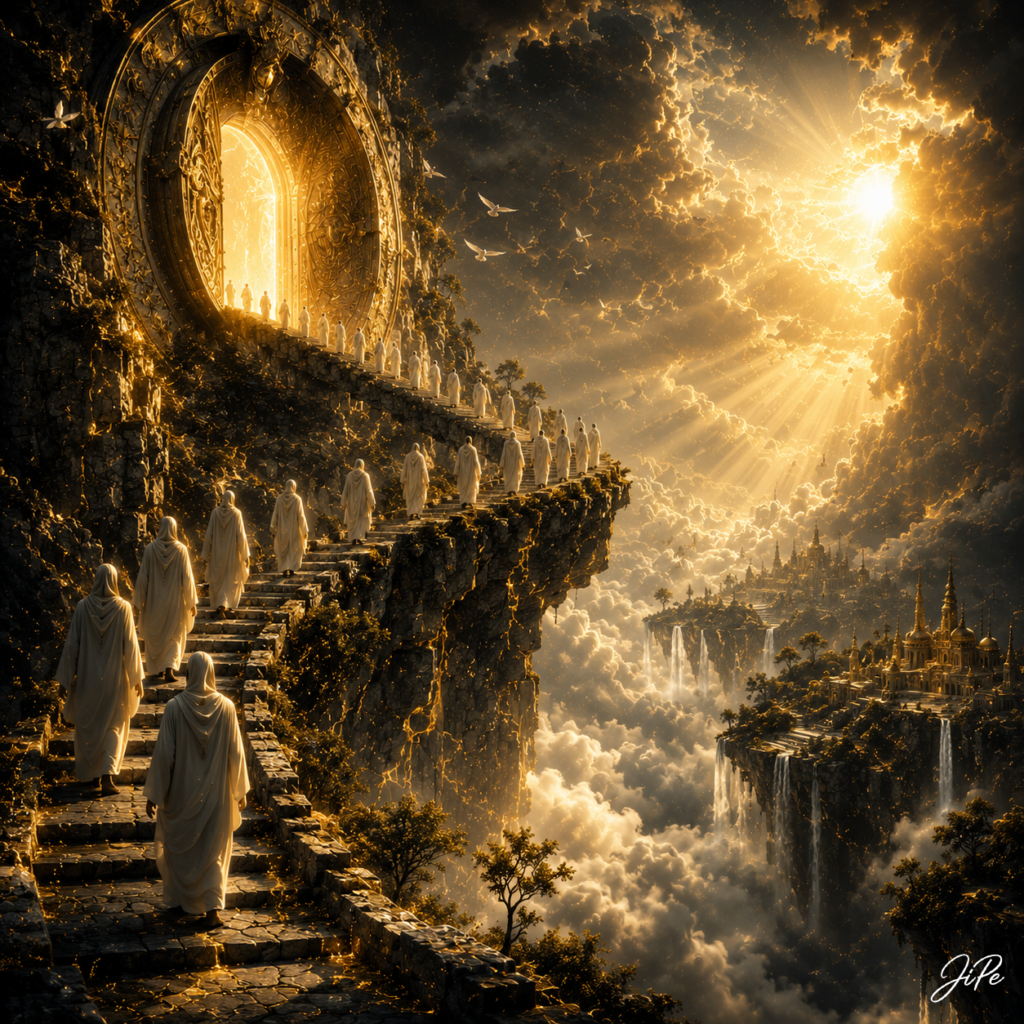
The Gates of Heaven is a monumental meditation on transcendence, hope, and humanity’s eternal longing to cross the threshold between the visible and the invisible. Rather than presenting heaven as a distant geographical destination or a literal theological landscape, the painting reimagines it as a timeless state of spiritual fulfilment—an encounter with absolute light, peace, and divine presence. Through its breathtaking scale, luminous atmosphere, and symbolic architecture, the work transforms one of civilization’s oldest spiritual concepts into a contemporary visual experience that speaks equally to faith, philosophy, and the universal human imagination.
At the heart of the composition stands an immense radiant gateway carved into a towering cliff. It dominates the landscape with overwhelming majesty, yet its invitation is quiet rather than forceful. Bathed in incandescent golden light, the monumental portal functions as the painting’s central symbol—a place where earthly existence dissolves into something infinitely greater. It is not merely an entrance to another realm, but a visual metaphor for transformation itself. Every step toward the gate becomes an inward journey toward wisdom, reconciliation, and ultimate truth.
The title, The Gates of Heaven, immediately evokes centuries of religious imagery, yet the painting deliberately transcends any single tradition. While echoes of Christian iconography are unmistakable, the work avoids doctrinal specificity in favour of universal symbolism. The gate may represent paradise, enlightenment, awakening, liberation, or the final reunion between the soul and eternity. In this openness lies the painting’s greatest strength: it allows viewers from different cultural and spiritual backgrounds to find their own meaning within its radiant vision.
A procession of luminous figures ascends the winding stone pathway with remarkable serenity. Their robes are intentionally simple, their identities anonymous, and their movements measured. None appear hurried, fearful, or uncertain. Instead, they advance together with quiet purpose, suggesting that the ultimate journey is not defined by struggle but by acceptance. The absence of individual identity transforms these figures into universal representations of humanity itself. They become every generation, every culture, every life eventually drawn toward the same mysterious destination.
The ascending pathway is one of the painting’s most profound symbolic devices. It winds naturally through the monumental landscape, emphasizing that transcendence is not achieved through sudden revelation alone but through a gradual pilgrimage. Every curve of the path speaks of patience, perseverance, and spiritual growth. The road is elevated above the clouds, suspended between earth and heaven, reinforcing the idea that transformation occurs in the liminal space between the known and the unknown.
The magnificent architecture of the gate itself deserves particular attention. Richly ornamented with intricate carvings and circular forms, it evokes echoes of Gothic cathedrals, Byzantine sanctuaries, ancient temples, and visionary architecture simultaneously. Yet it belongs fully to none of these traditions. Instead, it becomes an archetypal sacred structure—a timeless gateway existing outside historical chronology. The circular proportions reinforce themes of eternity, perfection, and divine unity, while the radiant interior suggests infinite space beyond the limits of human perception.
Light functions not merely as illumination but as the painting’s principal subject. It pours from the gateway with extraordinary intensity, extending across the surrounding cliffs, clouds, and figures. The sunlight breaking through the dramatic sky mirrors the brilliance of the portal itself, creating two complementary sources of radiance: one celestial and one transcendent. Together they dissolve the distinction between heaven and earth, suggesting that divine presence permeates both worlds simultaneously.
The extraordinary treatment of atmosphere is central to the painting’s emotional impact. Vast oceans of clouds transform the landscape into an almost dreamlike geography where mountains become floating islands and waterfalls disappear into infinite mist. These suspended worlds evoke both physical grandeur and spiritual mystery. The landscape ceases to obey ordinary geography, becoming instead a symbolic realm shaped by imagination, memory, and hope.
The distant city of luminous towers emerging from the clouds expands the narrative without fully explaining it. Rather than functioning as a literal destination, it represents the ideal city found throughout human history—from the Heavenly Jerusalem to mythical utopias and celestial kingdoms described in countless religious and philosophical traditions. Its shimmering architecture remains intentionally distant, preserving its role as an object of longing rather than possession.
Birds soaring through the radiant sky introduce an additional symbolic layer. Traditionally associated with freedom, spirit, and transcendence, they create subtle visual bridges between the earthly procession and the boundless heavens above. Their effortless movement contrasts beautifully with the deliberate ascent of the human figures, suggesting different expressions of liberation while reinforcing the painting’s atmosphere of peace.
From an art historical perspective, The Gates of Heaven occupies a fascinating position between Romantic landscape painting, sacred iconography, and contemporary visionary art. Its monumental scale recalls the sublime landscapes of the nineteenth century, where nature became a manifestation of divine power. Yet unlike Romantic painters who often emphasized humanity’s insignificance before nature, this work presents the human journey as an integral part of the cosmic order. The figures are small in scale, yet spiritually central to the composition.
The painting also reveals strong affinities with the symbolic tradition. Every visual element carries metaphorical weight. The cliffs suggest endurance; the ascending staircase embodies spiritual evolution; the clouds represent mystery; waterfalls evoke purification; gold signifies divine illumination; and the circular gate becomes the eternal threshold separating temporal existence from infinite reality. None of these symbols function independently; together they form a coherent visual philosophy centred on transformation through light.
The restricted colour palette contributes enormously to the painting’s unity. Warm golds dominate the composition, balanced by deep charcoal shadows and subtle earth tones. This limited range creates extraordinary emotional coherence while allowing light itself to become almost tangible. Gold is never decorative. It functions as a visual manifestation of sacred presence, recalling both Byzantine mosaics and contemporary mixed-media aesthetics while remaining entirely original in execution.
The painterly surface enhances this impression further. Rich textures, weathered stone, luminous atmospheric effects, and subtle gold-infused details create an image that appears simultaneously monumental and intimate. The tactile quality of the architecture contrasts beautifully with the softness of the clouds, producing an engaging dialogue between permanence and impermanence, matter and spirit.
Psychologically, The Gates of Heaven explores one of humanity’s oldest questions: what lies beyond the visible limits of existence? Rather than answering this mystery directly, the painting invites contemplation. The emphasis is not on what awaits beyond the gate but on the journey toward it. The procession becomes an allegory for every stage of human life, suggesting that meaning is discovered not only in arrival but in the act of moving faithfully toward the unknown.
One of the work’s most compelling qualities is its profound serenity. There is no drama of judgment, no conflict, no visible fear. Instead, the painting replaces anxiety with quiet confidence. The figures advance without hesitation because the light ahead is welcoming rather than intimidating. This subtle emotional decision transforms the traditional imagery of heaven into something deeply compassionate and universally accessible.
The composition demonstrates remarkable control of visual rhythm. The ascending staircase guides the eye naturally toward the radiant gate, while diagonal rays of sunlight create dynamic counter-movements across the sky. The distant city balances the composition on the opposite side, expanding the spatial depth while preventing the viewer’s attention from becoming fixed on a single point. Every compositional element contributes to a carefully orchestrated experience of movement, elevation, and wonder.
Ultimately, The Gates of Heaven is not simply a vision of paradise. It is a meditation on hope itself. It reminds us that humanity has always imagined luminous destinations beyond suffering, beyond limitation, and beyond death—not merely as places to arrive, but as ideals that shape the way we live. The gate becomes a symbol of every moment in which fear gives way to faith, despair yields to possibility, and darkness opens toward light.
In its synthesis of monumental architecture, symbolic storytelling, radiant illumination, and contemplative beauty, The Gates of Heaven stands as a powerful contemporary exploration of one of the oldest themes in art history. It invites viewers not merely to admire a magnificent landscape, but to reflect upon their own inner pilgrimage toward meaning, compassion, and transcendence. The final destination remains unseen beyond the radiant threshold, yet the painting suggests that perhaps the greatest miracle is not what lies beyond the gate—but the light that guides every soul toward it.