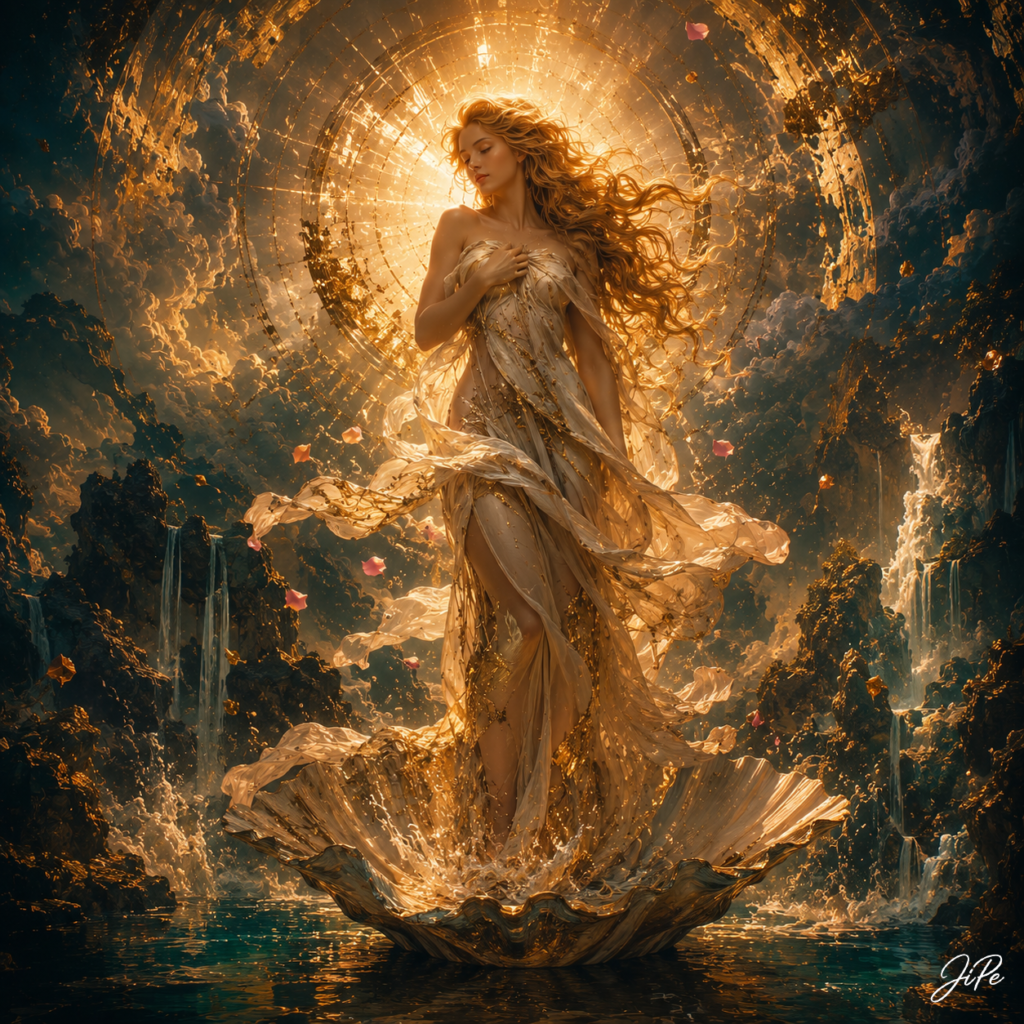
The First Breath of Heaven holds its central presence at the threshold between embodiment and something less easily named. The figure appears suspended within an atmosphere of extraordinary stillness, as though the surrounding world has momentarily withdrawn to make space for a single inward event. Movement remains everywhere, yet the emotional centre is quiet.
Light gathers behind and around the figure with an almost physical intensity. Rather than simply revealing, it seems to dissolve boundaries—between body and space, fragility and radiance, emergence and return. The surrounding darkness gives this luminosity its gravity, preventing the scene from becoming purely celebratory. Beauty here carries the faint tension of impermanence.
The title, The First Breath of Heaven, suggests a beginning, but leaves uncertain what has begun. It may be an arrival into consciousness, a release from it, or the brief recognition of something that has always existed beyond ordinary perception. The word “breath” makes the infinite unexpectedly intimate: vastness reduced to a single, invisible exchange.
Perhaps heaven is not presented as a destination at all, but as an instant of permeability. The unanswered question is whether the figure is entering another realm—or whether, for one suspended moment, another realm has entered her.