Monumental Visionary Fine Art exploring mythology, consciousness, sacred light, and timeless visual storytelling.

Monumental Visionary Fine Art exploring mythology, consciousness, sacred light, and timeless visual storytelling.

Religious Paintings

The Divine Shield

The Divine Shield
The Divine Shield

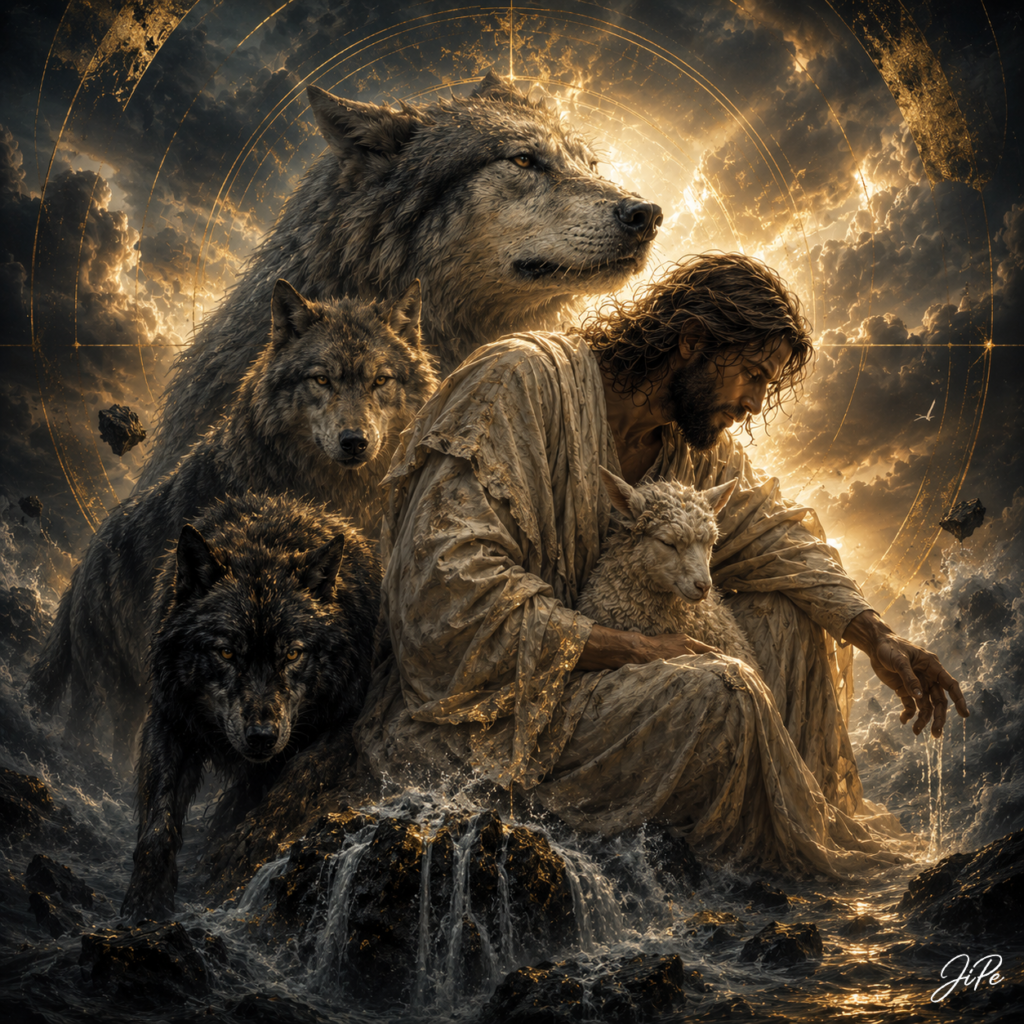
The Divine Shield is a monumental allegorical vision of divine protection, spiritual guardianship, and the enduring relationship between Christ and those entrusted to His care. Drawing upon biblical imagery, Christian theology, and symbolic natural forms, the artwork presents a deeply contemplative meditation on God’s presence amid uncertainty, danger, and the spiritual struggles of human existence. Rather than illustrating a single biblical episode, the composition synthesizes multiple scriptural motifs into a timeless vision of refuge, compassion, and unwavering divine faithfulness.

At the center of the composition sits Christ, portrayed not as a triumphant king enthroned in majesty, but as the compassionate Shepherd whose authority is expressed through humility, gentleness, and sacrificial love. His posture is one of quiet contemplation, His gaze lowered toward the flowing water beneath Him, suggesting profound awareness of both the suffering and the hope woven into the human condition. Rather than commanding the surrounding scene, Christ becomes its calm and immovable center—a presence whose peace remains unshaken despite the immense forces that surround Him.

Nestled securely within His embrace rests a white lamb, one of Christianity’s oldest and most enduring symbols of innocence, redemption, and divine care. The lamb recalls Christ’s own declaration as the Good Shepherd who lays down His life for His sheep, while simultaneously evoking His identity as the Lamb of God whose sacrifice brings reconciliation between humanity and God. This dual symbolism creates a remarkable theological paradox: Christ is both Shepherd and Lamb, protector and sacrifice, guardian and redeemer. The intimate tenderness with which He holds the animal transforms the monumental composition into an image of deeply personal compassion.

Encircling Christ are three wolves of varying size and temperament. Their presence immediately introduces an intriguing symbolic tension. Throughout biblical tradition, wolves often represent danger, false teaching, persecution, or the ever-present threats confronting God’s people. Yet in this composition they are not depicted as attacking predators. Instead, they stand watchfully beside Christ, forming a living circle of vigilance and strength. The largest wolf rises behind Him like an ancient sentinel, while the others occupy the foreground with attentive focus. Their expressions convey alertness rather than aggression, suggesting that even the untamed powers of creation are brought into harmony under divine authority.

This reinterpretation of the wolf expands the artwork beyond conventional iconography. Rather than functioning solely as symbols of danger, the wolves become embodiments of courage, endurance, discernment, and protective strength. Their transformation reflects a broader theological vision in which creation itself participates in God’s redemptive purpose. The imagery resonates with prophetic visions of restored harmony found in the Hebrew Scriptures, where former enemies coexist peacefully under the reign of divine peace. The wolves thus become guardians not because their nature has been erased, but because it has been rightly ordered within the presence of Christ.

The surrounding landscape is both earthly and cosmic. Dark waters cascade over rugged stone while luminous clouds open into vast celestial expanses above. The environment resists precise geographical identification, existing instead within a symbolic realm where heaven and earth converge. Water flows continuously throughout the composition, representing life, purification, renewal, and the sustaining grace of God. Unlike turbulent seas that symbolize chaos in biblical literature, these streams possess a measured rhythm, suggesting the quiet persistence of divine providence even amid the world’s uncertainties.

Behind the central figures unfolds a radiant celestial geometry composed of concentric circles and luminous arcs that recall sacred diagrams, astronomical charts, and medieval cosmological imagery. These delicate structures establish Christ as the spiritual center of a divinely ordered universe. The circular forms evoke eternity, perfection, and the unbroken faithfulness of God, while their subtle integration into the clouds suggests that divine order exists beyond immediate human perception. The composition therefore moves effortlessly between the visible and the invisible, inviting contemplation of realities that transcend ordinary experience.

Light serves as the principal theological language of the painting. A magnificent golden radiance surrounds Christ, illuminating His figure without overwhelming it. Rather than functioning as a conventional halo, the light expands outward through the heavens, bathing the wolves, the lamb, the water, and the surrounding landscape in a unified atmosphere of sacred presence. Darkness remains visible along the edges of the composition, yet it never possesses ultimate authority. Instead, shadow becomes the necessary contrast through which divine illumination reveals its full brilliance.

The restrained palette of warm golds, muted earth tones, silvery grays, and deep charcoal blues creates a remarkable emotional equilibrium. Gold symbolizes divine glory, revelation, and eternal hope, while the cooler tones evoke the realities of earthly struggle and spiritual pilgrimage. The careful balance between these contrasting colors reflects one of the central theological themes of the artwork: God’s protection does not remove believers from the realities of suffering but accompanies them faithfully through them.

Stylistically, The Divine Shield represents a sophisticated synthesis of classical sacred art, Romantic naturalism, and contemporary visionary aesthetics. The anatomical realism of Christ recalls the devotional traditions of Renaissance painting, while the dramatic atmosphere and emotional grandeur echo the sublime landscapes of the Romantic era. At the same time, the intricate celestial structures, cinematic lighting, and symbolic integration of natural elements reveal the possibilities of modern digital artistry as a vehicle for profound theological expression.

From an art historical perspective, the work participates in the long tradition of Christian pastoral imagery while significantly expanding its symbolic vocabulary. Throughout centuries of religious art, Christ has frequently been represented as the Good Shepherd surrounded by sheep, emphasizing gentleness, guidance, and pastoral care. The Divine Shield, however, introduces the powerful symbolism of wolves not as simple adversaries but as transformed guardians whose strength has been redirected toward protection rather than destruction. This reinterpretation enriches the traditional iconography, presenting a more complex vision of redemption that embraces not only humanity but the entirety of creation.

The composition is carefully organized around a stable triangular structure formed by Christ, the lamb, and the dominant wolf. This geometric balance reinforces the artwork’s atmosphere of spiritual security. Every surrounding element—the flowing water, the celestial circles, the descending light, and the attentive wolves—directs the viewer’s attention toward the serene figure of Christ, establishing Him as the unwavering center of the visual and theological narrative.

Symbolically, each component contributes to a unified meditation on divine guardianship. The lamb represents innocence, vulnerability, and the faithful believer. The wolves embody strength disciplined by grace. The flowing water signifies spiritual renewal and divine sustenance. The celestial geometry reflects the hidden order of creation, while the radiant heavens affirm God’s sovereign presence over both the visible and invisible realms. Together these symbols weave a rich iconographic tapestry that rewards prolonged contemplation and scholarly interpretation alike.

Emotionally, The Divine Shield achieves a rare balance between intimacy and grandeur. The viewer encounters both the tenderness of Christ’s embrace and the immense scale of the cosmic landscape that surrounds Him. This juxtaposition reflects one of Christianity’s most enduring theological affirmations: that the Creator of the universe remains personally present to each individual soul. The painting therefore speaks simultaneously of infinite majesty and profound compassion.

Ultimately, The Divine Shield is a powerful visual meditation on the enduring promise that divine protection is rooted not in the absence of adversity but in the abiding presence of Christ. Through its masterful integration of biblical symbolism, natural imagery, theological reflection, and visionary imagination, the artwork invites visitors, scholars, and contemplative viewers alike to reflect upon the mystery of a God who is both Shepherd and Savior, whose strength is revealed through love, and whose presence transforms fear into trust. It stands as a compelling contemporary contribution to the tradition of sacred art, affirming that beneath the shelter of divine grace, even the wildest forces of creation may become instruments of peace, guardianship, and hope.

Lämna ett svar