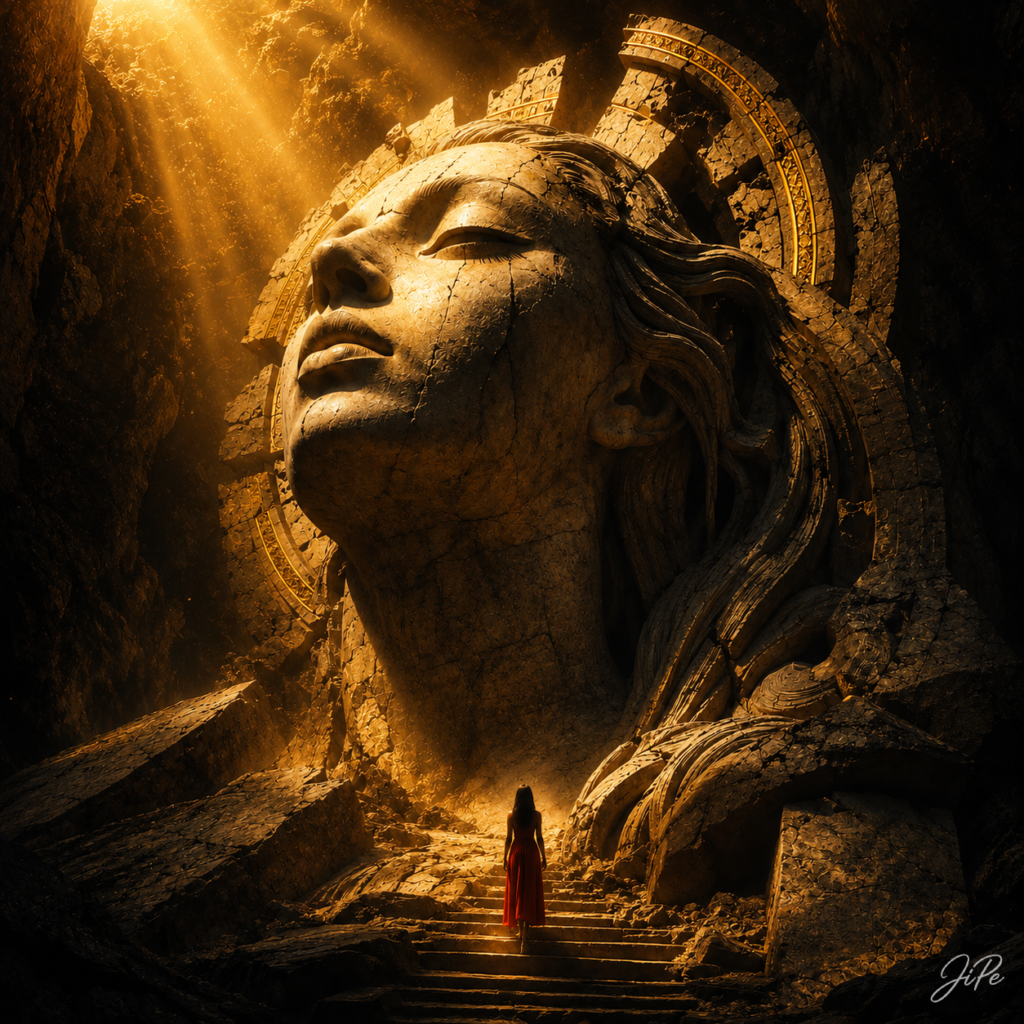
The Awakening of the Colossus unfolds in the charged stillness between dormancy and revelation. An immense presence rises beyond ordinary proportion, yet its closed eyes withhold the certainty of awakening. Below, the solitary figure establishes a fragile human measure, standing not merely before something vast, but at the threshold of an encounter whose consequences remain unknowable.
Light enters as both summons and disturbance. It descends into darkness with an almost physical weight, touching surfaces that seem ancient enough to have outlived their own meaning. The surrounding silence feels less empty than suspended—as though the entire space were listening for the first movement of something long forgotten.
The title introduces an unsettling possibility: awakening may belong equally to the colossus and to the one who approaches it. Scale becomes psychological rather than architectural. What appears external might also be an image of dormant memory, buried consciousness, or a magnitude within the self that can only be approached indirectly.
Nothing confirms whether the moment promises recognition or danger. The figure remains poised before the impossible presence, and the work leaves us with a quieter uncertainty: when something immense awakens, who is truly being transformed?