
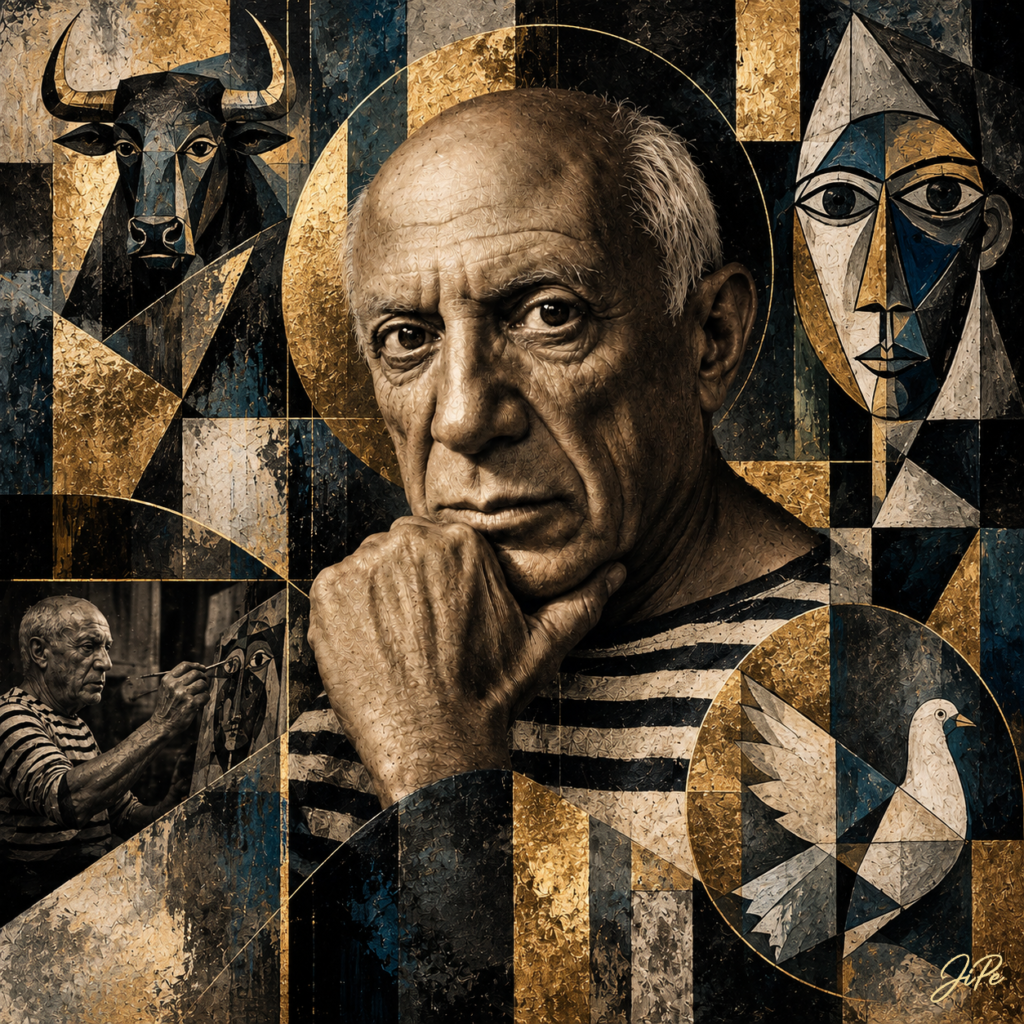
Pablo Picasso presents the artist as both a singular presence and a figure surrounded by the vast consequences of his own imagination. Few artists became as internationally recognizable during their lifetime, and Picasso’s name remains inseparable from the radical transformations of twentieth-century art. His fame extended beyond museums and studios: he became a cultural figure whose public identity approached the scale of his work.
Here, that stature is met by an unexpected stillness. The directness of his gaze carries the weight of observation rather than spectacle, while the surrounding forms seem to inhabit a shifting territory between memory, invention, and the accumulated language of a lifetime. Light gives the central presence a severe intimacy, separating the man from the mythology that has gathered around his name.
The title Pablo Picasso therefore contains a subtle tension. It names an individual, yet also evokes an immense cultural legacy—thousands of works, successive reinventions, and an influence that continues long after the artist himself has disappeared.
What remains most elusive is the distance between creation and creator: when an artist’s vision becomes part of collective consciousness, can we still encounter the person—or only the world that formed around his name?