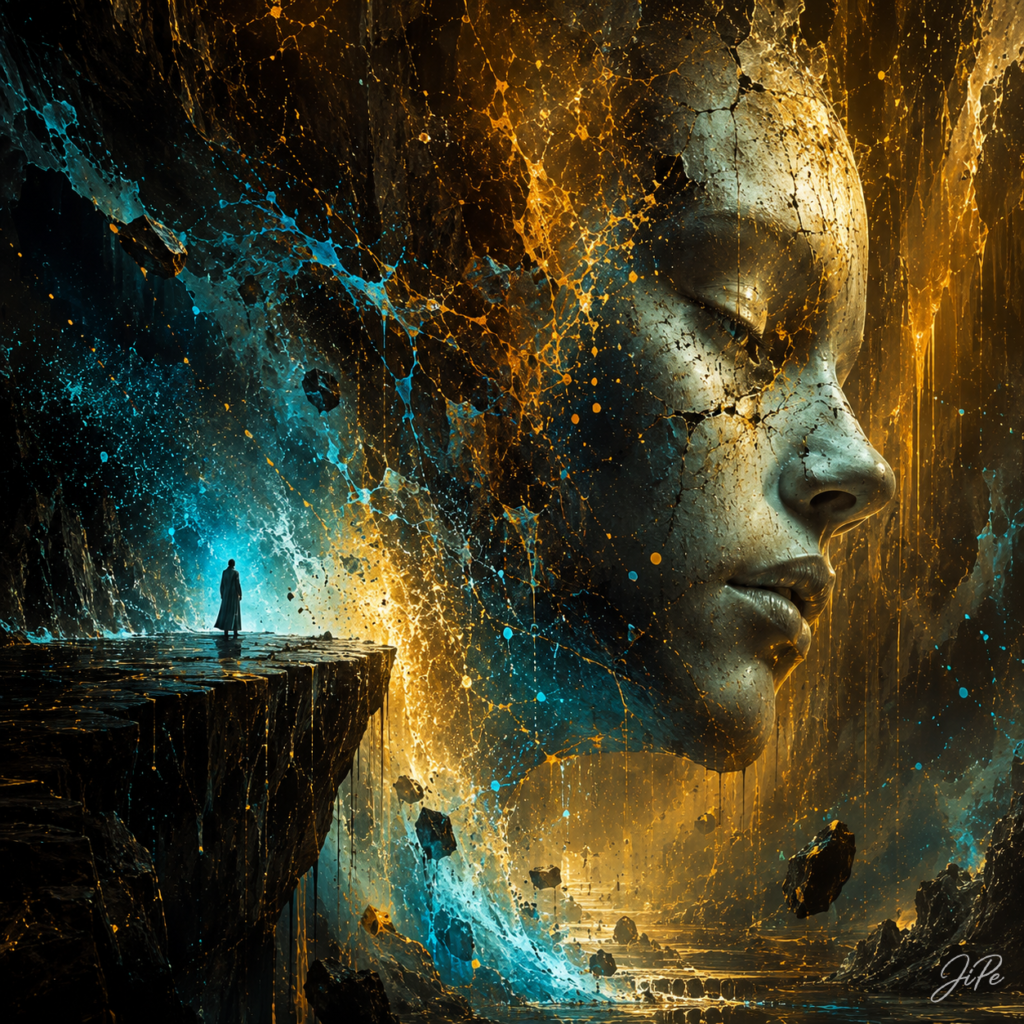
Monument of the Forgotten confronts memory at a scale that exceeds the individual. An immense presence occupies the space like the remnant of a vanished order, while the distant human figure stands before it in near silence. Between them lies an extraordinary imbalance of scale, yet the smaller presence does not disappear. Instead, solitude becomes a form of attention.
The monument seems caught between endurance and dissolution. Its fractured surface suggests that permanence may be only an illusion sustained by remembrance, while the surrounding darkness and luminous ruptures make the space feel unstable, as though time itself were breaking open. Light enters not as consolation, but as an exposure of what remains.
The title introduces an unsettling contradiction: a monument exists to resist forgetting, yet here forgetting appears already embedded within the monument itself. What has been preserved may no longer retain its name, its history, or even the meaning once assigned to it. Only presence survives.
The solitary witness therefore faces more than a relic. Perhaps the encounter concerns the limits of remembrance itself: when every story has vanished, every name has been lost, and only the form remains—what, exactly, is still being remembered?