Decay and Golden Flow

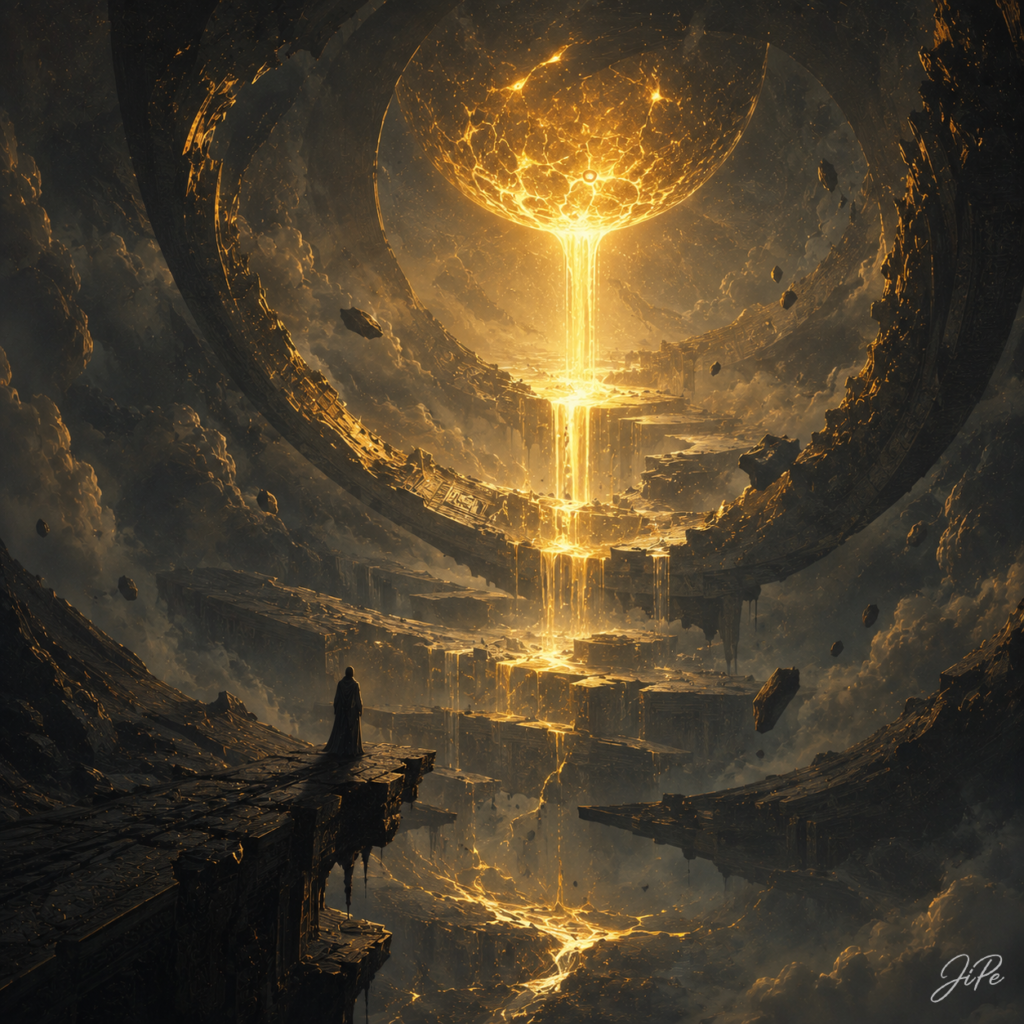
Decay and Golden Flow presents a vast metaphysical landscape in which ruin and radiance coexist as parts of the same continuous process. Suspended architecture, fractured pathways, monumental circular structures, drifting stone, and an impossible river of golden light construct a world that appears simultaneously ancient and cosmic. At the lower left, a solitary figure stands at the edge of a broken platform, contemplating an immense luminous phenomenon descending from a celestial sphere high above.
The work is immediately spectacular in scale, yet beneath its visual grandeur lies a quieter philosophical question: What remains when structures collapse, worlds disappear, and everything once believed permanent begins to decay?
The painting proposes an unexpected answer.
Something continues to flow.
A world after permanence
The title Decay and Golden Flow establishes the central tension of the work before the image is even considered. “Decay” suggests deterioration, erosion, mortality, abandoned civilizations, and the inevitable transformation of material things. “Flow,” by contrast, implies continuity, movement, renewal, and passage.
Placed together, the two ideas create a paradox.
Decay is usually understood as an ending.
Flow suggests that nothing truly stops.
The painting develops this contradiction across almost every part of its composition. The architectural world is visibly collapsing, yet an extraordinary current of golden energy continues uninterrupted through it. Platforms fracture and disappear into darkness, but the luminous stream moves downward from level to level as though obeying a deeper law than the ruined structures surrounding it.
The civilization may have ended.
The architecture may be dying.
But the energy remains.
This distinction becomes the philosophical foundation of the work.
The solitary witness
The human figure is remarkably small in relation to the surrounding environment. Standing alone upon a dark projecting platform, the figure appears less like the protagonist of a conventional narrative than a witness to something immeasurably greater.
No facial expression is visible.
No dramatic gesture tells us what to feel.
Instead, the figure simply stands.
This stillness is crucial.
Around the traveler, matter is unstable. Stone floats through the atmosphere. Architecture hangs above an abyss. Clouds move through impossible spaces. Golden energy falls across multiple levels. Monumental rings extend beyond ordinary human scale.
Against all of this movement, the figure remains motionless.
The contrast creates an atmosphere of contemplation rather than action.
The traveler may have reached the remains of a forgotten civilization. Perhaps the journey has ended here. Perhaps it is only beginning. The painting offers no definitive narrative.
What matters is the encounter.
A human being stands before something that exceeds the scale of human understanding.
In this respect, Decay and Golden Flow belongs strongly to the artistic tradition of the sublime: the attempt to visualize experiences so vast that they produce both awe and a recognition of human limitation.
The architecture of a lost world
The landscape is filled with enormous architectural fragments that appear to belong to a civilization whose identity has disappeared.
Terraces, bridges, platforms, carved surfaces, and circular structures remain suspended throughout the environment. Some appear deliberately constructed; others have become almost geological through erosion.
The distinction between architecture and landscape has begun to disappear.
This ambiguity is significant.
Human beings create architecture partly as an assertion against time. Buildings, monuments, temples, and cities embody the desire to establish permanence. Stone appears durable. Monumentality suggests continuity.
Yet archaeology repeatedly demonstrates the opposite.
Cities become ruins.
Temples collapse.
Names disappear.
Civilizations become fragments interpreted by people who no longer understand the worlds that created them.
The architecture in Decay and Golden Flow seems to have reached this final stage. Its original purpose is unknowable. Whatever ceremonies, societies, beliefs, or technologies once animated these structures have vanished.
Only form remains.
And even form is deteriorating.
The monumental rings
Dominating the composition are enormous circular structures that curve through the landscape like the remains of an impossible cosmic mechanism.
Their scale is difficult to comprehend. They appear simultaneously architectural, astronomical, and symbolic.
They might be the ruins of an ancient machine.
They might represent planetary orbits.
They might be sacred structures.
Or they may have no literal function at all.
Their ambiguity allows them to operate as symbols.
The circle has historically represented eternity, wholeness, recurrence, cosmic order, perfection, and the endless cycles of existence. Yet here these circular forms are damaged and incomplete.
The symbol of eternity itself appears to be decaying.
This creates one of the painting’s most powerful contradictions.
If even the architecture of eternity can fracture, what can truly remain permanent?
The answer appears visually at the center.
Not structure.
Movement.
Not stone.
Energy.
Not the vessel.
The flow.
The celestial source
At the highest point of the composition hangs an enormous luminous sphere.
Its surface appears fractured, filled with an incandescent network of golden energy. Rather than remaining contained within the celestial body, this energy escapes downward in a concentrated vertical stream.
The sphere can be interpreted in numerous ways.
It may be a dying sun.
A cosmic reservoir.
A sacred source.
A fractured world.
A divine object.
A symbol of consciousness.
Or the visual embodiment of creation itself.
The painting deliberately avoids identifying it.
Its mystery is essential.
What is clear is that the sphere functions as the origin of the golden flow.
The energy contained within it can no longer remain enclosed.
The celestial body has fractured.
And because it has fractured, it releases light.
This establishes an important symbolic relationship between breaking and revelation.
The sphere does not become meaningless because it is damaged.
Its rupture produces the central miracle of the painting.
Golden flow as transformation
The extraordinary golden stream descending through the composition is the work’s primary visual and symbolic axis.
It begins within the celestial sphere, falls toward the upper platforms, continues downward across ruined architectural levels, and eventually becomes a branching luminous current deep within the lower landscape.
At first glance, it resembles liquid gold.
Yet it might equally be understood as light, molten matter, cosmic energy, memory, time, consciousness, or spiritual force.
Its ambiguity is intentional.
The stream represents something that cannot be fully contained within a physical category.
It is flow itself.
The surrounding architecture attempts to channel it, but cannot possess it.
The platforms temporarily receive it.
The ruins redirect it.
The fractures allow it to pass.
But the current continues.
This creates a profound contrast between constructed form and elemental movement.
Architecture belongs to history.
The flow belongs to eternity.
Light emerging from fracture
Throughout the image, golden illumination repeatedly appears within cracks, broken surfaces, and damaged structures.
This motif transforms destruction into revelation.
Normally, a crack represents weakness—the point where something begins to fail. Within Decay and Golden Flow, however, fractures become openings through which illumination becomes visible.
The idea can be interpreted psychologically as well as cosmologically.
Human beings often imagine wholeness as an untouched state. Yet experience inevitably introduces loss, change, disappointment, aging, and transformation.
The painting suggests another understanding of wholeness.
Perhaps something does not need to remain unbroken in order to remain meaningful.
Perhaps fracture can reveal dimensions that perfection conceals.
The golden fissures therefore become visual metaphors for the possibility that transformation can emerge through damage rather than despite it.
The vertical journey
The composition is organized around a powerful vertical movement.
The eye begins naturally with the small figure in the lower-left region. From there, the broken platforms lead inward toward the illuminated architecture. The golden current then carries the gaze upward—or downward, depending on how the image is entered—through successive levels until it reaches the enormous sphere.
This creates an unusual spatial experience.
The painting can be visually traveled in both directions.
One may follow the energy downward from its celestial source toward the depths.
Or one may begin with the human figure and trace the light upward toward its origin.
These two movements produce different interpretations.
The downward movement resembles creation: energy descending into matter.
The upward movement resembles transcendence: consciousness seeking its source.
The composition accommodates both simultaneously.
The traveler stands between them.
A landscape outside ordinary physics
The world of Decay and Golden Flow does not obey familiar physical laws.
Massive stone structures appear suspended without support. Rocks float within the atmosphere. Architectural platforms extend across impossible distances. Clouds occupy spaces that might otherwise be interpreted as underground caverns or cosmic voids.
Gravity seems uncertain.
Scale becomes unstable.
Space itself appears folded.
This places the work within the territory of Surrealism and visionary art, where physical impossibility is used not merely for spectacle but to make invisible ideas visible.
The landscape does not need to be physically possible because it represents a reality of another kind.
It might be memory.
Dream.
Myth.
A universe after civilization.
An interior psychological landscape.
Or a symbolic representation of time itself.
The impossibility of the architecture encourages the viewer to stop asking, “Where is this place?” and instead ask, “What does this place mean?”
The palette of darkness and gold
The painting is built primarily from a restrained dialogue between charcoal, black, muted earth tones, and incandescent gold.
This limited palette gives the work extraordinary visual unity.
Darkness occupies most of the composition, allowing the golden elements to become intensely significant. Light is not evenly distributed. It appears selectively, concentrating attention upon the sphere, waterfalls of energy, fractured architecture, and pathways through the ruins.
Gold therefore operates structurally as well as symbolically.
It directs the eye.
But it also establishes meaning.
Against the decaying black world, gold represents what persists.
This does not necessarily mean that gold symbolizes goodness in a moral sense. Its role is more fundamental.
It represents presence against absence.
Energy against stillness.
Continuity against dissolution.
Illumination against oblivion.
The sublime and the solitary human
The tiny traveler standing before the immense environment establishes a relationship familiar from Romantic landscape painting.
Artists associated with the Romantic sublime frequently placed small human figures before overwhelming mountains, seas, ruins, storms, or vast skies. The difference in scale emphasized the limits of human power while simultaneously celebrating the extraordinary human capacity to contemplate infinity.
Decay and Golden Flow extends this tradition into a contemporary cosmic realm.
The traveler cannot control the environment.
The traveler cannot rebuild the ruins.
The traveler cannot stop the flow.
Yet the traveler can witness.
This act of witnessing becomes significant.
Consciousness may be physically insignificant compared with the scale of the universe, but it possesses the remarkable capacity to recognize scale, mortality, beauty, and mystery.
The solitary figure therefore provides the painting with its emotional measure.
Without the figure, the ruins would simply be enormous.
With the figure, they become overwhelming.
Without the figure, the golden current would be spectacular.
With the figure, it becomes transcendent.
Time made visible
One of the deeper interpretations of the golden flow is that it represents time.
Time moves continuously through structures that appear permanent.
Buildings rise and fall within it.
Civilizations emerge and disappear.
Individuals enter and leave it.
Planets form and die.
Yet time continues.
Seen in this way, the painting becomes an image of existence as temporary architecture built within an unstoppable current.
The ruined platforms represent attempts to create stability.
The golden flow represents the impossibility of stopping transformation.
This interpretation gives the title particular depth.
Decay is not the opposite of flow.
Decay is produced by flow.
Things decay because time moves.
Yet the same movement that destroys also creates.
New landscapes emerge from old ones.
Matter becomes other matter.
Memory transforms into history.
Death becomes part of the conditions from which new life can emerge.
Flow therefore contains both creation and destruction.
The ruins as memory
The architecture can also be understood as a metaphor for memory.
Memories rarely survive unchanged. They fragment. Details disappear. Certain moments remain illuminated while others sink into darkness.
The environment in Decay and Golden Flow possesses this quality.
Only portions of the ancient structures remain visible.
Some disappear into cloud.
Others have broken away completely.
Fragments float disconnected from their original context.
Yet golden traces move through them.
Seen psychologically, the landscape could represent consciousness looking backward across the remains of experience.
The traveler may therefore be exploring not a dead civilization, but an interior archaeology.
The ruins become the structures of a life remembered imperfectly.
The golden flow becomes what continues to connect them.
Sacred architecture without a religion
The enormous circular forms and monumental terraces create an unmistakably sacred atmosphere, yet the work contains no explicit iconography belonging to a particular religion.
This is an important distinction.
The painting uses the emotional vocabulary of sacred architecture—monumental scale, symmetry, elevation, illumination, mystery—without assigning it to a specific theology.
The result is a form of universal sacredness.
The golden source may be divine.
But it may equally represent nature, consciousness, time, creation, or the unknowable origin of existence.
The painting therefore allows religious and secular interpretations to coexist.
Its fundamental subject is not doctrine.
It is wonder.
The civilization that could not contain eternity
Another interpretation emerges from the relationship between the architecture and the golden stream.
The ancient structures appear to have been built around the flow.
Perhaps the lost civilization discovered it.
Perhaps they worshipped it.
Perhaps they attempted to control it.
Perhaps the entire architectural system was designed to capture, direct, or understand the mysterious energy descending from the sphere.
If so, the ruins suggest that they ultimately failed.
The civilization disappeared.
The flow remained.
This creates a powerful allegory about the human desire to possess what can only be experienced.
We construct systems around mysteries.
We give them names.
We create institutions, philosophies, technologies, and monuments in an attempt to understand them.
But reality always exceeds the structures created to contain it.
The architecture breaks.
The mystery continues.
Decay without despair
Despite its ruined world, the painting is not fundamentally pessimistic.
There is destruction everywhere, but there is also extraordinary beauty.
The ruins are not depicted as meaningless debris. Their surfaces catch golden illumination. Their fractures reveal hidden structures. Their deterioration has become part of the aesthetic and philosophical identity of the landscape.
Decay is therefore not presented simply as tragedy.
It is presented as transformation.
This distinction allows the work to address mortality without surrendering to despair.
Everything material may change.
But change does not necessarily mean disappearance.
Something passes onward.
Matter changes form.
Energy moves.
Influence continues.
Memory survives imperfectly.
The river flows.
The unknown destination
One of the most important aspects of the golden current is that the viewer cannot see where it ultimately ends.
It descends beyond the visible architecture and branches into the darkness below.
This prevents the image from becoming a closed symbolic system.
The source is visible.
The destination is not.
In this sense, the traveler and viewer share the same limitation.
We can see something of where the flow originates.
We can witness part of its journey.
But we cannot see its final destination.
This mirrors the human experience of existence itself.
We arrive within processes already underway.
We participate in them temporarily.
We leave before knowing how they ultimately unfold.
The threshold of understanding
The solitary figure stands on a projecting platform that appears to end abruptly before the greater landscape.
This is not merely a compositional device.
It symbolizes the limit of knowledge.
The traveler has gone as far as ordinary ground allows.
Beyond lies an impossible structure governed by forces that cannot be fully understood.
The figure therefore stands at the threshold between observation and participation.
Will the traveler continue?
Is there even a path?
The painting does not answer.
Instead, it preserves the moment of contemplation.
This unfinished journey is crucial because it keeps the work open.
The viewer is not shown a conclusion.
We are shown the instant when wonder becomes a question.
A contemporary vision of impermanence
From an art-historical perspective, Decay and Golden Flow brings together elements of Romantic Sublime, Surrealism, Symbolism, visionary art, and contemporary fantastic landscape painting.
Its vast scale and solitary observer recall Romantic traditions.
Its impossible architecture belongs to surreal and visionary modes.
Its symbolic use of gold, circles, ruins, and light connects it to Symbolism.
Its cinematic spatial depth and highly detailed environmental construction give these traditions a contemporary visual language.
Yet the work’s deeper concerns are ancient.
Human civilizations have always confronted impermanence.
Every monument is ultimately a negotiation with time.
Every archive is an attempt to resist forgetting.
Every work of art is, in some sense, an attempt to allow something to continue beyond the moment of its creation.
Decay and Golden Flow transforms this fundamental human concern into an entire world.
What remains?
At its deepest level, the painting asks a deceptively simple question:
When everything temporary has disappeared, what remains?
The architecture suggests that form does not.
The ruins suggest that power does not.
The broken structures suggest that permanence does not.
Even the enormous celestial sphere is fractured.
Yet something continues through all of them.
The golden flow.
Whether interpreted as time, consciousness, memory, life, creative energy, spirit, or transformation itself, this luminous current becomes the painting’s answer to decay.
Not immortality in the sense of remaining unchanged.
Something more subtle.
Continuity through transformation.
Perhaps nothing survives by remaining exactly what it was.
Perhaps survival occurs through becoming something else.
The beauty of impermanence
This idea gives the painting its final emotional resonance.
The ruins are beautiful not because destruction is desirable, but because they reveal the passage of time.
The cracks are luminous because they expose what had been hidden.
The collapsing architecture becomes meaningful because it demonstrates that even monumental structures belong to change.
And the solitary figure becomes important because consciousness allows this impermanence to be witnessed.
The traveler cannot stop decay.
Neither can we.
But the painting suggests that there may be another way to understand it.
Instead of viewing change only as loss, we may see it as movement within a larger continuity.
The golden current does not restore the ruined civilization.
It passes through it.
That difference is essential.
The past is not reconstructed.
It becomes part of the flow.
Ultimately, Decay and Golden Flow presents a universe in which permanence is an illusion but meaning remains possible. Its monumental ruins, fractured celestial body, impossible architecture, suspended fragments, and solitary witness all exist within an environment continually transformed by luminous energy.
Everything built eventually breaks.
Everything fixed eventually changes.
Every civilization becomes memory.
Every individual becomes part of a history that continues without them.
And yet the painting refuses to equate impermanence with emptiness.
At the center of the darkness, something still moves.
From the fractured sphere, golden light descends through the remains of an ancient world, crossing one broken level after another before disappearing into depths beyond human sight.
The traveler watches.
The ruins endure for a little longer.
And the current continues.
In Decay and Golden Flow, the deepest form of permanence is not the ability to resist change. It is the mysterious continuity that passes through change itself—the golden flow that survives every fracture, carries the memory of what has been, and continues toward what has yet to become.