
Born Beneath the Black Sun
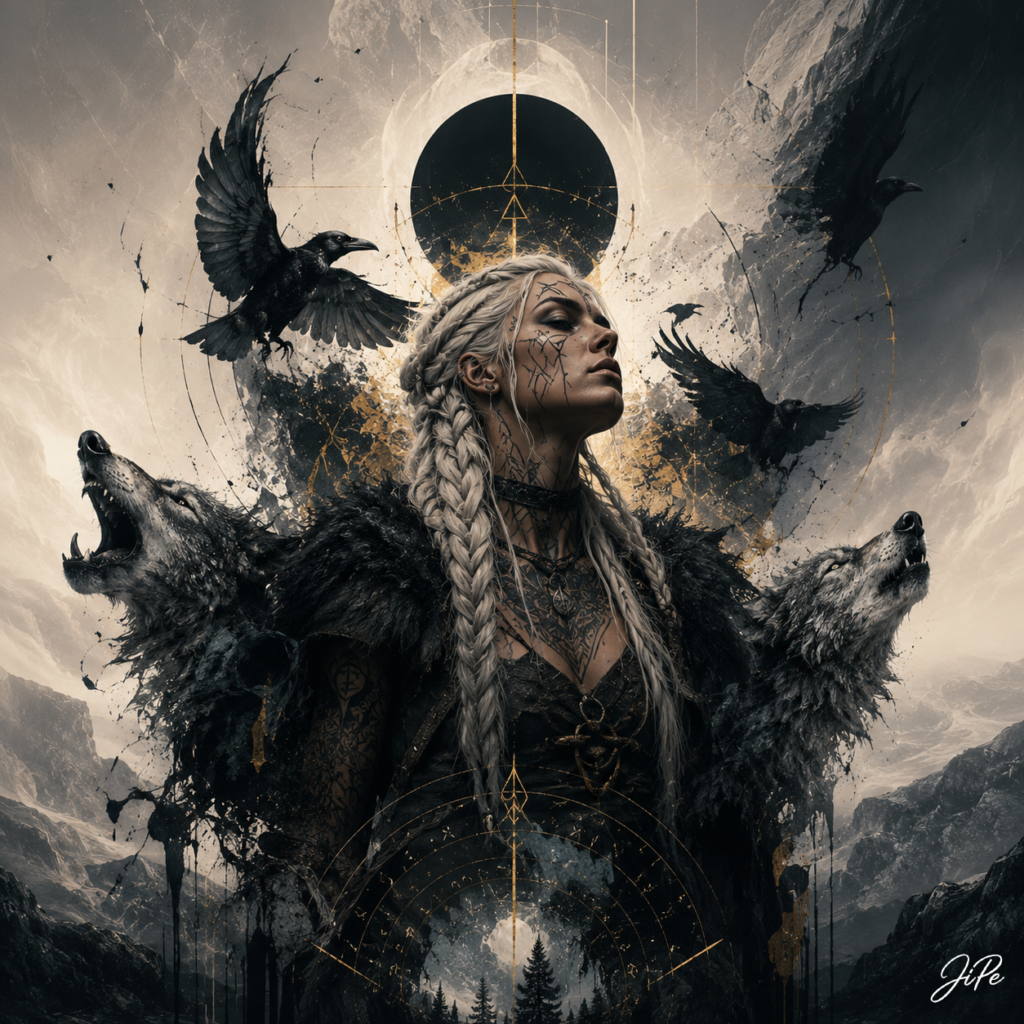
Born Beneath the Black Sun is a monumental exploration of destiny, ancestral memory, and the profound relationship between humanity and the untamed forces of nature. Positioned within the traditions of symbolic realism, Norse mythology, and contemporary visionary art, the painting transcends narrative illustration to become a meditation on identity forged through darkness rather than light. It presents a world where myth is not a distant past but a living psychological landscape, and where the symbols of the ancient North continue to resonate as universal reflections of courage, sacrifice, and spiritual transformation.
At the heart of the composition stands a solitary woman whose presence commands both stillness and authority. Her eyes are closed, her face lifted toward the unseen heavens, suggesting complete communion with forces beyond ordinary perception. She neither confronts the viewer nor seeks attention; instead, she exists within a state of profound inner certainty. Her expression conveys acceptance rather than triumph, embodying the quiet confidence of someone who has embraced both suffering and strength as inseparable aspects of existence.
Her long silver braids immediately evoke the visual language of Norse tradition, recalling the legendary shieldmaidens, seeresses, and women who occupied sacred roles within Viking society. Yet she is intentionally presented as an archetype rather than a historical figure. She represents the eternal traveller between worlds—the individual who carries inherited wisdom while remaining open to transformation. Intricate markings upon her skin resemble ancient runes, suggesting that memory itself has become inscribed upon the body. These symbols do not merely decorate her form; they imply that identity is written through experience, lineage, and the invisible narratives carried across generations.
Suspended above her is the monumental black sun, encircled by radiant halos and sacred geometric structures. Throughout the composition, the eclipse functions as its metaphysical centre. Rather than symbolising destruction, the black sun represents hidden illumination—a paradox in which darkness becomes the birthplace of insight. It recalls ancient cosmologies in which eclipses marked moments of transition, revelation, and renewal. Here, the celestial phenomenon serves as both crown and gateway, suggesting that true awakening often emerges only after passing through uncertainty and shadow.
Radiating around the eclipse are delicate geometric lines and concentric circles that establish an invisible cosmological order. These forms evoke sacred diagrams, astronomical charts, and ancient systems of symbolic knowledge. They connect the human figure to a universal architecture that extends beyond history and culture, proposing that the rhythms governing the heavens also shape the inner life of the soul. The precision of these geometries contrasts beautifully with the expressive painterly textures surrounding them, creating a dialogue between order and chaos, permanence and continual transformation.
Encircling the central figure are ravens and wolves—two of the most enduring symbols within Norse mythology. The ravens immediately evoke Huginn and Muninn, the companions of Odin, traditionally representing thought and memory. Their powerful wings create a dynamic rhythm throughout the composition while suggesting the continual movement between knowledge and intuition, observation and remembrance. They become living messengers between the earthly and the divine, carrying wisdom across invisible boundaries.
The wolves positioned at either side of the figure introduce another layer of symbolic complexity. They embody instinct, resilience, loyalty, and the untamed forces of the natural world. Their upward gaze mirrors the posture of the central figure, establishing a visual unity between humanity and wilderness. Rather than threatening her, the wolves appear as guardians or spiritual companions, reminding the viewer that civilisation and primal nature are not opposing realities but complementary dimensions of existence. Together with the ravens, they create a powerful symbolic trinity of intellect, instinct, and spiritual awareness.
The dramatic mountain landscape surrounding the figures reinforces the painting’s timeless atmosphere. Jagged peaks rise beneath vast northern skies, stripped of unnecessary detail and rendered with restrained elegance. The landscape functions less as geographical location than as psychological terrain—a place where silence becomes tangible and where every element appears shaped by immense geological and spiritual time. It is a world untouched by modernity, existing somewhere between memory, mythology, and dream.
The painting’s colour palette is intentionally restrained, dominated by charcoal black, weathered stone, muted ivory, and luminous gold. This limited spectrum heightens the emotional intensity of the composition while allowing symbolic contrasts to emerge with remarkable clarity. Gold appears sparingly yet decisively, flowing through the work like veins of hidden light. Rather than functioning as ornament, it represents divine presence, transformation, and the enduring possibility of transcendence even within darkness. The black sun itself becomes the ultimate expression of this paradox: an image in which darkness radiates rather than conceals.
The richly textured surface further deepens the work’s symbolic resonance. Layers of distressed paint, fractured textures, expressive brushwork, ink-like drips, and weathered passages give the impression that the painting has evolved organically over time. Every mark contributes to an archaeological sense of accumulated memory, as though the image has emerged from ancient stone, forgotten manuscripts, and the erosion of centuries. This tactile complexity invites prolonged contemplation, rewarding close observation with increasingly subtle relationships between realism and abstraction.
From an art historical perspective, Born Beneath the Black Sun exists at the intersection of contemporary figurative painting, visionary symbolism, mythological narrative, and mixed-media aesthetics. While echoes of Nordic folklore, Romantic landscape painting, and Symbolist philosophy are clearly present, the work ultimately establishes its own distinctive visual language. It avoids literal storytelling in favour of symbolic openness, allowing each viewer to construct a deeply personal interpretation.
The title serves as the conceptual foundation of the work. Born Beneath the Black Sun suggests that identity is not formed solely through moments of clarity and prosperity, but equally through encounters with uncertainty, hardship, and mystery. The black sun becomes an emblem of origins rather than endings—a celestial force under which resilience is forged, wisdom is inherited, and transformation begins. It proposes that every individual carries within them both shadow and light, and that genuine wholeness arises only when these opposing forces are embraced rather than denied.
Ultimately, Born Beneath the Black Sun is a meditation on the enduring relationship between humanity, mythology, and the natural world. It reminds us that the oldest stories continue to speak because they describe timeless psychological truths rather than historical events. Standing before this work, viewers are invited to recognise the ancient forces that still shape the human spirit: instinct and intellect, solitude and belonging, mortality and transcendence. Beneath the silent eclipse, where ravens carry memory across the sky and wolves guard the threshold between worlds, the painting suggests that our deepest origins are found not in certainty, but in the mysterious darkness from which every journey toward wisdom begins.