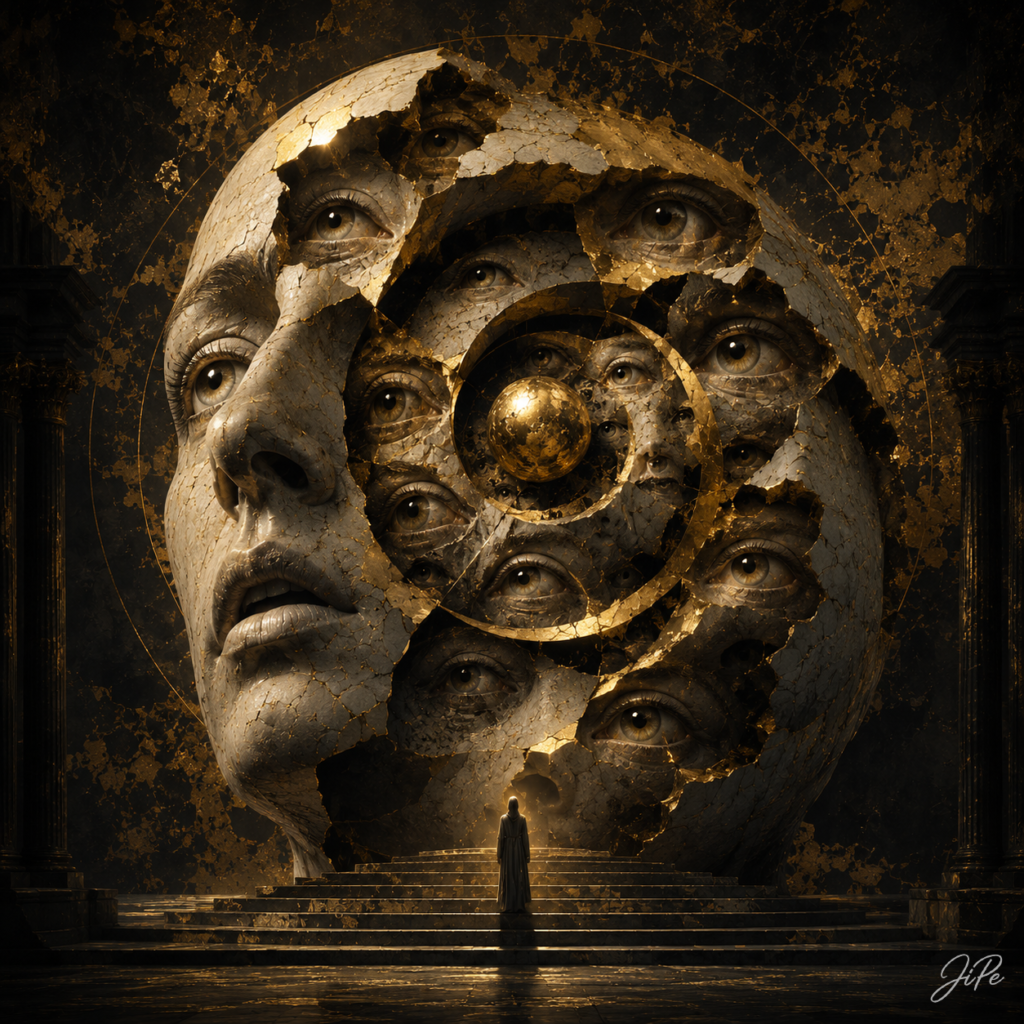
The Eyes Beneath the Stone confronts the viewer with a presence that appears ancient, fractured, and strangely awake. Monumental scale turns the encounter into something almost architectural: the solitary figure below does not merely stand before an image, but before an intelligence whose boundaries seem impossible to determine.
The tension emerges from a reversal of perception. To look is ordinarily to possess a certain distance from what is seen; here, that distance collapses. Vision multiplies until observation itself becomes overwhelming. The stone surface suggests permanence and silence, yet beneath its fractures something restless persists, as though consciousness had survived the structures intended to contain it.
Light moves sparingly through this darkness, gathering along ruptures and hidden depths. Rather than offering clarity, it exposes further layers, making revelation inseparable from uncertainty. The title, The Eyes Beneath the Stone, suggests that surfaces may conceal not emptiness but attention.
The smallest presence in the work may therefore occupy its most precarious position: standing before what has already seen more than can be known. The unresolved question is not simply what lies beneath the stone, but whether the act of uncovering it has made the observer visible in return.