Monumental Visionary Fine Art exploring mythology, consciousness, sacred light, and timeless visual storytelling.

Monumental Visionary Fine Art exploring mythology, consciousness, sacred light, and timeless visual storytelling.

Fantasy Paintings

Between Night and Dawn

Between Night and Dawn

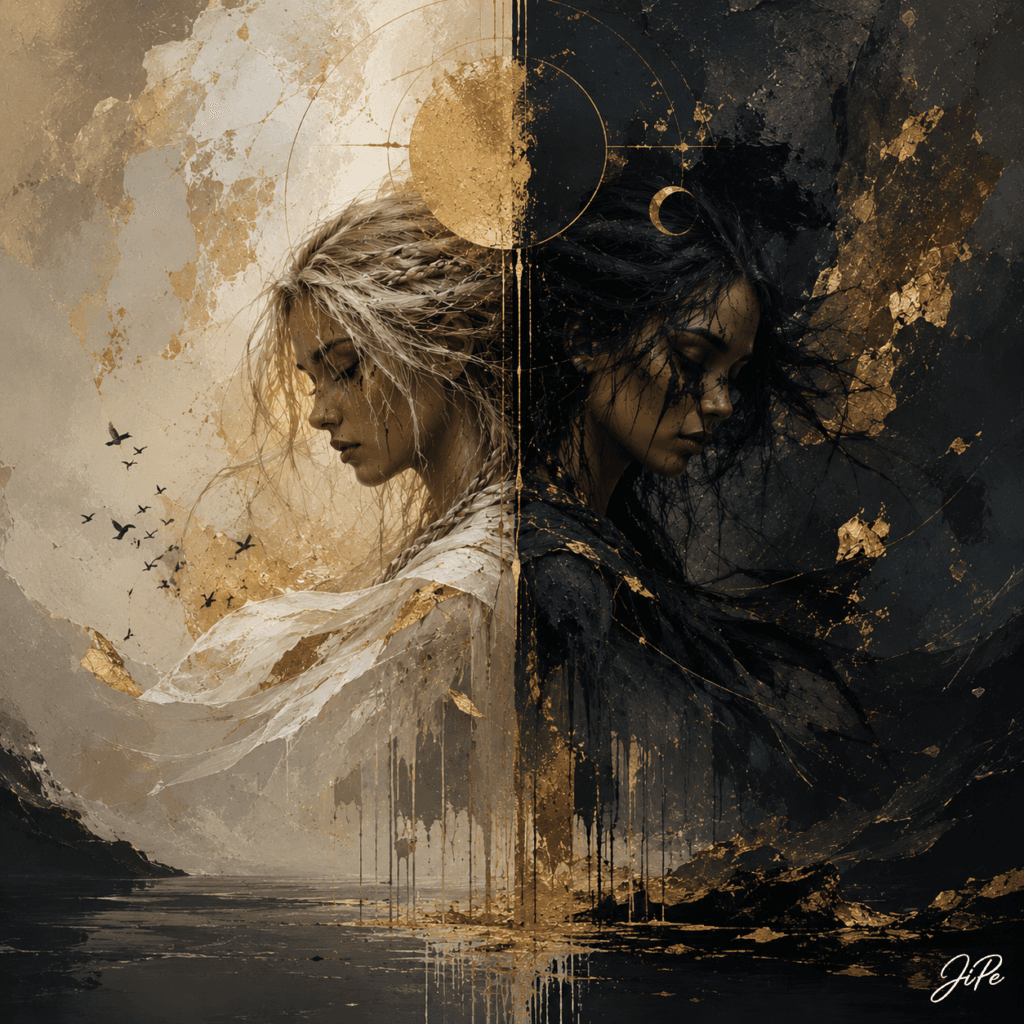
Between Night and Dawn is an exploration of duality, transition, and the fragile threshold between opposing states of existence. Rather than portraying two separate individuals, the painting presents two aspects of a single consciousness—light and shadow, memory and possibility, endings and beginnings. It is a symbolic reflection on the human condition, revealing that transformation rarely occurs in moments of certainty, but within the quiet space where opposites coexist.

The title refers not only to the physical passage from darkness into daylight, but to the emotional and psychological landscapes that define every human journey. Night becomes a metaphor for introspection, uncertainty, loss, and the hidden dimensions of the self, while dawn represents awakening, hope, renewal, and the promise of change. The painting inhabits the moment between these two realities—the instant when neither has fully disappeared nor fully emerged.

At the center of the composition stand two female figures, positioned back to back yet intrinsically connected. They do not confront one another; instead, they exist in quiet dialogue. Their closed eyes suggest introspection rather than separation, emphasizing an inward journey over external interaction. The composition deliberately avoids conflict, presenting duality not as opposition but as complementarity. Each figure gives meaning to the other, illustrating the idea that light cannot exist without darkness, nor renewal without the experiences that precede it.

The left figure, enveloped in luminous ivory tones, symbolizes openness, innocence, clarity, and the gentle emergence of hope. Bathed in soft golden light, she appears almost weightless, her flowing garments dissolving into the surrounding atmosphere. Rather than representing perfection, she embodies vulnerability and acceptance—the courage required to move forward despite uncertainty.

In contrast, the figure on the right emerges from layers of charcoal, deep black, and muted gold. She is not a representation of evil or despair, but of the hidden self: the unconscious, memory, grief, resilience, and the experiences that shape personal growth. Her presence introduces emotional gravity to the composition, reminding the viewer that darkness is not simply the absence of light but an essential part of human existence. Without shadow, illumination loses its meaning.

The vertical division separating the two figures serves as one of the painting’s most significant structural elements. It functions simultaneously as a boundary and a bridge. Rather than creating separation, it symbolizes the invisible threshold through which transformation occurs. The line suggests that every individual continually exists between multiple identities—between who they have been and who they are becoming. It is less a barrier than a point of passage, where opposing forces merge into a unified whole.

Circular geometry reinforces this symbolic dialogue throughout the composition. Behind the illuminated figure, the radiant golden disc recalls the imagery of the rising sun, eternity, and spiritual awakening. Behind the darker figure, a crescent moon introduces themes of intuition, mystery, dreams, and the unseen rhythms of life. Together, these celestial symbols create a visual language rooted in universal cycles: day and night, life and death, endings and beginnings. They remind us that transformation is not linear but cyclical, governed by rhythms far older than human perception.

The flock of birds ascending into the luminous horizon adds another poetic dimension to the work. Traditionally associated with freedom, migration, and transcendence, the birds become symbols of thoughts, memories, and aspirations moving beyond limitation. Their movement introduces a subtle sense of hope without disrupting the painting’s meditative stillness. They suggest that even during moments of profound uncertainty, something within us continues moving toward possibility.

The composition itself is carefully balanced between stillness and movement. The figures remain calm and introspective, while flowing fabrics, windswept hair, and expressive painterly gestures introduce continuous visual energy. This contrast reflects the emotional reality of transformation: internally quiet yet constantly unfolding. The viewer senses that the figures are suspended within an eternal moment, existing outside conventional notions of time.

Technically, Between Night and Dawn combines refined realism with expressive abstraction. The faces are rendered with remarkable sensitivity and anatomical precision, while surrounding forms gradually dissolve into textured brushwork, fractured surfaces, and layered painterly gestures. Thick impasto effects, weathered textures, and luminous gold leaf-like accents contribute to a tactile visual experience that celebrates the materiality of painting itself. These textured passages intentionally blur the boundary between representation and abstraction, allowing emotion and symbolism to emerge through surface as much as through subject matter.

Gold plays a central symbolic role throughout the composition. Rather than functioning merely as an aesthetic accent, it represents continuity, transformation, and the enduring presence of light within darkness. Inspired by historical sacred painting as well as the philosophy of kintsugi, the golden elements suggest that fractures, transitions, and imperfections are not flaws to conceal but essential aspects of growth. Gold becomes the visual thread connecting both halves of the painting, reminding the viewer that light exists even within shadow.

The restrained palette of ivory, charcoal, black, muted earth tones, and luminous gold creates a timeless atmosphere that transcends contemporary trends. Dramatic chiaroscuro enhances the sculptural quality of the figures, while subtle atmospheric transitions soften the composition, preserving its contemplative mood. Every tonal relationship is carefully orchestrated to support the painting’s central dialogue between illumination and obscurity.

From an art historical perspective, Between Night and Dawn belongs to a contemporary tradition of symbolic figurative painting while drawing inspiration from classical portraiture, visionary art, and abstract expression. The synthesis of realistic anatomy, expressive textures, sacred geometry, and minimalist compositional structure positions the work within a broader conversation about the role of symbolism in contemporary art. Rather than illustrating mythology directly, it creates a modern visual mythology grounded in universal psychological experience.

Conceptually, the painting invites reflection on the dual nature of identity. Human beings often seek certainty by separating light from darkness, strength from vulnerability, or hope from sorrow. Between Night and Dawn challenges these distinctions by suggesting that every stage of growth requires the coexistence of both. It proposes that transformation is not achieved by escaping darkness, but by understanding its relationship to light.

The work intentionally resists a definitive interpretation. Some viewers may recognize themes of healing, resilience, and emotional recovery. Others may see an allegory of consciousness, the integration of opposing aspects of the self, or the timeless cycle of life and renewal. This openness is central to the painting’s meaning, allowing every observer to complete the narrative through their own experiences, memories, and emotional associations.

Ultimately, Between Night and Dawn is a meditation on becoming. It captures the silent moment before transformation becomes visible—the fragile interval where uncertainty gives way to possibility, where endings quietly prepare the way for beginnings. Standing before this work, the viewer is invited to recognize that the space between darkness and light is not a place of conflict, but one of profound creation. It is within this threshold, suspended between night and dawn, that the deepest forms of personal transformation begin.

Lämna ett svar