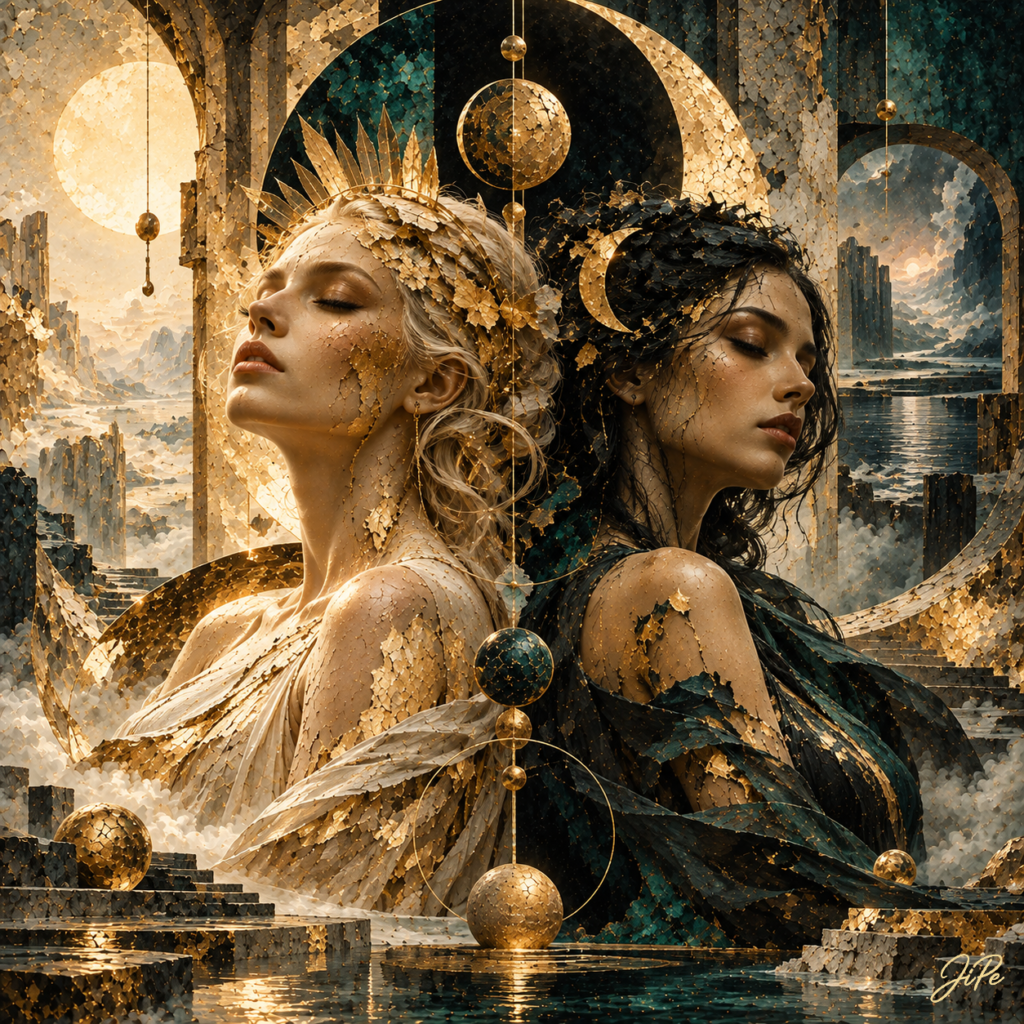
In Daughters of Sun and Moon, two figures inhabit a shared stillness, their closeness suggesting an ancient kinship that neither distance nor difference can entirely dissolve. Turned away from one another, they seem absorbed in separate inner worlds, yet their presence forms an indivisible whole. There is no confrontation between them, only the quiet gravity of a connection that exists beyond recognition or speech.
Around them, vast spaces unfold with an almost ceremonial silence. Light moves between warmth and coolness, intimacy and remoteness, touching both figures without resolving the distinction between their realms. The surrounding immensity lends their repose a monumental quality, while the delicacy of their expressions introduces an unexpected vulnerability. What appears eternal remains touched by the possibility of change.
The title evokes an inheritance older than memory, perhaps a bond shaped by forces that cannot coexist without also defining one another. Yet the figures resist becoming simple opposites. Their separation feels less like division than the necessary distance through which identity becomes possible.
Something remains suspended between them: an unspoken recognition, a forgotten promise, or the faint awareness of a unity that can no longer be fully experienced. If each belongs to a different order of existence, what is it that continues to hold them together when neither can turn to face the other?