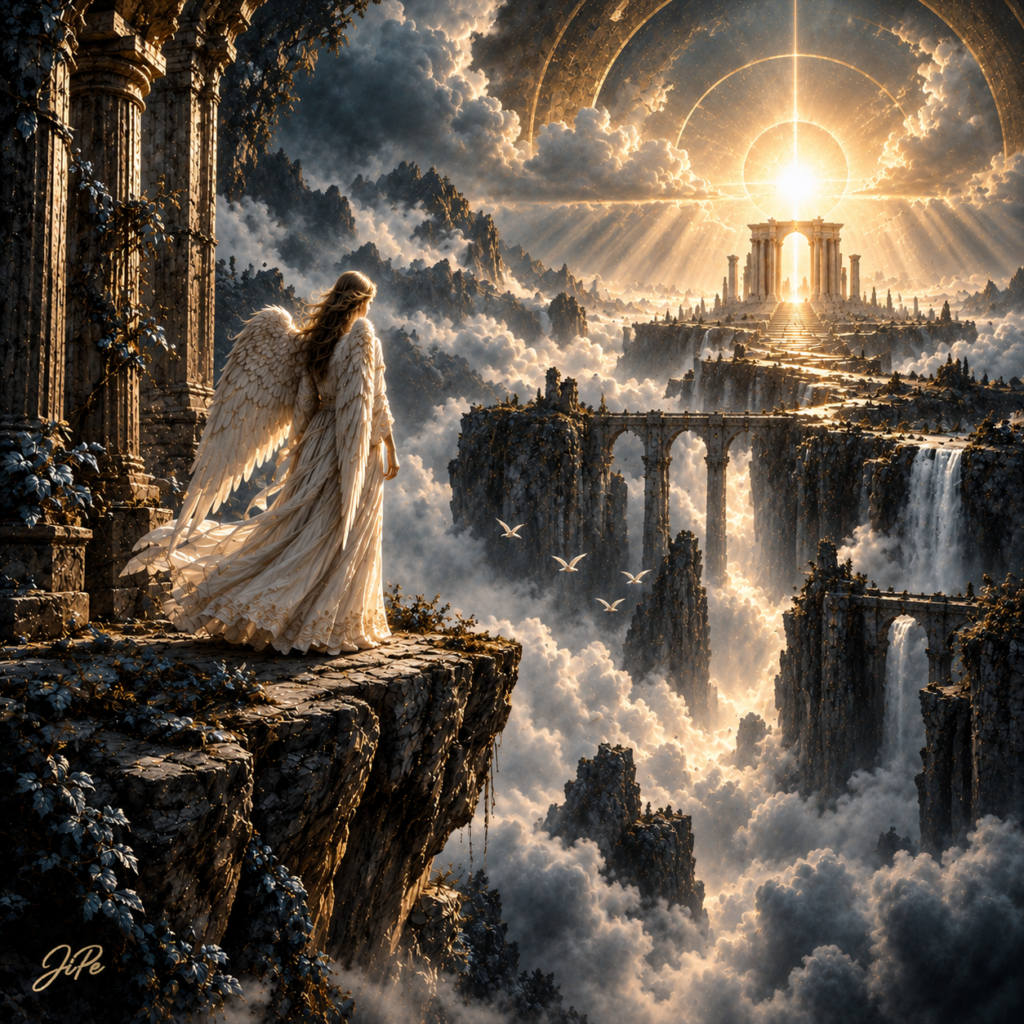
At the Edge of Paradise unfolds around the tension of nearness without arrival. A solitary presence occupies the threshold between what can be inhabited and what can only be contemplated, while the immense distance beyond seems at once impossibly remote and almost within reach. Scale becomes psychological: the vastness does not diminish the figure so much as deepen the gravity of waiting.
Light gathers at the farthest point of the work with an authority that is difficult to name. It may suggest promise, revelation, memory, or something less certain—a perfection whose very radiance makes approach more complicated. Between the observer and that brightness lies a space of separation, suspended between longing and restraint.
The title, At the Edge of Paradise, leaves paradise itself deliberately unresolved. Is the edge a place of exclusion, hesitation, protection, or choice? The work holds these possibilities together without allowing one to prevail. Its silence is therefore not empty; it carries the pressure of an unmade passage.
Perhaps paradise is most powerful at the moment before it can be entered. And perhaps the greater mystery is not what waits beyond the threshold, but what keeps us standing before it.