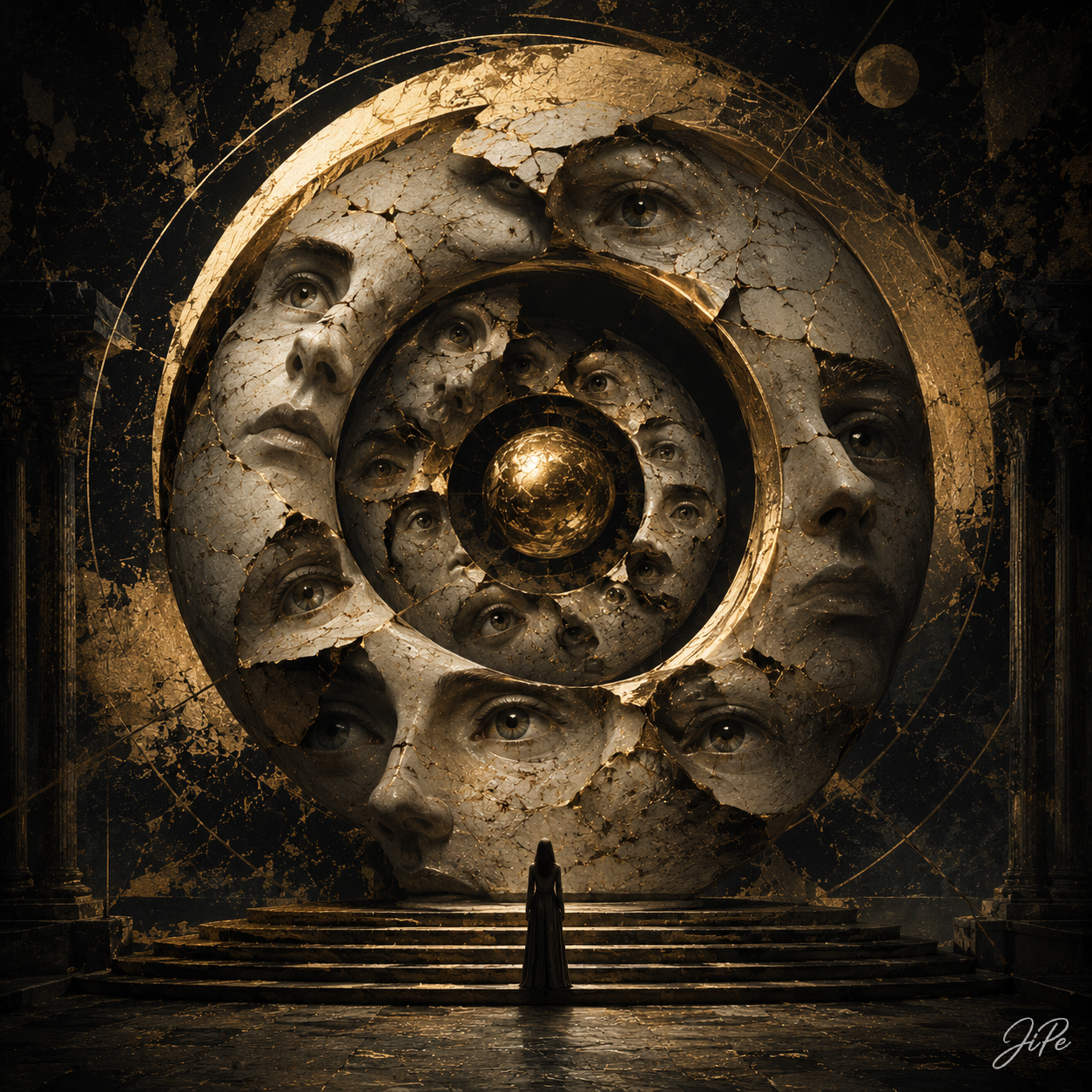

At the Edge of a Vanished World holds its subject in a state of suspended recognition, as though presence itself were emerging from something already lost. The face commands an almost monumental intimacy, yet its fractured boundaries resist permanence. Beyond it, an immense distance opens—quiet, luminous, and strangely unreachable. The two spaces seem to exist simultaneously, joined less by geography than by memory.
Light becomes a threshold rather than a source of clarity. It gathers at the margins of darkness, suggesting revelation while withholding certainty. Across the work, order and dissolution remain in delicate opposition: structures imply hidden systems, while surfaces appear to erode beneath their own accumulated history. The gaze intensifies this tension. Direct yet unreadable, it seems suspended between witness and remembrance.
The title introduces the possibility that disappearance is not an ending but a condition of perception. Perhaps the vanished world lies beyond the figure; perhaps it survives within her. Scale becomes uncertain, and with it the boundary between interior and exterior, memory and landscape, observer and observed.
What remains is the unsettling sense of standing before something that has already passed—and discovering that it may still be looking back.