
Where Mountains Remember
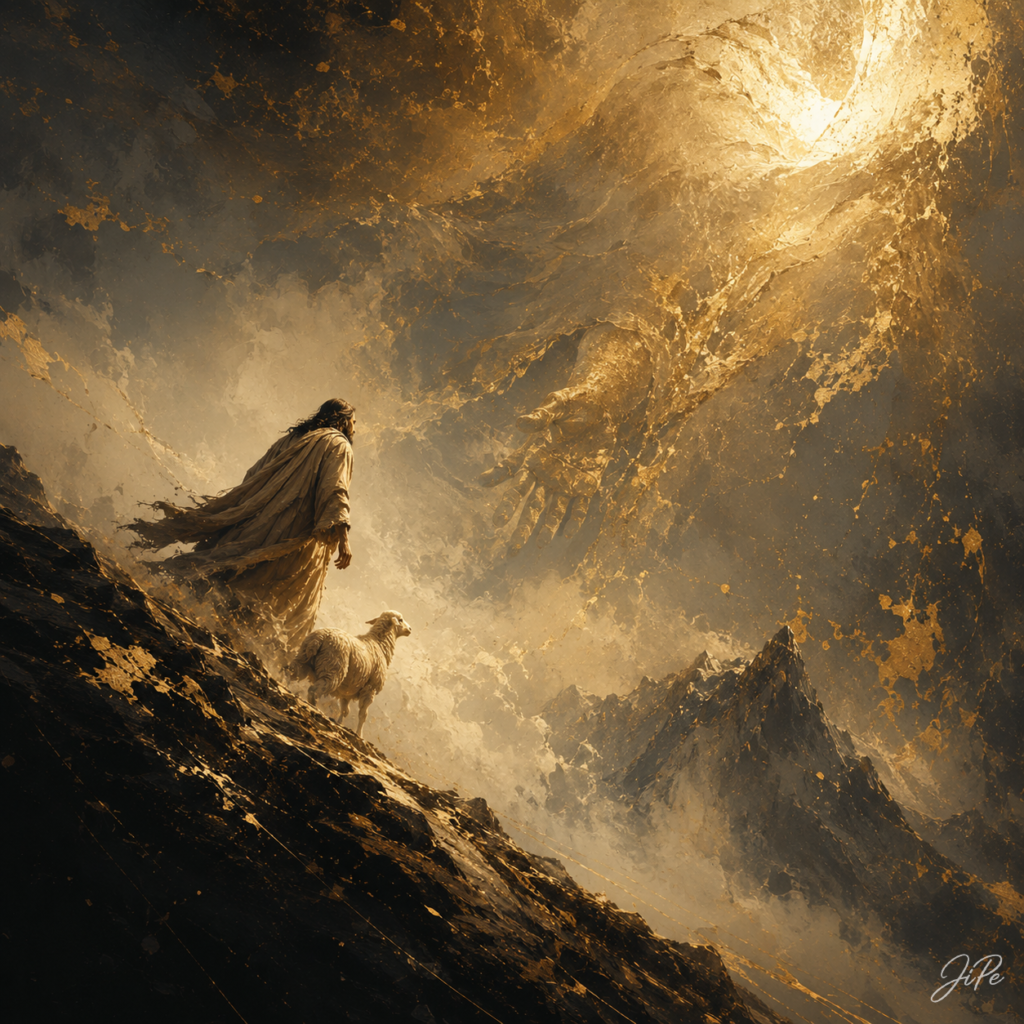
Where Mountains Remember is a monumental meditation on faith, memory, and the eternal dialogue between humanity and the divine. Blending contemporary visionary symbolism with cinematic landscape painting and richly textured mixed-media aesthetics, the work transforms a dramatic mountain wilderness into a sacred meeting place where time itself appears to dissolve. The painting does not depict a historical event or a literal biblical narrative. Instead, it invites viewers into an archetypal moment—a timeless encounter in which creation remembers its Creator, and the silence of the mountains becomes a language older than history itself.
At the center of the composition, a solitary traveler ascends a steep mountainside accompanied only by a lamb. Their small silhouettes stand in striking contrast to the immense landscape that surrounds them. Yet the true focal point lies beyond the physical terrain. Emerging from an ocean of radiant gold and swirling light, an immense celestial hand reaches downward through the heavens. Suspended between cloud, light, and abstraction, the gesture evokes neither command nor judgment. Instead, it is an invitation—an expression of grace extended toward humanity across the immeasurable distance between heaven and earth.
The title, Where Mountains Remember, transforms the landscape into something profoundly alive. These mountains are not passive geological formations but ancient witnesses carrying memories beyond human comprehension. Throughout mythology, sacred scripture, and world literature, mountains have long represented places of revelation, covenant, transformation, and encounter with the divine. Here they become repositories of spiritual memory, preserving echoes of every prayer, every act of hope, every pilgrimage, and every moment when eternity briefly touched the temporal world.
The composition is built upon an extraordinary dialogue between scale and intimacy. The human figure appears almost insignificant within the monumental landscape, yet this apparent smallness becomes the source of profound dignity. Rather than diminishing humanity, the overwhelming environment reveals the immense generosity of divine attention. The celestial hand reaches not toward kings or empires but toward a lone traveler climbing through uncertainty. The painting reminds viewers that significance is measured not by physical scale but by relationship.
The lamb accompanying the traveler introduces one of the work’s most enduring symbolic elements. Throughout religious art, pastoral imagery, and sacred literature, the lamb has represented innocence, sacrifice, guidance, vulnerability, and divine care. Within this composition, it becomes a companion rather than merely a symbol. Walking alongside the pilgrim, it quietly reinforces themes of trust, protection, and faithful perseverance. The relationship between the two figures suggests that the journey toward transcendence is never entirely solitary.
Perhaps the painting’s most remarkable achievement lies in its treatment of light. Rather than functioning simply as atmospheric illumination, light becomes an active spiritual presence. It pours through the upper heavens in molten streams of gold, dissolving the boundaries between cloud, landscape, and divine form. The enormous hand itself appears composed not of flesh but of luminous energy, as though it is continuously forming from the very substance of creation. This ambiguity preserves the mystery of the sacred while avoiding literal representation.
The celestial hand recalls one of the oldest visual traditions in Western art—the symbolic ”Hand of God” found in Byzantine mosaics, medieval manuscripts, and Renaissance painting. In those historical works, the divine was often represented indirectly through a hand emerging from heaven. Here that tradition is reimagined within a contemporary visionary language. The hand no longer appears isolated but is born from swirling painterly gestures, abstract textures, and radiant atmospheres that suggest divine presence as an ever-unfolding force rather than a fixed image.
The surrounding mountains contribute far more than dramatic scenery. Their fractured peaks and rugged surfaces symbolize the difficult terrain of human existence—the obstacles, losses, and uncertainties that accompany every meaningful spiritual journey. Yet these mountains are illuminated rather than consumed by darkness. Warm reflections of gold settle upon their ridges, suggesting that even hardship retains the capacity to reflect grace.
Materiality plays an essential role in communicating this vision. Thick painterly textures, layered impasto, weathered surfaces, and expressive brushwork create a tactile richness that invites close observation. The surface itself appears ancient, almost archaeological, as though the image has slowly emerged from stone over countless centuries. Cracks, splashes, and subtle traces of gold evoke the philosophy of kintsugi, where fractures become visible testimonies of endurance rather than signs of failure. Every layer contributes to the sensation that memory itself has become material.
The restrained palette of charcoal, warm ochre, muted ivory, and radiant antique gold reinforces the painting’s emotional gravity. Darkness occupies much of the composition, yet it never overwhelms the viewer. Instead, shadow serves as the necessary condition through which light acquires meaning. Gold becomes more than color; it becomes revelation itself—a visible manifestation of hope entering the world.
From an art historical perspective, Where Mountains Remember draws upon several influential traditions while establishing a distinctly contemporary voice. Romanticism contributes its fascination with the sublime relationship between humanity and vast natural forces. Symbolism transforms every visual element into layered psychological and spiritual meaning. Surrealism dissolves the conventional boundaries separating heaven and earth, while contemporary visionary art introduces cinematic atmosphere, monumental scale, and immersive metaphysical storytelling. The result is a work that feels both timeless and unmistakably modern.
The painting also resonates deeply with archetypal psychology. The ascending traveler embodies the universal figure of the pilgrim—the individual who willingly leaves certainty in search of deeper truth. The mountain represents initiation, the lamb symbolizes innocence and trust, while the descending hand becomes the archetype of grace meeting human effort. Rather than presenting salvation as something earned through conquest, the composition suggests that every sincere journey eventually encounters compassion waiting long before arrival.
An equally compelling interpretation emerges through the relationship between movement and stillness. The traveler advances upward while clouds surge across the heavens and light pours through invisible openings. Yet emotionally the painting remains profoundly calm. This paradox creates a contemplative experience in which motion becomes another form of silence. The world appears alive without becoming chaotic, reminding viewers that the deepest transformations often unfold quietly.
The absence of explicit narrative greatly enhances the painting’s universality. No destination is shown beyond the distant peaks. The identity of the traveler remains unknown. The divine gesture itself never fully resolves into physical certainty. This openness allows viewers from diverse philosophical and spiritual traditions to encounter the work through their own experiences of hope, longing, memory, or faith.
The title ultimately reveals its deepest meaning only after prolonged contemplation. Mountains do not literally remember, yet they endure across civilizations, witnessing countless generations while remaining unchanged. In this sense they become symbols of eternal consciousness—silent guardians preserving truths that humanity repeatedly forgets. Standing before them, the pilgrim enters not merely a landscape but a living archive of spiritual memory stretching beyond recorded history.
Where Mountains Remember is therefore not simply a landscape painting, nor solely a religious image. It is a profound reflection on humanity’s enduring desire to seek meaning beyond the visible world. Through its extraordinary synthesis of symbolic narrative, monumental composition, expressive materiality, and luminous contemporary aesthetics, the work invites viewers into a sacred threshold where nature, memory, and transcendence become inseparable.
In that radiant meeting place between stone and heaven, effort and grace, silence and revelation, the painting offers a timeless insight: before humanity remembers the divine, creation has already been remembering us. The mountains have always stood waiting—not merely as witnesses to history, but as guardians of the eternal conversation between the human soul and the infinite.