Where Light Breaks Through

Where Light Breaks Through is a contemplative exploration of emergence, resilience, and the transformative power of illumination. Situated between abstraction and emotional landscape, the work abandons recognizable forms in favor of elemental forces—light, shadow, movement, and texture—creating a visual experience that speaks less to the intellect than to memory, intuition, and feeling. Rather than depicting a place, an event, or a figure, the painting captures a moment of becoming: the instant when darkness yields not through destruction, but through revelation.
The title itself serves as both a poetic statement and an open question. Where Light Breaks Through invites viewers to consider not only where light enters the composition, but where it enters their own lives. It suggests that illumination is not something imposed from outside, but something that emerges precisely where pressure, fracture, uncertainty, and vulnerability intersect. The painting becomes less an image than a metaphor for the human condition—one in which every transformation begins with a single point of breakthrough.
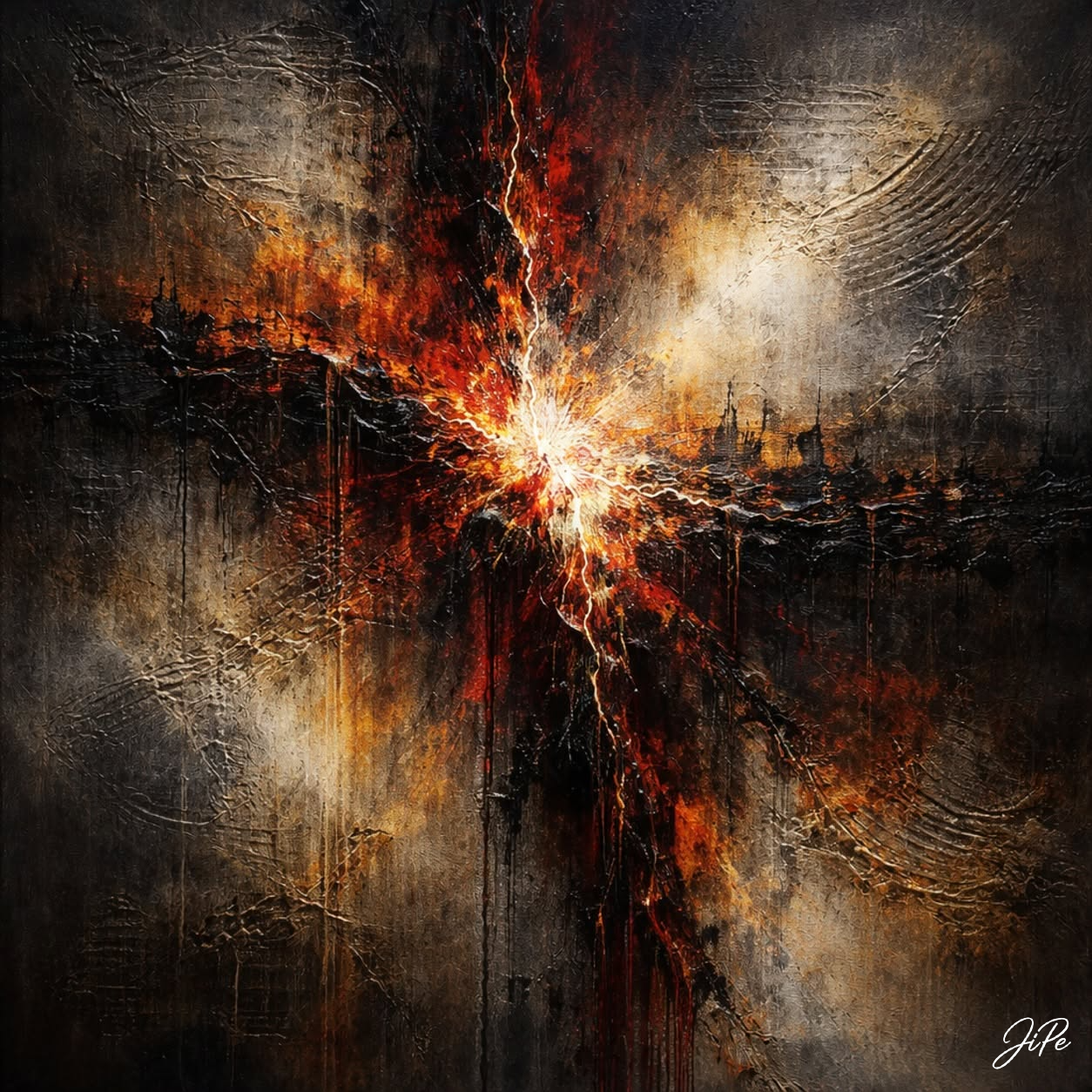
At first glance, the composition appears deceptively simple. Vast fields of charcoal black, warm ivory, and muted gray converge toward a luminous center where streams of molten gold collide and radiate outward. Yet the longer one observes the work, the more complex its internal structure becomes. The painting is governed by opposing forces that simultaneously attract and resist one another. Darkness presses inward while light expands outward. Soft atmospheric passages dissolve into heavily textured impasto. Order emerges from apparent chaos, only to dissolve again into energetic movement.
This dynamic equilibrium forms the emotional architecture of the work.
The central convergence functions as the painting’s undeniable focal point. Here, radiant gold appears to erupt through the surrounding darkness with extraordinary energy. The luminous axis extends vertically across the composition, suggesting an invisible connection between heaven and earth, spirit and matter, beginning and end. Yet this line is not rigid or mechanical. It appears alive—cracked, textured, weathered, and organic—as though light itself has carved its own path through resistant material.
Rather than representing destruction, these fractures become symbols of possibility.
The painting proposes that breakthrough is never smooth.
It is always marked by tension, resistance, and transformation.
Throughout the composition, gold functions as far more than a decorative element. It carries profound symbolic significance, recalling centuries of artistic tradition in which gold represented the sacred, the eternal, and the divine. Here, however, the gold has abandoned its flawless perfection. Instead, it appears fractured, weathered, and embedded within rough painterly surfaces. It behaves less like precious metal than like living energy moving through matter.
This contemporary reinterpretation transforms the symbolic language of gold from one of perfection into one of resilience.
The surface itself plays an equally essential role in communicating meaning. Thick layers of paint create an almost sculptural quality, allowing the artwork to occupy a space between painting and relief. Every ridge, fracture, scrape, and accumulation of pigment records an act of construction. The visible materiality reminds viewers that beauty is not achieved through smoothness but through complexity. Every texture becomes evidence of process, suggesting histories concealed beneath the visible surface.
The painting therefore exists not only as an image but also as an object shaped by time.
Its tactile presence encourages prolonged observation, revealing subtle transitions that cannot be perceived in a single glance.
Color is deliberately restrained. Deep blacks establish visual gravity, while muted whites and soft grays create atmospheric openness. Against this quiet foundation, the golden passages achieve extraordinary intensity. Because the palette avoids unnecessary distraction, every shift in luminosity acquires emotional significance.
The relationship between darkness and light never becomes oppositional.
Instead, darkness functions as the necessary condition through which illumination becomes visible. One cannot exist without the other.
This philosophical balance distinguishes the work from more conventional narratives of conflict between good and evil or despair and hope. Rather than suggesting victory over darkness, the painting proposes coexistence. Light emerges not because darkness disappears, but because it becomes permeable.
Compositionally, the work achieves remarkable balance through controlled asymmetry. The explosive center radiates energy outward while the surrounding fields create expansive areas of visual silence. Thin golden lines arc gently across the surface like invisible trajectories or celestial diagrams, introducing an additional layer of spatial complexity. These delicate gestures contrast beautifully with the heavy impasto beneath them, reinforcing the dialogue between precision and spontaneity.
The result is a composition that feels simultaneously monumental and intimate.
The painting invites viewers inward rather than overwhelming them with spectacle.
From an art historical perspective, Where Light Breaks Through occupies an intriguing position between Abstract Expressionism, contemporary textured abstraction, and spiritual abstraction. One might recognize echoes of artists who sought to transcend representation through gesture, color, and material, yet this work maintains its own distinctive visual vocabulary. Unlike purely gestural abstraction, every movement here appears intentional, carrying symbolic weight while preserving emotional openness.
There are also resonances with the long tradition of sacred painting, where light served not merely as illumination but as revelation. However, the work avoids overt religious iconography. Instead, it speaks to universal experiences of awakening, recovery, creativity, and inner transformation.
Its spiritual dimension remains deliberately inclusive.
Every viewer is free to discover their own narrative within its forms.
Psychologically, the painting resonates with experiences of personal renewal. The central rupture may suggest the breaking of fear, grief, limitation, or silence. The expanding light may symbolize insight, healing, forgiveness, creative inspiration, or hope emerging after prolonged uncertainty.
Because the composition contains no literal figures, the viewer unconsciously occupies the emotional space within the painting. One does not simply observe the breakthrough; one experiences it.
This participatory quality gives the work extraordinary emotional accessibility despite its abstract language.
The absence of recognizable narrative becomes one of its greatest strengths.
Instead of telling a story, the painting creates conditions for countless personal stories to unfold.
Materially, the layered surfaces reinforce this conceptual depth. The cracks, scraped edges, fractured textures, and visible accumulations of pigment recall geological formations, weathered stone, ancient walls, and landscapes shaped by immense natural forces. The painting appears almost archaeological, as though the light has existed beneath the surface for centuries and has only now found its way into visibility.
This sensation introduces the dimension of time.
The breakthrough is not instantaneous.
It is the culmination of unseen processes unfolding beneath the surface long before becoming visible.
The vertical movement of the golden axis further enriches the symbolic structure. It recalls ancient concepts of the axis mundi—the invisible pillar connecting earthly existence with higher consciousness. Whether interpreted spiritually, psychologically, or philosophically, this central pathway becomes a visual metaphor for alignment. It suggests moments when fragmented aspects of experience suddenly cohere into unexpected clarity.
Surrounding this axis, sweeping movements of paint create expansive emotional landscapes without ever depicting literal geography. Mountains, rivers, storms, clouds, and horizons seem to emerge and dissolve simultaneously. This ambiguity allows the painting to occupy multiple realities at once: cosmic, geological, emotional, and spiritual.
Such openness is central to the work’s enduring power.
The painting resists definitive interpretation because transformation itself cannot be reduced to simple explanation.
Ultimately, Where Light Breaks Through is an artwork about hope—not the naïve hope that denies darkness, but the mature hope that emerges because darkness has been fully acknowledged. It reminds us that the most profound moments of change rarely arrive as dramatic victories. More often, they begin quietly, almost imperceptibly, at the precise point where endurance meets possibility.
The luminous center becomes a universal symbol of that fragile yet unstoppable moment when something hidden finally reveals itself.
Whether understood as healing after loss, inspiration after creative silence, faith after doubt, or clarity after confusion, the painting offers viewers a place in which they may recognize their own journeys reflected through abstract form.
Standing before the work, one becomes aware that the light is not merely entering the composition—it is unfolding from within it.
And perhaps, by extension, from within ourselves.
In Where Light Breaks Through, the artist transforms paint, texture, and light into a meditation on resilience, reminding us that the deepest illumination often emerges not despite the fractures we carry, but because of them. The painting ultimately celebrates the quiet miracle of transformation: the timeless truth that every new beginning starts at the place where light first finds a way through the darkness.