Monumental Visionary Fine Art exploring mythology, consciousness, sacred light, and timeless visual storytelling.

Monumental Visionary Fine Art exploring mythology, consciousness, sacred light, and timeless visual storytelling.

Religious Paintings

When Heaven Reflected Eternity

When Heaven Reflected Eternity

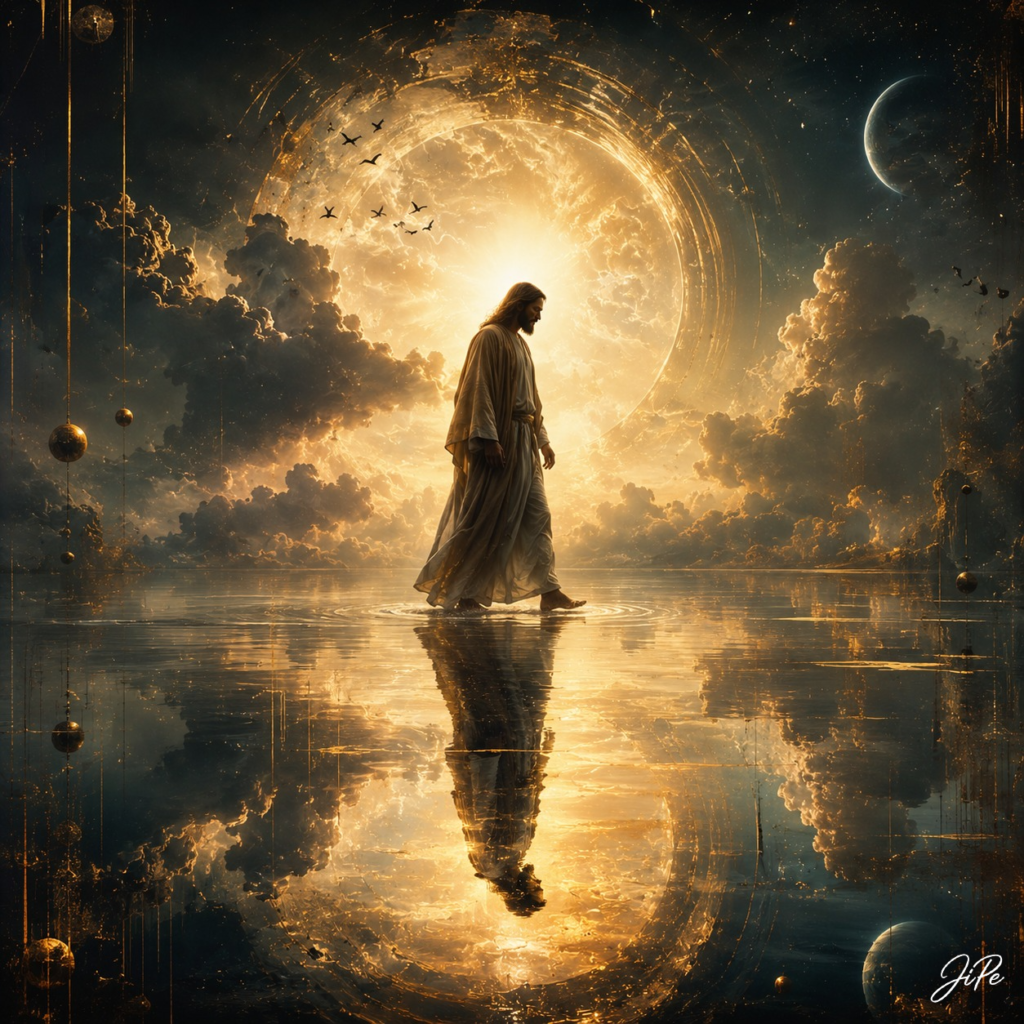
When Heaven Reflected Eternity is a contemplative vision of transcendence, divine presence, and the timeless journey of the human spirit. Rather than portraying heaven as a distant destination, the painting proposes a more profound idea—that eternity is not a place beyond existence, but a reality that quietly reveals itself whenever the visible and the invisible become perfectly aligned. It is an invitation to reflect upon the sacred moments when earthly experience briefly mirrors the infinite.

Created within the visual language of contemporary visionary symbolism, the work combines spiritual allegory, surreal landscape, and cinematic realism into a composition that exists somewhere between dream and revelation. Every element has been carefully orchestrated to dissolve conventional boundaries between earth and sky, body and spirit, time and eternity. The result is a painting that does not merely depict a celestial scene but seeks to evoke an experience of stillness, wonder, and quiet transcendence.

At the center of the composition walks a solitary figure clothed in flowing robes. His posture is calm, humble, and deeply contemplative. There is no gesture of triumph or spectacle. His head is gently lowered, his movement slow and deliberate, suggesting someone who walks not toward glory but toward understanding. The figure becomes less an individual than an archetype—a universal symbol of the soul’s lifelong pilgrimage toward truth.

He does not command the landscape.

He belongs to it.

He walks with complete trust through the unknown.

The reflective water beneath his feet is among the painting’s most significant symbolic elements. Traditionally, water has represented purification, transformation, memory, and the unconscious. Here, however, it becomes something even more profound. The perfectly still surface erases the distinction between heaven above and earth below. Reflection becomes revelation.

The sky descends.

The earth ascends.

Between them, eternity quietly appears.

Every step creates only the faintest ripple, reminding the viewer that even the smallest act of faith has the power to transform the world. The movement is gentle, almost imperceptible, emphasizing that true spiritual journeys rarely unfold through dramatic events. Instead, they emerge through countless quiet moments of perseverance, humility, and hope.

Behind the figure rises an immense sphere of radiant light, resembling both a celestial sun and a divine portal. Encircled by concentric rings of luminous energy, it evokes sacred geometry, cosmic order, and the eternal rhythm governing all creation. Throughout the history of religious and symbolic art, circles have represented perfection, unity, and infinity. Within this composition, the radiant halo expands beyond iconography to become the visual manifestation of eternity itself.

Its brilliance does not overwhelm.

It gently illuminates.

Its light feels less external than deeply remembered.

The surrounding clouds possess extraordinary monumentality, forming immense architectural masses that resemble both mountains and celestial cathedrals. Their sculptural presence transforms the atmosphere into a sacred sanctuary where nature itself becomes an expression of divine architecture. Light flows through these clouds with remarkable delicacy, dissolving darkness not through violence but through quiet revelation.

The painting suggests that heaven is not constructed from stone.

It is built from light.

Scattered throughout the celestial expanse, distant planets, floating spheres, and subtle cosmic details remind the viewer that the scene unfolds on a universal scale. Time loses its linear structure. The figure appears suspended between worlds, walking through a reality where earthly existence and cosmic eternity intersect. The universe no longer functions as a distant backdrop but becomes an active participant in the spiritual narrative.

Every star.

Every orbit.

Every reflection contributes to the silent harmony of the composition.

The restrained palette of deep midnight blues, luminous gold, warm ivory, and soft amber establishes an atmosphere of profound serenity. Darkness is never presented as a symbol of fear or separation. Instead, it becomes the infinite canvas upon which light reveals itself most clearly. Gold functions as far more than a decorative element; it symbolizes divine wisdom, grace, and the eternal presence that quietly permeates every corner of existence.

Throughout the painting, gold speaks without words.

It becomes the language of hope.

The language of eternity.

The painterly textures further enrich the symbolic experience. Layered brushwork and luminous surfaces create a visual impression reminiscent of weathered frescoes, illuminated manuscripts, and ancient sacred icons. The image feels simultaneously timeless and contemporary, suggesting that its spiritual questions belong equally to ancient civilizations and modern humanity.

From an art historical perspective, When Heaven Reflected Eternity synthesizes influences from Romantic landscape painting, Symbolism, Renaissance religious art, metaphysical painting, and contemporary visionary realism. Yet rather than imitating these traditions, the work transforms them into a distinctly modern visual language centered upon contemplation rather than doctrine.

Its spirituality remains intentionally universal.

The figure may evoke Christ, a pilgrim, a prophet, or simply the human soul itself.

The painting resists defining him.

In doing so, it allows every viewer to recognize something personal within his journey.

Psychologically, the work may be interpreted as an allegory of inner integration. The reflected image beneath the water symbolizes the reconciliation between conscious awareness and the deeper dimensions of the self. Walking becomes an act of balance between the temporal and the eternal. The immense light behind the figure represents not merely an external destination but an awakening already present within.

He is not walking toward eternity.

He is walking inside it.

The title, When Heaven Reflected Eternity, encapsulates this central philosophy with remarkable subtlety. Heaven is not portrayed as a distant realm beyond human reach. Instead, it appears whenever the soul becomes still enough to recognize the eternal within ordinary existence. Reflection becomes more than visual symmetry—it becomes spiritual recognition.

The mirror of water suggests that eternity has always been present.

It simply required a different way of seeing.

Perhaps the painting’s greatest achievement lies in its profound restraint. There are no dramatic miracles, no celestial armies, no overwhelming spectacle. Instead, transcendence unfolds through silence, light, and gentle movement. This quietness allows the viewer to enter the work emotionally rather than merely observe it visually.

The journey becomes deeply personal.

Every observer becomes the traveler.

Every reflection becomes an invitation.

Ultimately, When Heaven Reflected Eternity is a meditation on faith, presence, and the invisible relationship between the finite and the infinite. It reminds us that the sacred is often encountered not in extraordinary events but in moments of complete stillness—when reflection becomes clarity, when light becomes understanding, and when the boundaries between heaven and earth quietly disappear.

The painting offers a timeless reminder that eternity is not measured by endless time.

It is measured by perfect presence.

And sometimes, for a single quiet moment, heaven does not descend to meet the earth.

Instead, the earth remembers that it has always reflected heaven.

Lämna ett svar