Together Into Eternity

Together Into Eternity is a monumental contemporary vision of divine unity, presenting one of Christianity’s most profound theological mysteries through an extraordinary synthesis of sacred symbolism, cosmic imagery, and visionary realism. At once intimate and infinite, the artwork portrays the inseparable relationship between the Father, the Son, and the Holy Spirit while inviting viewers to contemplate humanity’s ultimate destiny: eternal communion with God. Rather than depicting a literal biblical event, the composition offers a symbolic meditation on divine companionship, redemption, and the promise that the journey of faith culminates not in solitude, but in everlasting fellowship with the Creator.
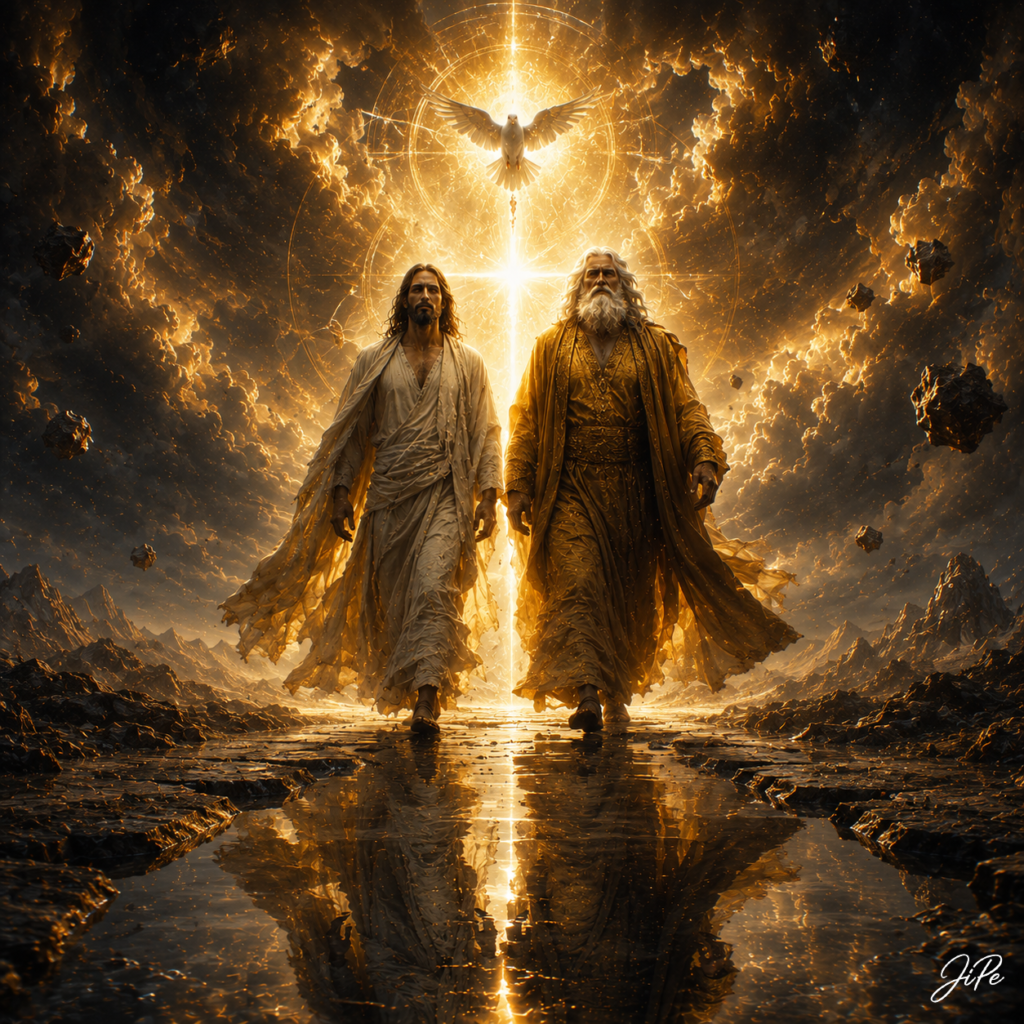
At the center of the composition, two majestic figures advance side by side through a radiant landscape flooded with celestial light. The younger figure evokes Christ, the incarnate Word whose earthly mission revealed God’s redeeming love through sacrifice, resurrection, and reconciliation. Beside Him walks an elder figure whose regal bearing, flowing white beard, and golden robes symbolize God the Father, the eternal source of all creation. The artist deliberately avoids portraying separation or hierarchy between the two. Instead, they move with perfect harmony, expressing unity of purpose, love, and divine will. Their synchronized stride becomes a visual affirmation of one of Christianity’s central theological truths: the Father and the Son act together in the unfolding work of salvation.
Towering behind them rises an immense cross composed entirely of radiant light. More than a symbol of Christ’s crucifixion, the luminous cross functions as the cosmic axis around which the entire composition is organized. It is simultaneously the instrument of redemption, the gateway to eternal life, and the eternal sign of divine love triumphing over sin and death. Unlike the wooden cross of Calvary, this celestial cross appears to exist beyond history itself, extending into the infinite reaches of heaven and earth. It radiates not suffering alone but transformation, illuminating the landscape with a light that transcends both time and space.
Above the cross descends a white dove suspended within concentric circles of golden light. Universally recognized within Christian tradition as the symbol of the Holy Spirit, the dove completes the Trinitarian vision at the heart of the artwork. Positioned directly above the Father and the Son, the Spirit becomes the living bond of divine communion, descending in peace while radiating life-giving energy throughout the heavens. The careful alignment of dove, cross, Christ, and the Father creates a powerful vertical axis that visually expresses the unity of the Holy Trinity. Rather than presenting three isolated symbols, the artist weaves them into a single luminous revelation of divine relationship.
The surrounding heavens are alive with extraordinary movement. Towering clouds part before an overwhelming radiance, while celestial geometry unfolds across the sky in delicate circles and intersecting lines reminiscent of sacred cosmological diagrams. Floating fragments of rock drift silently through the atmosphere, suggesting that the ordinary laws of physical reality have yielded to a higher order. These cosmic elements transform the landscape into a metaphysical realm where eternity intersects with creation. The universe itself appears to participate in the divine procession, affirming that the work of redemption embraces not only humanity but the whole of creation.
Light functions as the primary theological language of the composition. Brilliant gold permeates every surface, illuminating garments, clouds, reflections, and distant horizons with remarkable intensity. Rather than merely revealing form, light becomes the visible manifestation of divine presence. This treatment recalls the sacred gold of Byzantine mosaics and medieval icon painting, where luminous backgrounds symbolized heaven’s timeless reality. Yet here the artist reinterprets that ancient visual language through contemporary digital techniques, allowing light to flow organically across the composition with cinematic depth and emotional immediacy.
The reflective ground beneath the figures serves as one of the artwork’s most compelling symbolic devices. The tranquil surface mirrors both the heavenly light above and the advancing figures, dissolving the boundary between heaven and earth. Reflection becomes more than a visual effect; it represents the theological conviction that earthly existence is ultimately fulfilled through participation in divine reality. The mirror-like water evokes baptism, spiritual renewal, and the biblical promise that believers will one day see God ”face to face.” Every step taken by the Father and the Son appears to sanctify the ground itself, transforming ordinary creation into sacred space.
The garments of the two central figures further reinforce the theological dialogue within the work. Christ’s flowing white robe symbolizes purity, resurrection, and sacrificial love, recalling His transfiguration and victorious resurrection. In contrast, the Father’s magnificent golden robes evoke eternal majesty, divine wisdom, and sovereign authority. Yet despite these visual distinctions, the garments are illuminated by the same radiant light, emphasizing unity rather than difference. The artist subtly communicates that divine glory is shared without division—a visual reflection of classical Trinitarian theology.
Stylistically, Together Into Eternity represents an ambitious synthesis of sacred iconography, Romantic grandeur, Renaissance realism, and contemporary visionary art. The anatomical precision and dignified movement of the figures recall the devotional traditions of the High Renaissance, while the immense atmospheric landscape evokes the sublime aspirations of Romantic painting. Simultaneously, the celestial geometry, luminous textures, and immersive perspective place the work firmly within the evolving language of twenty-first-century digital sacred art. The result is a composition that honors centuries of Christian artistic tradition while speaking with remarkable clarity to contemporary audiences.
From an art historical perspective, the work belongs within the enduring tradition of depicting the divine mystery through symbolic rather than literal means. Throughout Christian history, artists have often approached representations of the Trinity with profound theological sensitivity, employing symbolic arrangements that preserve both divine transcendence and unity. Together Into Eternity continues this tradition while expanding its visual vocabulary. Rather than portraying the Trinity as a static doctrinal image, the artist presents the divine persons in dynamic movement, emphasizing relationship, mission, and eternal companionship.
The title, Together Into Eternity, serves as both theological declaration and existential invitation. On one level, it reflects the eternal communion shared within the Godhead itself—a relationship of perfect love existing beyond time. On another, it speaks directly to humanity’s vocation. The artwork suggests that through Christ’s redeeming work, believers are invited to participate in that same divine fellowship. Eternity is therefore understood not merely as endless duration but as perfect communion with God, where love, truth, and peace reach their ultimate fulfillment.
Symbolically, every component contributes to this central vision. The cross represents redemption and reconciliation. The dove embodies the life-giving presence of the Holy Spirit. The radiant clouds signify heavenly glory, while the floating stones remind viewers that divine reality transcends ordinary physical limitations. The reflective water speaks of spiritual transformation, and the advancing figures symbolize God’s continual movement toward humanity. Together, these elements create a richly layered iconographic program that rewards prolonged contemplation and scholarly interpretation.
Emotionally, Together Into Eternity balances awe with reassurance. The monumental scale of the composition inspires reverence before the mystery of divine majesty, yet the calm expressions and measured pace of the figures communicate profound peace. There is no atmosphere of fear or judgment. Instead, the painting radiates invitation, confidence, and hope. The viewer is not positioned as an outsider observing distant divinity, but as one standing upon the threshold of a journey toward eternal communion.
Theologically, the work reflects a deeply hopeful vision of salvation history. Redemption is portrayed not simply as forgiveness of sin but as restoration into relationship with God. The Father does not remain distant, nor does Christ walk alone. Together they advance toward creation, affirming the biblical promise that God desires to dwell with His people. The presence of the Holy Spirit completes this vision, revealing divine love as eternally active, relational, and life-giving.
Ultimately, Together Into Eternity is a profound meditation on the eternal companionship of God and humanity’s invitation to share in that communion. Through its masterful integration of Christian symbolism, monumental composition, luminous color, and visionary imagination, the artwork transforms complex theological truths into a compelling visual experience. It reminds visitors, scholars, collectors, and contemplative viewers alike that the Christian hope is not simply the promise of life beyond death, but the promise of walking forever in the presence of the Father, through the Son, in the power of the Holy Spirit. In this radiant vision, eternity is revealed not as an abstract concept but as the everlasting embrace of divine love—a journey made not alone, but together.