
The Prayer That Never Falls Silent
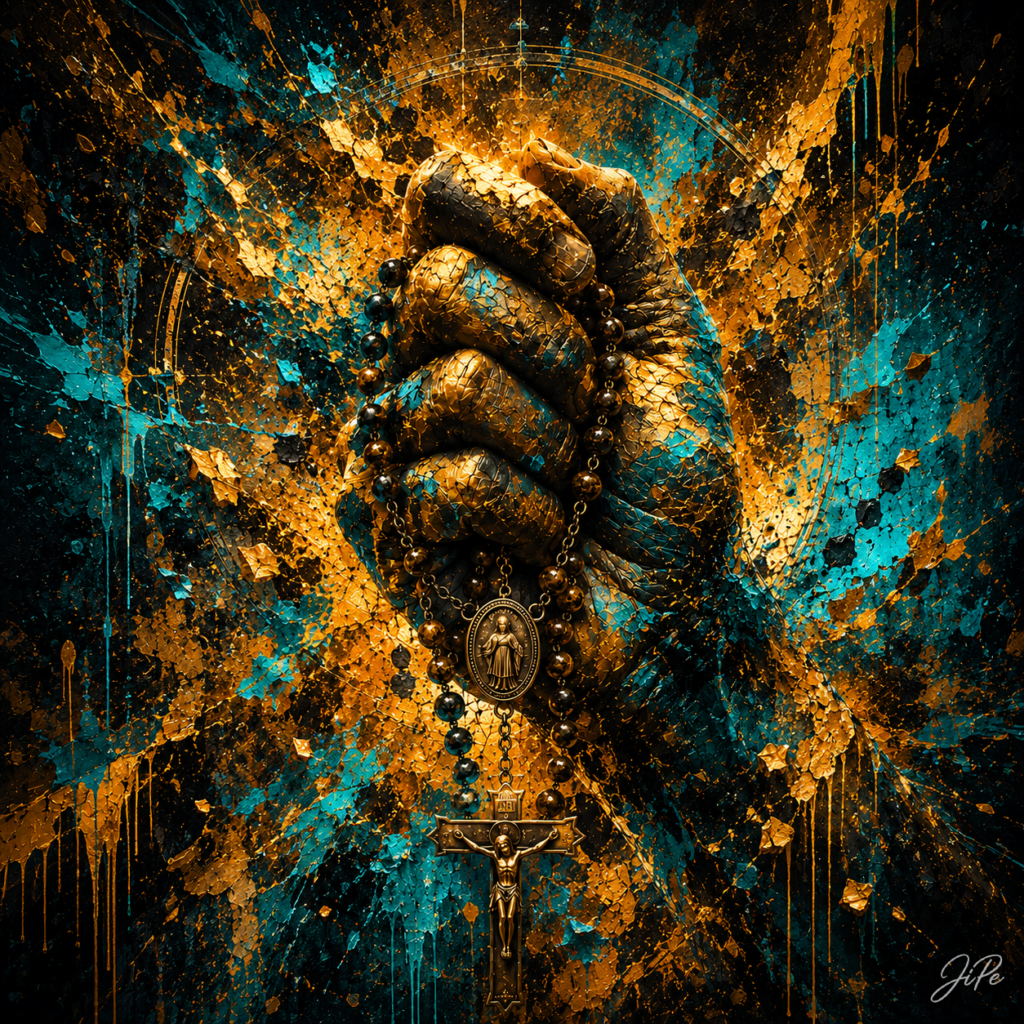
The Prayer That Never Falls Silent is a monumental contemporary meditation on the enduring power of prayer, presenting one of humanity’s most universal spiritual acts through a striking fusion of Christian symbolism, expressive abstraction, and sacred iconography. Rooted in centuries of devotional tradition while articulated through a distinctly modern visual language, the artwork explores prayer not merely as spoken words, but as a continuous dialogue between the human soul and the Divine. It is a work that transcends the boundaries of time, culture, and circumstance, affirming that every sincere prayer becomes part of an eternal conversation that can never be silenced.
At the center of the composition rises a pair of clasped hands, monumental in scale and sculptural in presence. Rendered with extraordinary detail, the hands dominate the visual field as a timeless symbol of humility, faith, surrender, and hope. Their posture recalls one of the oldest gestures in religious devotion—a universal expression that has accompanied humanity through moments of gratitude, suffering, repentance, and contemplation. The artist deliberately enlarges this familiar gesture beyond natural proportion, transforming an intimate act into a monumental statement about the spiritual dignity of prayer itself.
The hands appear weathered, their surface fractured with intricate networks of cracks illuminated by radiant gold. These fissures immediately evoke the philosophy of kintsugi, in which brokenness is not hidden but restored with precious metal, making every fracture an integral part of the object’s beauty and history. Within the theological framework of the artwork, these golden veins symbolize lives shaped by suffering, perseverance, forgiveness, and divine grace. Prayer is presented not as the language of perfection, but as the voice of imperfect humanity reaching toward infinite mercy. Every fracture becomes evidence that healing does not erase wounds but transforms them into places where light enters the soul.
Wrapped delicately around the clasped hands is a rosary whose dark beads descend naturally toward a beautifully rendered crucifix. Positioned at the visual center of the composition, the rosary serves as both devotional object and symbolic pathway. Each bead represents a moment of meditation, a whispered petition, a remembrance, or an act of trust repeated through generations of believers. The crucifix anchors the entire image in the mystery of Christ’s sacrifice, reminding viewers that Christian prayer ultimately finds its deepest meaning through the Cross. The medallion suspended above the crucifix enriches the iconographic program, recalling the communion of saints and the long tradition of intercessory devotion that has shaped Christian spirituality for centuries.
Unlike many traditional depictions of prayer that emphasize quiet intimacy, The Prayer That Never Falls Silent expands the act into a cosmic event. Behind the central figure, an explosion of radiant gold and luminous turquoise erupts across the composition in dynamic waves of color and energy. The abstract background does not function merely as decoration; it becomes a visual manifestation of prayer’s invisible movement. Every brushstroke, fracture, and burst of light suggests that prayer reverberates beyond the limitations of physical space, extending into dimensions that cannot be fully perceived by human senses.
The dramatic contrast between gold and turquoise establishes one of the painting’s most compelling visual dialogues. Gold, deeply associated throughout the history of sacred art with divine presence, eternity, and heavenly glory, symbolizes God’s unchanging faithfulness. Turquoise introduces an atmosphere of living vitality, renewal, contemplation, and spiritual openness. Together these complementary colors create a remarkable balance between transcendence and immediacy, suggesting that prayer simultaneously belongs to heaven and remains deeply rooted within the realities of earthly life.
Subtle concentric circles and geometric forms emerge beneath the painterly textures, evoking sacred geometry and celestial order. These delicate structures imply that prayer participates in a larger harmony woven into the fabric of creation itself. Rather than depicting prayer as isolated or private, the artist presents it as an integral element within the divine architecture of the universe. Every sincere petition becomes part of an eternal rhythm sustained by God’s continual presence.
Light functions as the principal theological language throughout the work. Rather than illuminating the hands from an external source, the golden radiance appears to emanate from within both the hands and the surrounding space. This inward illumination reflects a profound spiritual truth expressed throughout Christian mysticism: authentic prayer transforms the one who prays before it changes external circumstances. The glowing fractures and luminous reflections suggest that grace originates not from human effort but from divine presence dwelling within the heart.
The composition also engages deeply with the tension between permanence and transience. The clasped hands, though monumental, bear visible signs of age and wear. Their cracked surfaces speak of mortality, while the eternal gold flowing through them proclaims the enduring nature of God’s love. The rosary, with its repeating beads, introduces a rhythm that recalls both the passage of time and the timeless repetition of faithful devotion. Prayer, the artwork suggests, bridges these two realities by allowing fleeting human moments to participate in eternity.
Stylistically, The Prayer That Never Falls Silent represents an ambitious synthesis of classical devotional imagery and contemporary abstract expression. The anatomical realism of the hands recalls the careful observational traditions of Renaissance sculpture and Baroque religious painting, while the explosive background embraces the emotional freedom of Abstract Expressionism and modern digital art. Rather than opposing realism and abstraction, the artist allows each to enrich the other. Tangible physical forms anchor the viewer in recognizable experience, while the surrounding abstraction opens the imagination toward invisible spiritual realities.
From an art historical perspective, the work belongs to the enduring tradition of sacred devotional art while significantly expanding its visual vocabulary. Throughout Christian history, artists have depicted prayer through kneeling figures, saints in contemplation, or scenes of biblical revelation. Here, however, narrative is deliberately reduced to its essential gesture. The clasped hands become a universal icon capable of speaking across denominational, cultural, and even religious boundaries. Their silence becomes eloquent, affirming that prayer often communicates most profoundly when words fail.
The title, The Prayer That Never Falls Silent, introduces an important theological dimension. It suggests that genuine prayer does not disappear once spoken but continues to exist within the eternal presence of God. This concept resonates with biblical imagery in which the prayers of the faithful rise like incense before the heavenly throne, as well as with centuries of Christian liturgical tradition affirming that prayer participates in the everlasting worship of heaven. Silence, therefore, is not the absence of prayer but one of its deepest expressions. The artwork proposes that every act of faith, however quiet, continues to echo within eternity.
The composition is carefully balanced around the vertical axis formed by the rosary and crucifix. This central line establishes both visual stability and symbolic orientation, connecting earth to heaven through the language of devotion. The surrounding bursts of color radiate outward in all directions, reinforcing the idea that prayer’s influence extends far beyond the individual believer. Even the smallest act of faith possesses immeasurable spiritual resonance.
Emotionally, The Prayer That Never Falls Silent evokes both intimacy and transcendence. The familiar gesture of clasped hands invites personal reflection, while the monumental scale and luminous atmosphere inspire awe before the mystery of divine communion. The painting neither sentimentalizes prayer nor presents it as effortless. Instead, it acknowledges that authentic prayer often emerges from lives marked by struggle, uncertainty, and longing. Yet within those very realities, it reveals an enduring hope sustained by the unchanging faithfulness of God.
For visitors, theologians, collectors, and art historians alike, the artwork offers multiple avenues of interpretation. It may be encountered as a devotional image rooted in Christian spirituality, as a philosophical reflection on resilience and hope, or as a sophisticated exploration of how contemporary sacred art can communicate ancient truths through modern visual language. Its layered symbolism rewards sustained contemplation, revealing new relationships between color, material, gesture, and theological meaning with every viewing.
Ultimately, The Prayer That Never Falls Silent is a profound affirmation that prayer remains one of humanity’s most enduring acts of faith. Through its masterful integration of sacred symbolism, expressive abstraction, luminous color, and monumental form, the artwork transforms a simple gesture into a timeless vision of spiritual perseverance. It reminds us that every whispered petition, every silent tear, every prayer spoken in joy or despair becomes part of an eternal dialogue with God—a dialogue that transcends time, outlives human frailty, and continues to resound within the infinite silence of divine love.