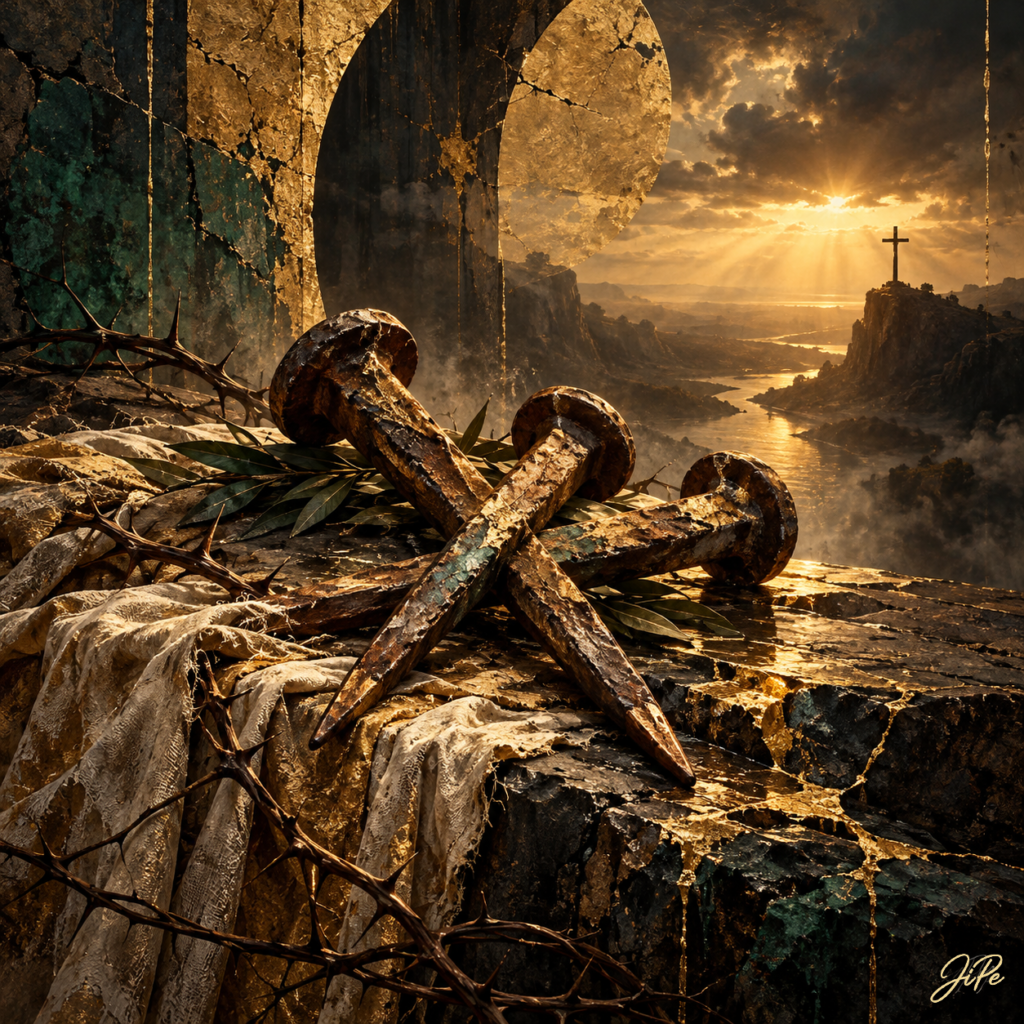
The Nails That Changed Eternity inhabits the fragile threshold between suffering and transcendence, where the weight of a single moment seems to extend beyond the boundaries of time. An atmosphere of profound stillness settles over the composition, yet beneath its silence lies an unresolved intensity, as though something irreversible has occurred and the world has not entirely recovered.
The monumental presence of the foreground stands in quiet opposition to the vast, luminous distance. Between them unfolds a tension of remarkable intimacy and scale: the physical and the infinite, the violence of history and the possibility of something beyond it. Light emerges not as reassurance, but as an enigmatic force, illuminating what remains while withholding any promise of resolution.
There is an unsettling beauty in this coexistence of devastation and radiance. The landscape appears suspended between remembrance and revelation, its immense silence suggesting that absence may possess a presence as powerful as anything tangible. Time itself seems uncertain here, as though the past continues to unfold within an eternal present.
And somewhere between the darkness that endures and the light that refuses to disappear, a question remains: can a moment of profound suffering alter eternity, or does eternity simply reveal what that moment has always contained?