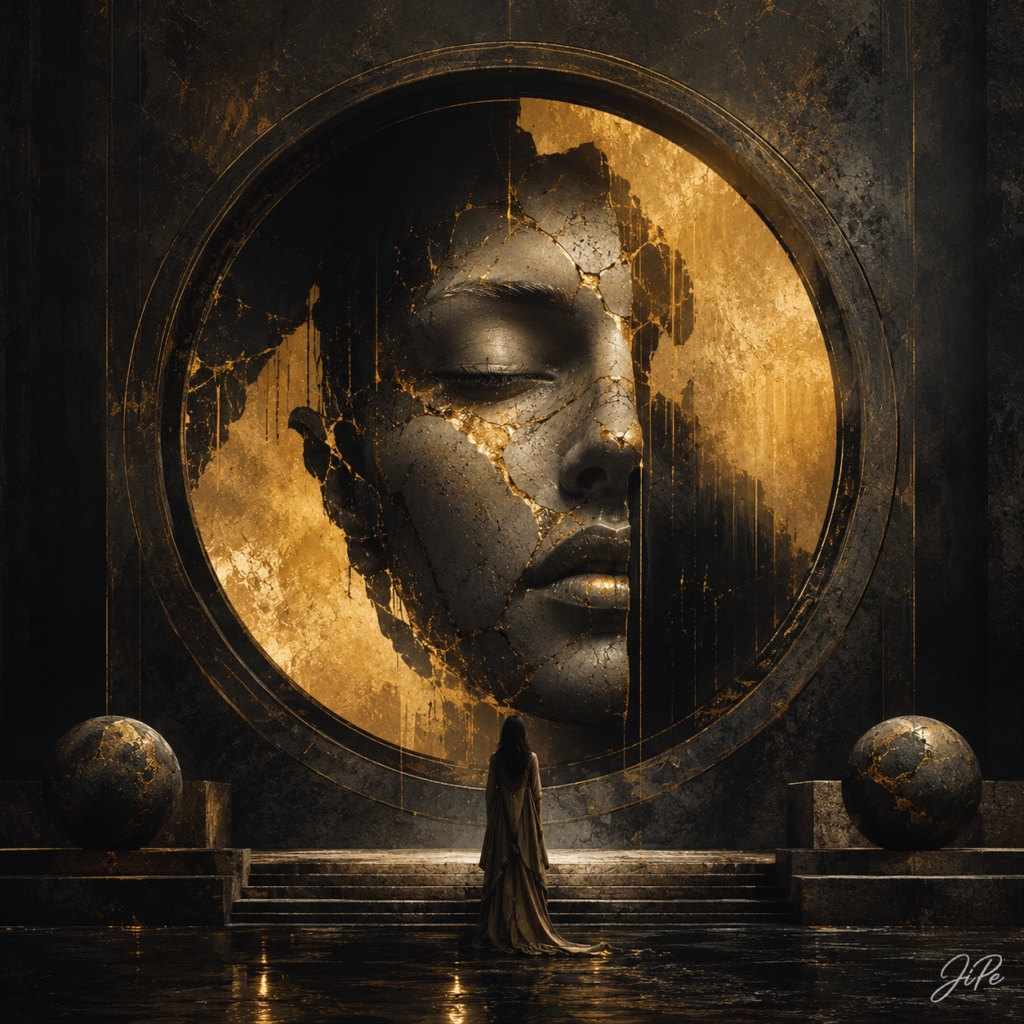
The Memory Within Stone

The Memory Within Stone is a meditation on permanence and impermanence, on the silent dialogue between time and identity, and on the enduring traces that every life leaves behind. In this deeply contemplative work, JiPe transforms stone from a symbol of permanence into a living archive of human experience. The monumental face emerging from darkness is neither portrait nor monument alone—it is memory itself, preserved beneath layers of silence, fractured by time, yet illuminated by an inner light that refuses to disappear.
The painting explores a profound philosophical question: Can anything truly be forgotten? Rather than presenting memory as something fragile or fleeting, JiPe imagines it as something geological—embedded within the very fabric of existence, waiting patiently beneath the surface until it is once again seen.
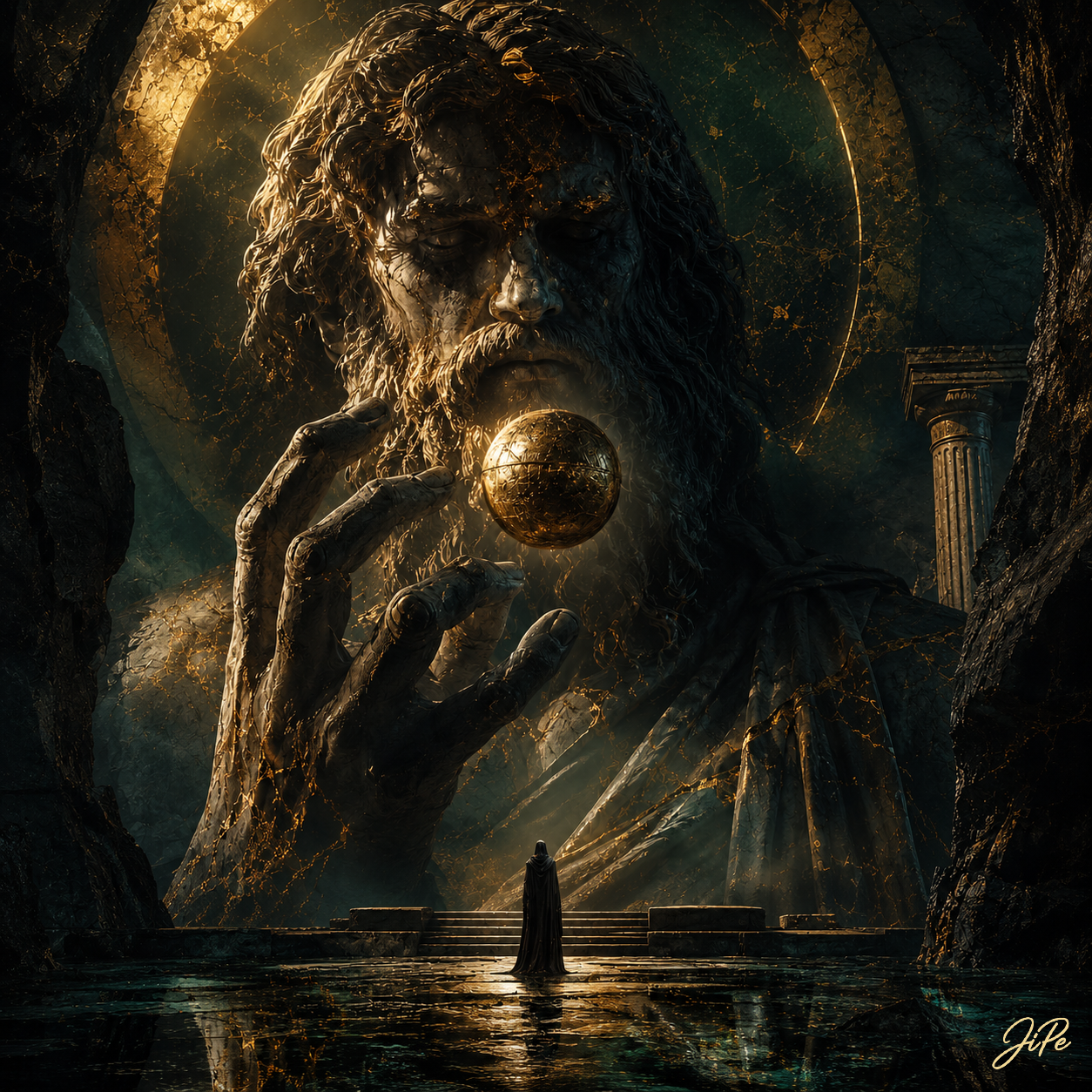
At the heart of the composition stands an immense stone face enclosed within a monumental circular structure that resembles both an ancient portal and an eternal halo. Its eyes remain peacefully closed, suspended somewhere between sleep and awakening, suggesting that remembrance often occurs beyond conscious thought. This is not the face of an individual, but an archetype—a universal human presence carrying the accumulated weight of countless lives, emotions, and experiences.
The title, The Memory Within Stone, immediately establishes the painting’s central metaphor. Stone is traditionally associated with endurance, monuments, temples, and civilizations that outlive generations. Here, however, stone becomes something far more intimate. It functions as a vessel of memory, preserving emotions long after voices have faded and histories have dissolved into myth. The sculpture appears less carved than discovered, as though time itself has slowly revealed what was always hidden beneath its surface.
Standing before this immense visage is a solitary human figure whose scale emphasizes the overwhelming magnitude of the encounter. The relationship between viewer and monument becomes one of humility rather than domination. The figure does not approach as a conqueror or observer but as a seeker entering a sacred space of remembrance.
This encounter forms the emotional centre of the composition. Rather than confronting another person, the solitary traveller appears to stand before a forgotten version of humanity itself. The monument becomes simultaneously external and internal—a mirror reflecting not physical appearance but accumulated consciousness.
One of the painting’s most compelling visual elements is the network of luminous golden fractures running across the stone face. Inspired by the philosophy of kintsugi, these radiant veins transform brokenness into beauty. Yet JiPe extends the symbolism beyond restoration. Each fracture resembles a pathway through memory, suggesting that the deepest truths are often revealed precisely where life has left its marks.
Rather than concealing damage, the gold celebrates it. The cracks become illuminated records of survival, growth, and transformation. Every fracture contains history. Every repaired surface speaks of endurance rather than loss. Within JiPe’s visual language, perfection is never synonymous with wholeness. True completeness emerges through the integration of experience.
Light plays an equally essential symbolic role. Warm golden illumination radiates from behind the monumental face, dissolving the boundary between stone and spirit. The source of the light remains partially concealed, implying that enlightenment itself often originates beyond immediate perception. Darkness surrounds the composition without ever overpowering it. Instead, shadow becomes a necessary counterpart that allows light to acquire emotional depth.
The circular architecture surrounding the portrait introduces another recurring motif throughout JiPe’s artistic practice. The circle functions simultaneously as halo, portal, cycle, eternity, and the uninterrupted continuity of existence. Unlike traditional architectural framing, this monumental ring suggests that memory itself is cyclical rather than linear. Every ending contains a beginning; every forgotten experience remains connected to the whole.
The restrained architectural environment contributes significantly to the painting’s psychological atmosphere. Monumental walls rise without ornament, stripped of unnecessary detail until they become almost metaphysical spaces. Their silence encourages contemplation. Rather than locating the viewer within a recognizable historical period, JiPe creates an environment that exists outside conventional time, where ancient civilizations and future possibilities converge.
Two weathered stone spheres rest on either side of the composition, reinforcing the work’s underlying themes of balance, continuity, and cosmic order. Their placement creates visual equilibrium while subtly evoking celestial bodies, suggesting that human memory participates within larger universal rhythms extending far beyond individual existence.
The colour palette demonstrates remarkable discipline. Deep charcoal blacks, muted stone greys, warm ochres, and luminous gold dominate the composition, producing an atmosphere of solemn grandeur. Gold is never employed merely for decorative effect. Instead, it functions symbolically as the visible manifestation of consciousness itself—illumination breaking through material existence.
This restrained chromatic harmony allows emotional intensity to emerge through tonal relationships rather than excessive contrast. Darkness envelops the monument without diminishing it, while every illuminated surface acquires extraordinary significance. The result is a visual language of quiet power rather than dramatic spectacle.
Equally important is JiPe’s extraordinary attention to texture. The weathered stone surfaces possess remarkable tactile presence. Cracked plaster, layered painterly brushwork, distressed mixed-media effects, and metallic gold leaf textures combine to create the impression that the monument has endured centuries of exposure while remaining spiritually untouched. The painting feels simultaneously ancient and contemporary, archaeological and visionary.
This material richness reinforces the conceptual foundation of the work. Time does not merely pass across the monument—it becomes physically embedded within it. Every weathered surface appears to contain forgotten narratives waiting to be rediscovered.
Art historically, The Memory Within Stone occupies a compelling dialogue with Symbolism, Romanticism, Surrealism, and contemporary visionary art. The monumental face recalls the symbolic portraits of late nineteenth-century Symbolist painters, while its architectural integration evokes ancient sacred sculpture and timeless religious iconography. Yet JiPe avoids direct historical quotation, instead synthesizing these influences into an unmistakably contemporary visual language distinguished by cinematic scale, psychological symbolism, and refined painterly realism.
Philosophically, the painting resonates with enduring questions concerning collective memory, cultural inheritance, and the persistence of human consciousness. The silent face may be understood as the embodiment of civilization itself—a repository of accumulated knowledge that survives the rise and fall of empires. Equally, it may represent the unconscious mind, where experiences remain preserved long after conscious recollection has faded.
The closed eyes become particularly significant within this interpretation. Vision is turned inward rather than outward. The monument does not observe the external world; it remembers an internal one. JiPe suggests that the deepest forms of knowledge arise not through observation alone but through introspection, contemplation, and quiet remembrance.
The solitary figure standing before the monument therefore becomes every viewer who has ever paused before history, memory, or the unknown. The painting invites us to ask not simply what we remember, but what continues to remember us. Are memories possessions that we carry, or are they living structures that quietly shape us long after we believe they have disappeared?
Within JiPe’s broader artistic practice, The Memory Within Stone represents one of his most distilled explorations of silence and permanence. While many of his visionary compositions depict vast celestial landscapes, mythological journeys, or monumental architectural spaces, this work achieves extraordinary emotional resonance through restraint. Its power lies not in spectacle but in stillness.
Ultimately, The Memory Within Stone proposes that nothing essential is ever truly lost. Beneath every fracture, beneath every forgotten chapter, beneath every weathered surface, something remains intact. Memory is not erased by time—it is transformed by it. Like stone shaped by countless seasons, the human soul bears the marks of every experience while preserving an inner essence that endures beyond change.
Standing before this remarkable work, viewers may gradually recognize that the monumental face is neither an ancient statue nor an anonymous figure from another age. It is the timeless image of humanity itself—scarred, illuminated, silent, and enduring. JiPe reminds us that while civilizations rise and disappear, while lives begin and end, memory continues to exist beneath the surface of existence like veins of hidden gold waiting patiently to be rediscovered. In that quiet revelation, The Memory Within Stone becomes not only a meditation on history, but a profound reflection on the enduring resilience of the human spirit.