Awakened by Eternity

Some works of art seek to portray a moment. Others attempt to tell a story. Awakened by Eternity belongs to a rarer category of contemporary visionary art—one that explores the threshold where human existence encounters something immeasurably greater than itself. Rather than depicting a literal event, the work presents an inner revelation: the instant in which mortality stands before eternity and discovers that what once appeared impossible has always been waiting beyond the horizon of perception.
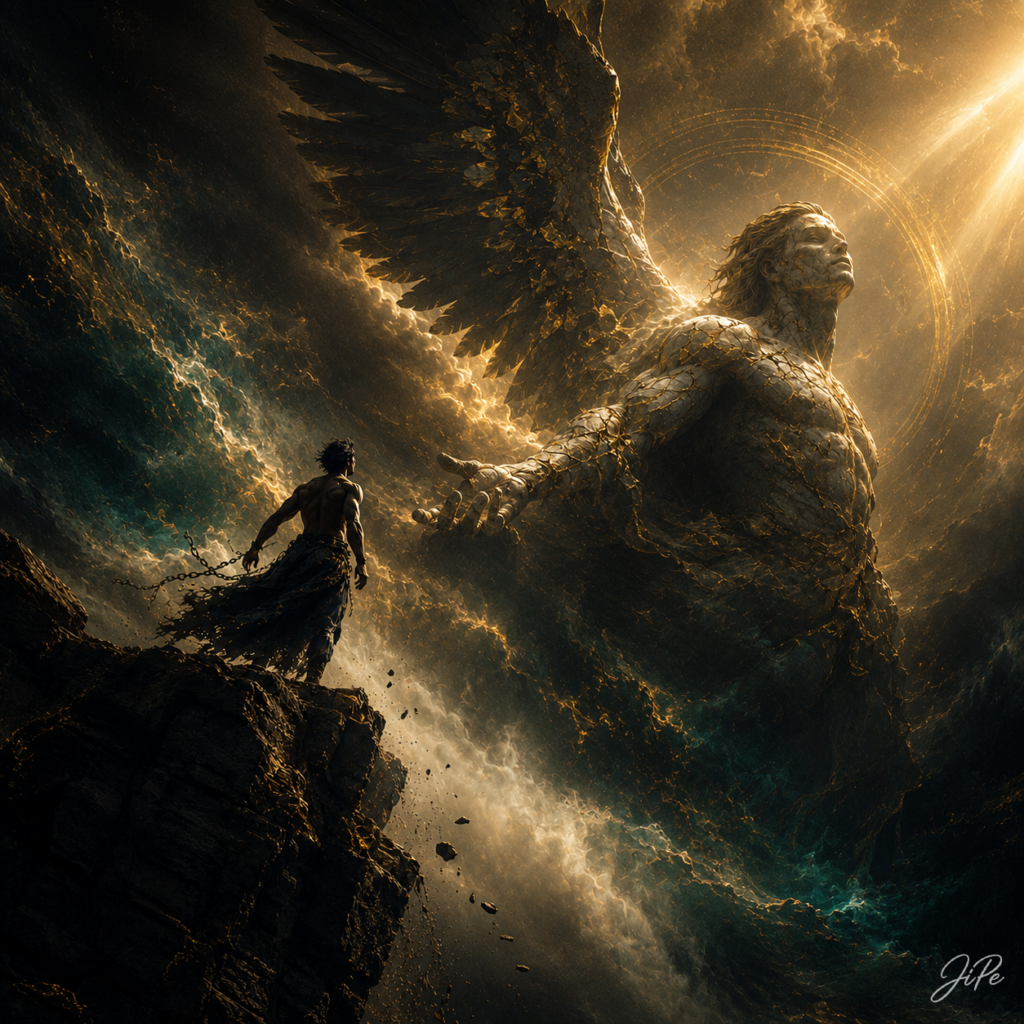
The composition unfolds on a monumental scale. A solitary human figure stands upon the edge of a fractured precipice, his body still carrying the weight of earthly struggle. Broken chains trail behind him, subtle yet unmistakable symbols of liberation from limitation, fear, and inherited burdens. Before him rises a colossal winged being whose immense stone-like form appears to emerge directly from the fabric of the cosmos. The giant is neither entirely statue nor entirely living presence. It exists between permanence and awakening, suggesting that eternity itself has taken form for a fleeting moment in order to meet the human soul.
The relationship between these two figures forms the emotional and philosophical centre of the painting. Their difference in scale is overwhelming, yet their encounter remains profoundly intimate. The extended hand of the celestial figure is not presented as an act of domination, but of invitation. The human figure is not kneeling in submission; instead, he stands upright, suspended between hesitation and transcendence. The space between their hands becomes the true subject of the work—a symbolic distance separating finite existence from infinite possibility.
Throughout the composition, light functions as far more than illumination. A radiant celestial source breaks through the darkness, enveloping the monumental figure in luminous gold while simultaneously reaching toward the solitary traveller. The light is not directional in the traditional painterly sense; it behaves almost as a living substance, flowing through clouds, dissolving darkness, and revealing hidden forms. It becomes a metaphor for consciousness itself—an invisible force capable of transforming perception without altering reality.
The artist’s characteristic use of fractured textures and kintsugi-inspired golden fissures plays a vital symbolic role. The monumental figure appears constructed from weathered stone whose countless cracks shimmer with gold, suggesting that perfection is not born from flawlessness but through endurance. The celestial being is ancient, scarred, and yet immeasurably radiant. Its fractured surface becomes a visual philosophy, proposing that wisdom accumulates not despite suffering, but because of it. Every golden vein speaks of time, memory, sacrifice, and renewal.
The sweeping black wings dominate much of the composition, introducing a striking tension between shadow and radiance. Rather than representing darkness as evil, the work presents it as an essential counterpart to light. One wing absorbs the surrounding atmosphere into profound shadow while the golden heavens illuminate the opposite side. This duality recalls ancient philosophical traditions in which creation emerges not through opposition alone but through balance. Light gains meaning because darkness exists to reveal it.
The surrounding landscape further reinforces the painting’s symbolic language. Jagged cliffs, turbulent seas, and immense skies evoke the timeless imagery of mythological journeys, recalling both sacred pilgrimage and the psychological ascent toward self-realisation. Nature here is not merely scenery but an extension of consciousness. The storm does not threaten the traveller—it reflects the inner transformation taking place within him. Every wave, cloud, and fragment of stone participates in the same cosmic dialogue.
Circular geometric forms surrounding the celestial figure introduce another recurring motif within the artist’s visual language. These luminous rings echo sacred geometry, astronomical diagrams, and ancient cosmological maps. They quietly imply that the universe possesses an underlying order beyond immediate human understanding. Their presence transforms the encounter from an isolated miracle into part of an eternal cosmic rhythm where time, space, and spirit converge.
The restrained colour palette of deep charcoal, weathered stone, luminous gold, and subtle turquoise creates extraordinary visual cohesion. Gold becomes more than decoration; it functions as the symbolic language of transcendence. Meanwhile, the rare emergence of cool turquoise within the surrounding darkness introduces emotional depth, suggesting mystery, infinity, and the unknown realms lying beyond visible existence. The contrast between these tones produces a cinematic atmosphere while maintaining the timeless quality associated with classical monumental painting.
Art historically, Awakened by Eternity resonates with the spiritual ambitions of Symbolism while embracing the expressive materiality of contemporary mixed-media aesthetics. Echoes of Romantic landscape painting, Renaissance monumentality, and mythological narrative can all be sensed beneath its surface, yet the work remains unmistakably contemporary. Rather than quoting historical traditions, it transforms them into a new visual language where digital craftsmanship, painterly texture, and symbolic storytelling merge seamlessly.
Psychologically, the work speaks to one of humanity’s oldest experiences: the moment when an individual realises that the greatest transformation begins not through external conquest, but through inner awakening. The broken chains suggest liberation from limiting identities. The immense celestial presence embodies a higher dimension of the self as much as a divine encounter. The painting intentionally refuses to define whether the giant is angel, guardian, memory, or awakened consciousness. Its ambiguity allows each viewer to project personal meaning into the encounter.
This openness is one of the painting’s greatest strengths. Rather than prescribing interpretation, it invites contemplation. Some viewers may recognise themes of redemption, others the courage to embrace destiny, while still others may see the reconciliation between humanity and the eternal. The work succeeds precisely because it leaves space for individual reflection while maintaining a powerful emotional coherence.
Ultimately, Awakened by Eternity is a meditation on transcendence—not as an escape from the human condition, but as its fulfilment. It suggests that eternity is not something that begins after life, but something that quietly exists within every decisive moment of courage, faith, surrender, and transformation. The colossal figure does not awaken the traveller by force; rather, it reveals what has always been present beneath fear and limitation.
The painting reminds us that the greatest journeys are never measured by the distance we travel, but by the depth with which we awaken. In that silent encounter between the finite and the infinite, Awakened by Eternity becomes more than an image—it becomes an invitation to stand at the threshold of the unknown and recognise that eternity has been reaching toward us all along.