The Keeper of Eternal Time

The Keeper of Eternal Time is a monumental meditation on time, memory, and transcendence. It does not portray time as a sequence of measurable moments but as a living, sacred force that shapes every existence while remaining forever beyond human possession. Suspended between mythology and dream, the painting presents an imagined universe where time itself becomes a guardian rather than an adversary—a silent witness to creation, transformation, and eternity.
Rather than depicting chronological history, the work visualizes the timeless dialogue between mortality and the infinite. Every symbolic element contributes to a philosophical narrative in which human consciousness stands not against time, but within its vast and eternal embrace.
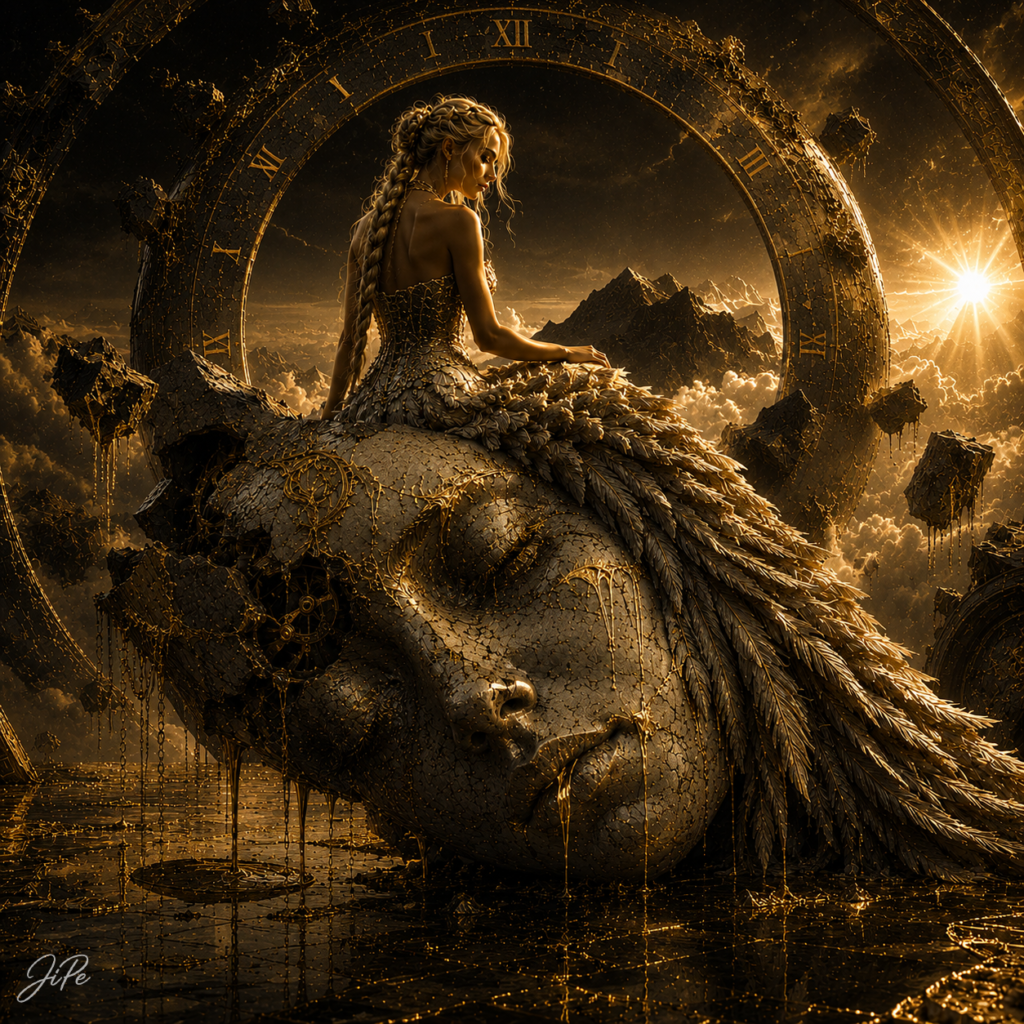
At the heart of the composition rests an immense sculptural face, partially submerged in reflective water and fractured by the passage of ages. The monumental head appears neither asleep nor lifeless. Instead, it exists in a profound state of contemplation, suspended somewhere between memory and awakening. Its weathered surface, marked by delicate golden fissures, recalls ancient stone monuments worn by centuries, yet simultaneously infused with new life through luminous veins of gold.
The face becomes more than a sculpture.
It becomes the embodiment of time itself.
Silent.
Patient.
Endless.
Resting upon this colossal monument sits a solitary woman dressed in an extraordinary gown composed of layered feathers, flowing organically across the sculpture like living architecture. Her posture is calm and introspective. She neither dominates nor mourns the fallen monument beneath her. Instead, she appears entrusted with its guardianship, as though she alone understands the language spoken by forgotten centuries.
She is not a ruler of time.
She is its keeper.
Its witness.
Its faithful companion.
The contrast between the monumental face and the graceful human figure establishes one of the painting’s central themes. Humanity exists only briefly within history, yet consciousness possesses the remarkable ability to contemplate eternity. The woman becomes a bridge between these two realities—a mortal presence entrusted with something infinitely older than herself.
Surrounding the central figures rise immense circular structures resembling celestial clocks, monumental portals, and cosmic astrolabes. Roman numerals encircle these vast rings, immediately evoking humanity’s oldest attempts to measure time. Yet here these clocks have expanded beyond ordinary function. They no longer measure hours or years.
They measure existence itself.
The circles become symbols of eternity rather than chronology. Without visible hands or mechanical movement, they suggest that true time is cyclical rather than linear. Birth, death, memory, transformation, and renewal exist not as isolated events but as interconnected rhythms within an infinite cosmic order.
The recurring circular geometry reinforces this idea throughout the composition. Every ring echoes the celestial movements of planets, the cycles of seasons, the beating of the heart, and the endless repetition through which life continually recreates itself.
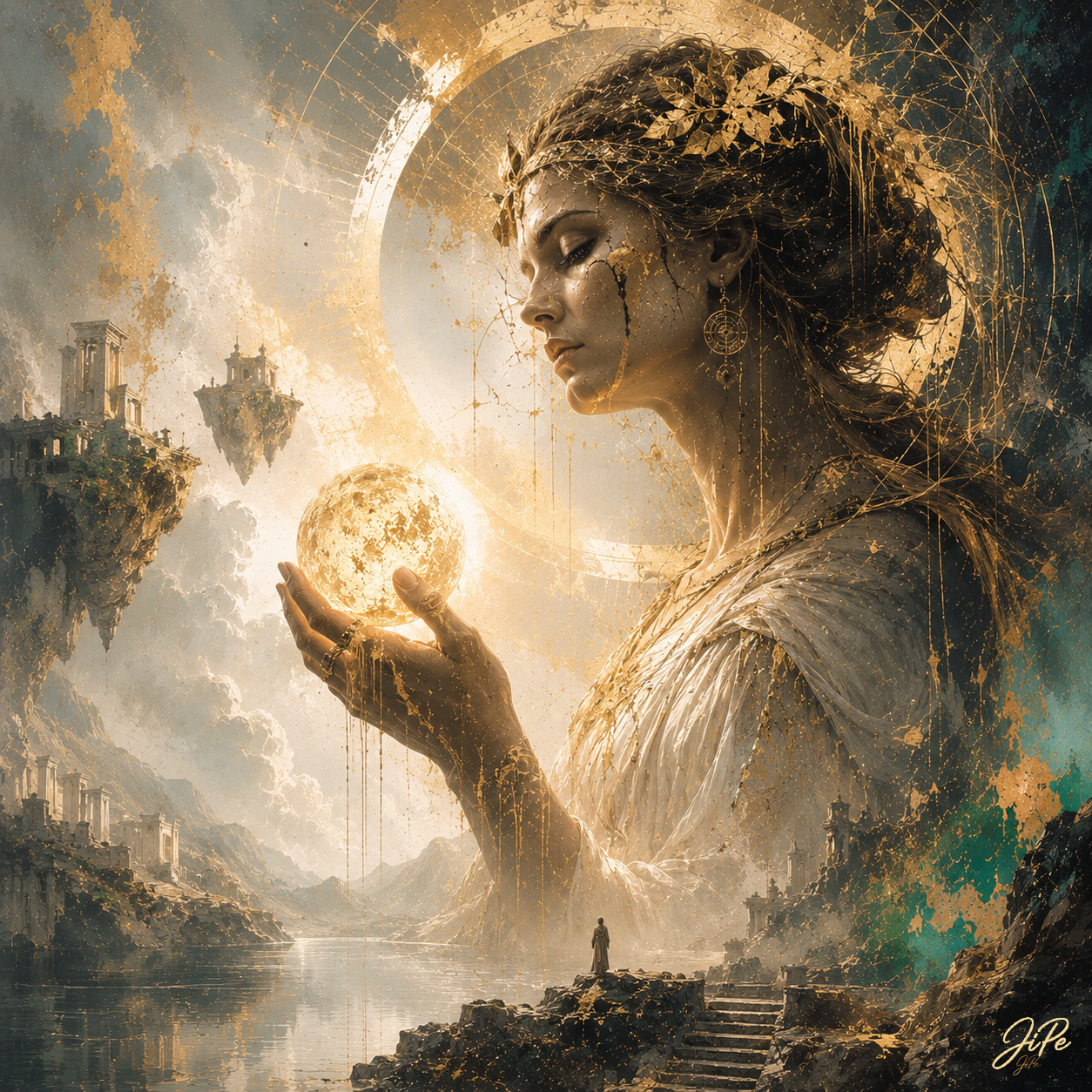
Gold dominates the painting with extraordinary presence. Rather than functioning merely as decorative brilliance, it becomes the visual language of permanence. Golden rivers flow across fractured stone, delicate metallic threads unite broken surfaces, and luminous reflections spread across the water beneath the sculpture.
This luminous treatment recalls the philosophy of kintsugi, where broken objects are restored with gold, transforming damage into beauty rather than concealing it. In The Keeper of Eternal Time, however, this symbolism reaches a cosmic scale.
Time does not erase fractures.
It reveals their meaning.
Gold becomes the visible memory of every transformation the monument has endured. Each crack represents not decay but accumulated experience. The sculpture grows more beautiful because it has survived.
Floating throughout the heavens are fragmented islands of stone, suspended impossibly within luminous clouds. Some appear like remnants of forgotten civilizations, while others resemble celestial ruins drifting beyond gravity itself.
These floating structures evoke abandoned empires, vanished cultures, and forgotten histories. Yet rather than suggesting loss, they imply continuity. Nothing truly disappears.
Everything remains.
Only transformed by time into another form.
The expansive landscape beneath the monument contributes another essential symbolic dimension. Calm reflective water mirrors both sculpture and sky, dissolving the distinction between above and below. Reflection becomes memory made visible—a reminder that every moment continues to exist within consciousness long after physical events have passed.
The still water also creates remarkable emotional balance. Despite the monumental scale of the composition, the atmosphere remains deeply peaceful. There is no violence within the destruction.
Only acceptance.
Only continuity.
Perhaps the most remarkable symbolic relationship within the painting exists between the living woman and the ancient monument. One represents impermanence, the other endurance. Yet rather than opposing one another, they exist in perfect harmony.
This relationship suggests that humanity’s true significance lies not in overcoming time but in learning to exist gracefully within it. The woman does not attempt to restore the broken monument.
She honors it.
She understands that beauty and history are inseparable.
Her magnificent feathered gown further deepens the symbolism. Feathers have long represented transcendence, freedom, wisdom, and spiritual ascent across numerous cultures. Here they cascade over the ancient sculpture like flowing time itself—soft, organic, and constantly moving despite the stillness of stone.
The contrast between feather and rock becomes another meditation on permanence and change.
Stone preserves.
Feathers transform.
Together they create harmony.
From an art historical perspective, The Keeper of Eternal Time synthesizes elements drawn from Symbolism, Romanticism, Surrealism, and contemporary visionary art. Monumental sculptural forms recall ancient civilizations while the celestial clocks introduce metaphysical symbolism reminiscent of Renaissance cosmology and sacred geometry. The dreamlike spatial relationships transcend naturalism entirely, placing the work within the tradition of visionary symbolic painting rather than conventional figurative representation.
The painting also resonates psychologically. The colossal face may be understood as the collective unconscious—the accumulated memory of humanity itself. The seated woman becomes conscious awareness contemplating the immense inheritance carried by every individual. The surrounding clocks symbolize the countless attempts to understand mortality through systems of measurement that ultimately prove inadequate before eternity.
Time cannot truly be possessed.
It can only be witnessed.
The title, The Keeper of Eternal Time, beautifully encapsulates this philosophical vision. Time itself requires no guardian. Instead, the keeper safeguards humanity’s relationship with eternity. She preserves memory, honors transformation, and reminds us that every fleeting human life participates in something infinitely larger than itself.
The work therefore invites viewers to reconsider their own understanding of time. Rather than experiencing it as an enemy steadily carrying life away, the painting proposes a more profound perspective. Time becomes the medium through which wisdom, compassion, resilience, and beauty are formed.
Without time, nothing matures.
Without change, nothing becomes sacred.
Without endings, eternity could never be imagined.
Perhaps the greatest achievement of The Keeper of Eternal Time lies in its extraordinary atmosphere of contemplative silence. Despite the cosmic scale, monumental symbolism, and architectural grandeur, the painting never overwhelms. Instead, it slows perception. It invites viewers to pause, breathe, and experience time differently—not as urgency, but as presence.
The sculpture sleeps.
The woman watches.
The clocks remain still.
And within that profound stillness, the viewer begins to sense a deeper rhythm beyond minutes, years, and centuries.
Ultimately, The Keeper of Eternal Time is not about the passage of time but about what endures through it. It is a reflection on memory, resilience, and the eternal dialogue between the finite human experience and the infinite universe. Through its masterful use of monumental symbolism, luminous gold, visionary architecture, and poetic stillness, the work reminds us that eternity is not simply the absence of time.
It is the moment when time itself becomes transparent, revealing the enduring essence that has always existed beneath its passing surface.
In that revelation, the keeper is not merely a figure within the painting.
She becomes a mirror for the viewer—quietly asking whether we measure our lives by the hours that disappear, or by the moments that remain forever.