Monumental Visionary Fine Art exploring mythology, consciousness, sacred light, and timeless visual storytelling.

Monumental Visionary Fine Art exploring mythology, consciousness, sacred light, and timeless visual storytelling.

Surreal Paintings

The Hand That Carries the World

The Hand That Carries the World

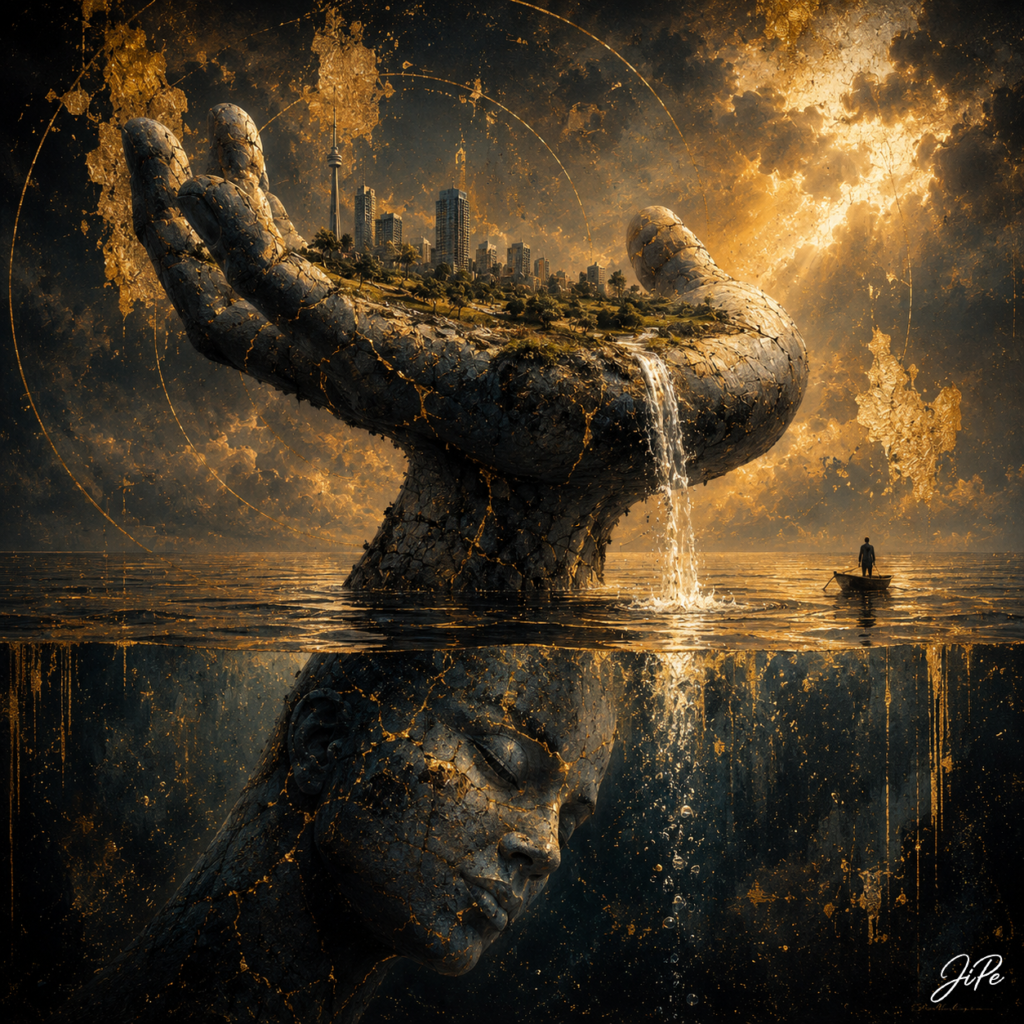
The Hand That Carries the World is a monumental allegory of stewardship, responsibility, and the delicate balance between human civilisation and the greater forces that sustain it. Situated at the intersection of contemporary symbolic art, visionary realism, and philosophical landscape painting, the work transforms an impossible scene into a timeless meditation on humanity’s place within creation. Through its striking juxtaposition of monumental stone sculpture, fragile urban life, and the hidden face beneath the water, the painting explores one of the defining questions of our age: what unseen forces uphold the world we have built, and what responsibility do we bear toward them?

Rather than depicting a literal narrative, the composition unfolds as a visual philosophy. Every element functions simultaneously as landscape and metaphor, inviting viewers to move beyond observation into reflection. The work suggests that civilisation is not self-sustaining, but rests upon foundations that remain largely invisible—whether those foundations are nature, memory, spirituality, sacrifice, or the silent endurance of time itself.

At the heart of the composition rises an immense stone hand emerging from the sea. Its weathered surface bears the scars of centuries, marked by fractures, erosion, and veins of luminous gold that appear to heal rather than conceal its imperfections. Unlike a clenched fist, this hand is open, steady, and gentle. It neither dominates nor possesses. Instead, it supports.

Balanced upon its palm rests an entire landscape containing forests, flowing water, and a modern city skyline. Towering buildings rise confidently toward the heavens, symbols of innovation, ambition, and human achievement. Yet their apparent permanence is immediately challenged by the scale of the hand beneath them. The city becomes unexpectedly fragile—a miniature civilisation resting upon an ancient force vastly greater than itself.

The title, The Hand That Carries the World, deliberately expands the meaning of ”world.” The world represented here is not merely the physical planet but the totality of human existence: our societies, our dreams, our cultures, and our shared future. The hand may be interpreted as the hand of creation, nature, time, compassion, or even collective humanity itself. By refusing to define its identity explicitly, the painting transcends religious and cultural boundaries, allowing every viewer to bring their own philosophical understanding to the work.

Perhaps the most profound revelation occurs below the waterline. Beneath the surface lies the immense face of a sleeping figure, partially submerged in darkness yet illuminated by subtle golden fractures that echo those found upon the hand above. This hidden presence fundamentally transforms the meaning of the composition. The hand is no longer an isolated monument but part of an unseen being whose existence extends beyond visible reality.

The sleeping face introduces a powerful meditation on the invisible foundations of civilisation. Every society depends upon structures that often remain unnoticed: generations who came before us, ecosystems that sustain life, forgotten wisdom, quiet sacrifice, and the natural world itself. The submerged figure becomes a metaphor for everything humanity relies upon without fully acknowledging. It reminds us that visible achievement always rests upon hidden depth.

Its closed eyes are particularly significant. The figure does not watch over the city through authority or surveillance. Instead, it supports through quiet endurance. This absence of direct intervention distinguishes the work from traditional depictions of divine power. Rather than commanding humanity, the figure simply bears its weight with patience. Its silence becomes an expression of unconditional generosity.

The waterfall cascading from the edge of the hand further reinforces this symbolism. Emerging from the elevated landscape above, the water flows naturally into the surrounding sea, visually connecting civilisation with the greater cycles of nature. It suggests that nothing exists independently; all creation participates in continuous exchange. Water becomes a symbol of renewal, memory, and continuity, reminding viewers that every act of consumption must ultimately return to its source.

The lone figure standing within a small boat introduces another crucial narrative layer. Positioned near the monumental hand yet separated from it by water, this individual appears almost insignificant within the vast composition. However, the traveller also serves as the emotional anchor of the painting. Unlike the sleeping colossus or the distant city, this figure occupies the human scale. They become our representative—an observer confronting truths that extend far beyond ordinary perception.

The boat itself carries rich symbolic meaning. Throughout mythology, literature, and religious tradition, boats have represented transition, pilgrimage, discovery, and the passage between worlds. Here the vessel occupies a threshold between visible civilisation and invisible reality. The traveller neither approaches the city nor the submerged face directly, but remains suspended between them, suggesting humanity’s uncertain position within the larger order of existence.

Compositionally, the painting demonstrates extraordinary sophistication. The sweeping arc of the monumental hand naturally guides the viewer’s eye upward toward the city before the waterfall redirects attention downward toward the submerged face. This elegant circular movement encourages continuous visual exploration while reinforcing the conceptual relationship between surface and depth, achievement and foundation, consciousness and memory.

The vertical axis created by the waterfall becomes particularly significant. It visually unites the city, the supporting hand, the sea, and the sleeping figure into one uninterrupted symbolic system. Nothing exists independently; every element participates within a greater whole. This compositional unity reflects the painting’s philosophical message that all forms of existence remain fundamentally interconnected.

Light functions throughout the work as its primary symbolic language. The dramatic sky glows with radiant golden illumination that breaks through turbulent cloud formations, bathing the scene in warm celestial light. Rather than serving purely atmospheric purposes, this illumination suggests revelation. It is not simply sunlight but a metaphor for awareness itself. Gold flows across stone, clouds, water, and architecture, dissolving traditional distinctions between the material and the spiritual.

The restrained palette of charcoal blacks, weathered greys, luminous ochres, and radiant gold creates remarkable emotional cohesion. Gold recalls centuries of sacred artistic tradition—from Byzantine mosaics and Gothic altarpieces to Japanese kintsugi—where precious metal symbolises transcendence, healing, and incorruptibility. Here the golden fractures running through the stone suggest that true strength does not arise despite imperfection but because of it. The visible cracks become evidence of endurance rather than weakness.

Materiality further enriches the painting’s conceptual depth. Thick painterly textures evoke carved stone, weathered sculpture, cracked earth, and ancient frescoes simultaneously. The surface appears shaped by immense geological time, lending the monumental forms an extraordinary sense of permanence. Yet the city above remains unmistakably contemporary, creating a compelling dialogue between civilisation’s fleeting achievements and the timeless forces upon which they depend.

Art historically, The Hand That Carries the World synthesises diverse visual traditions into a singular contemporary language. The monumental symbolism recalls the visionary architecture of Romanticism and Symbolism, while its philosophical use of landscape echoes painters such as Caspar David Friedrich. Simultaneously, the cinematic scale, richly textured surfaces, and surreal juxtapositions firmly position the work within contemporary visionary realism, where impossible imagery becomes a vehicle for profound psychological and existential inquiry.

The painting also engages with environmental and ethical questions without becoming overtly political. The modern skyline resting gently upon an ancient stone hand raises subtle questions about stewardship rather than ownership. Are we masters of the world, or merely temporary custodians? Does civilisation stand independently, or is it continuously supported by systems beyond our control? Rather than offering simple answers, the artwork invites sustained contemplation.

Psychologically, the composition may also be interpreted as an image of the human condition itself. The city represents conscious identity—the visible achievements through which individuals define themselves. The submerged face symbolises the unconscious, carrying memories, emotions, and deeper truths that remain largely hidden. The supporting hand becomes the integrating force that allows both dimensions to coexist. In this reading, the painting explores not only civilisation but the architecture of the human mind.

Despite its monumental scale, the work ultimately conveys remarkable tenderness. Nothing appears violent or threatening. The hand supports rather than grasps. The sleeping figure rests rather than commands. Even the dramatic sky radiates hope rather than catastrophe. The painting proposes that the greatest forms of strength are quiet, patient, and sustaining. Creation is presented not as domination but as continual care.

Ultimately, The Hand That Carries the World is a profound reflection on humanity’s dependence upon forces that often remain unseen. It reminds us that every city, every civilisation, and every individual life rests upon foundations extending far deeper than immediate perception. Nature, memory, compassion, time, and collective human experience become the invisible architecture supporting the visible world.

Standing before this work, viewers are invited to reconsider their relationship with existence itself. The monumental hand asks not who rules the world, but what truly carries it. In answering that question, the painting gently suggests that the greatest powers are often the quietest—those that ask for nothing in return, yet continue, generation after generation, to uphold everything we call our own.

Lämna ett svar