
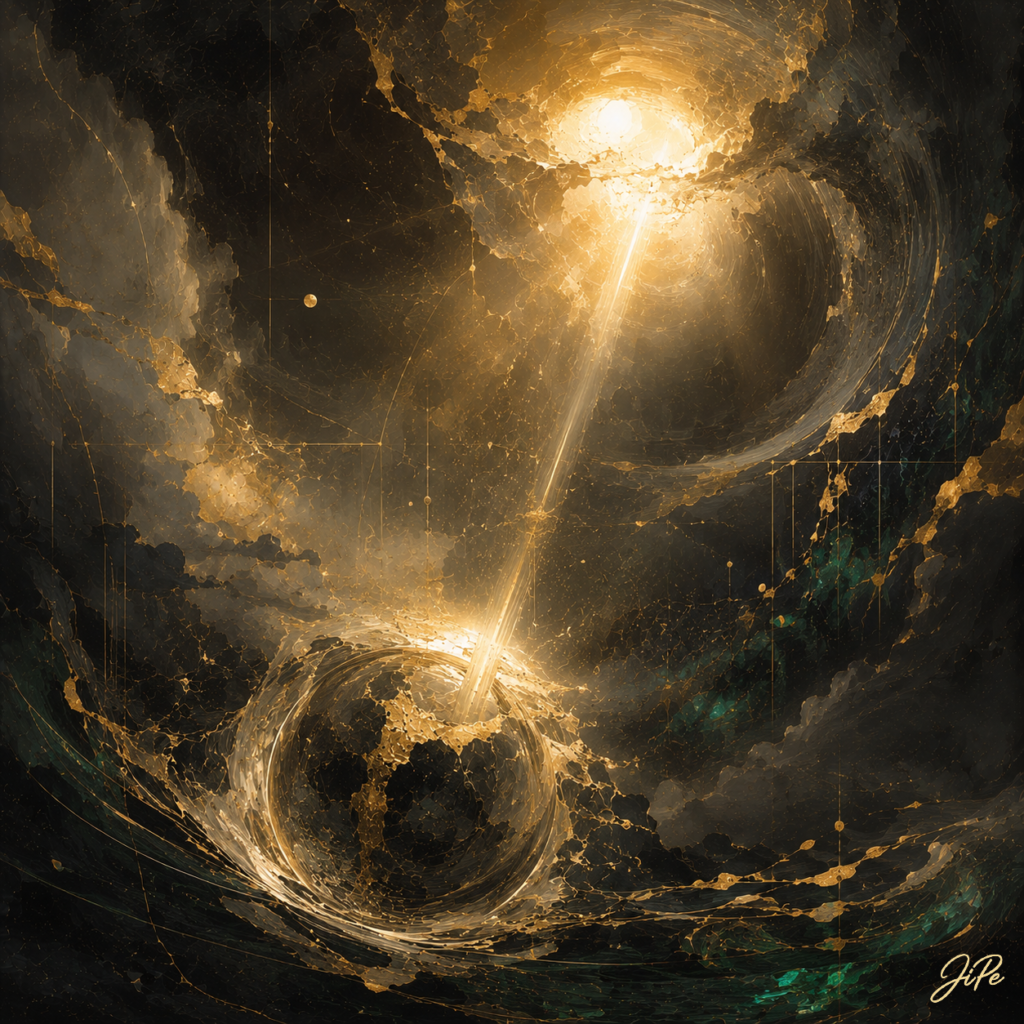
The Gravity of Light unfolds within an immense, uncharted darkness, where distance and time seem momentarily suspended. A luminous connection stretches across the vastness, establishing a fragile relationship between forces that might otherwise remain eternally apart. The surrounding space possesses an almost overwhelming depth, yet the composition is held in a state of remarkable stillness, as though an invisible equilibrium has interrupted the natural course of events.
Light assumes an unexpected weight, becoming something that draws, binds, and perhaps even burdens what it touches. Its radiance carries a quiet intensity, suggesting an exchange whose origins and consequences remain concealed. Between the distant points of illumination lies a tension that feels both cosmic and profoundly intimate, recalling the invisible attachments through which separate existences may become inseparable.
The title introduces a subtle contradiction: that which appears weightless may exert the deepest influence. Within this uncertainty, attraction and dependence become difficult to distinguish. The darkness is not merely an absence surrounding the luminous presence, but an essential part of the relationship, preserving the distance through which connection acquires its significance.
There is something almost melancholic in this suspended encounter, a sense that proximity may never entirely overcome separation. Perhaps the true gravity of light resides not in its power to illuminate, but in its capacity to hold distant things together without ever allowing them to meet.