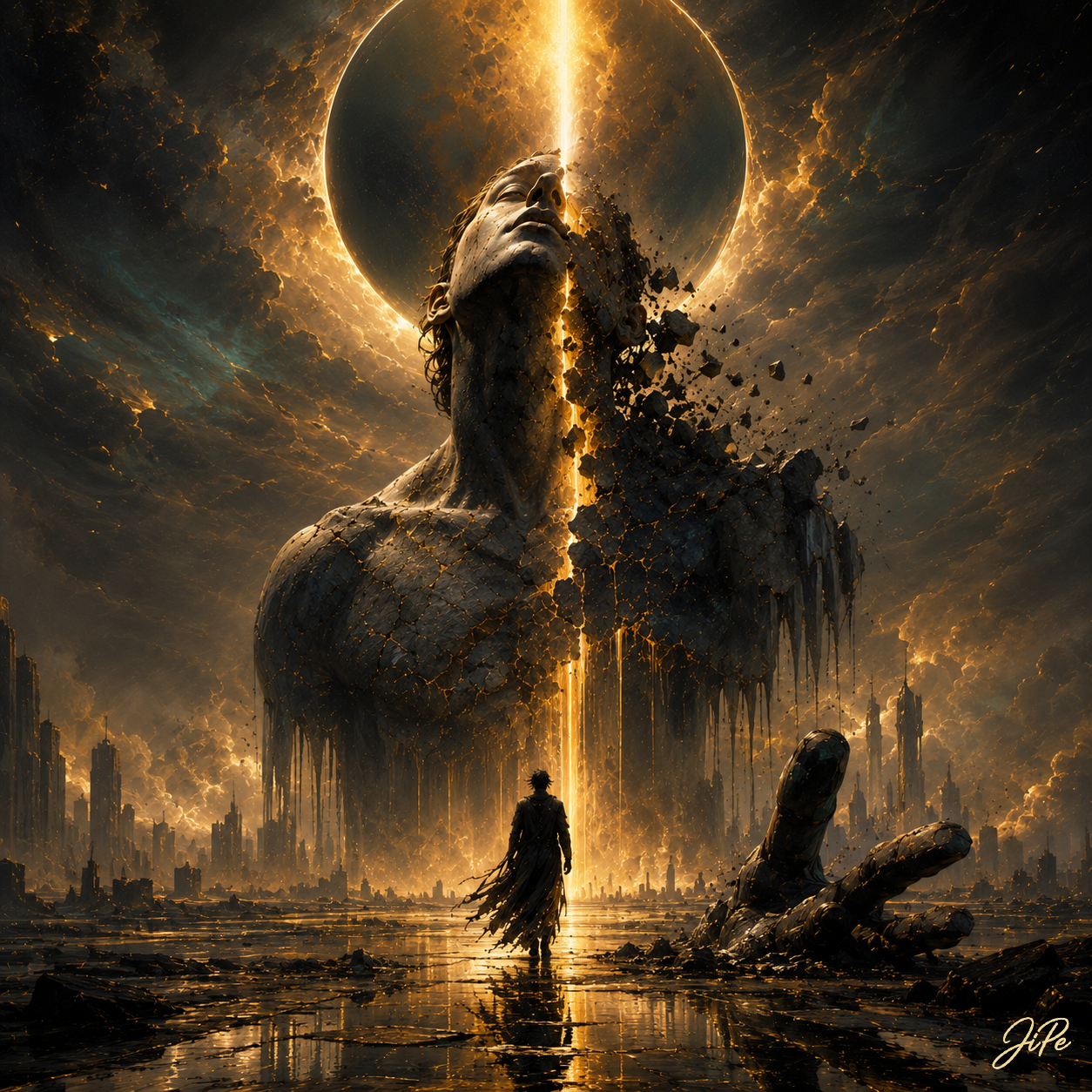

The Geometry of Surrender inhabits the fragile interval between control and release. The human presence appears caught within an invisible order, where movement, stillness, and vast spatial forces converge without resolving into harmony. Surrender here does not feel passive. It carries the intensity of a conscious relinquishing, a moment in which resistance has become indistinguishable from transformation.
Around this suspended state, structure persists. Invisible trajectories seem to organize what otherwise threatens to dissolve, suggesting that even abandonment may possess its own hidden logic. Light emerges sparingly from the darkness, touching certain thresholds without fully entering them. The resulting tension is deeply psychological: the desire to yield exists alongside the instinct to remain intact.
The title introduces an unexpected contradiction. Geometry belongs to measure, boundary, and relation; surrender implies the abandonment of such certainties. Their coexistence suggests that dissolution may not be chaos at all, but another form of order—one perceived only when familiar structures of identity begin to loosen.
What remains unresolved is whether surrender leads beyond the self or more deeply into it. Perhaps the final boundary is not crossed through force, but through the moment we cease insisting that it remain a boundary.