Monumental Visionary Fine Art exploring mythology, consciousness, sacred light, and timeless visual storytelling.

Monumental Visionary Fine Art exploring mythology, consciousness, sacred light, and timeless visual storytelling.

Surreal Paintings

The Cosmic Orchestra

The Cosmic Orchestra

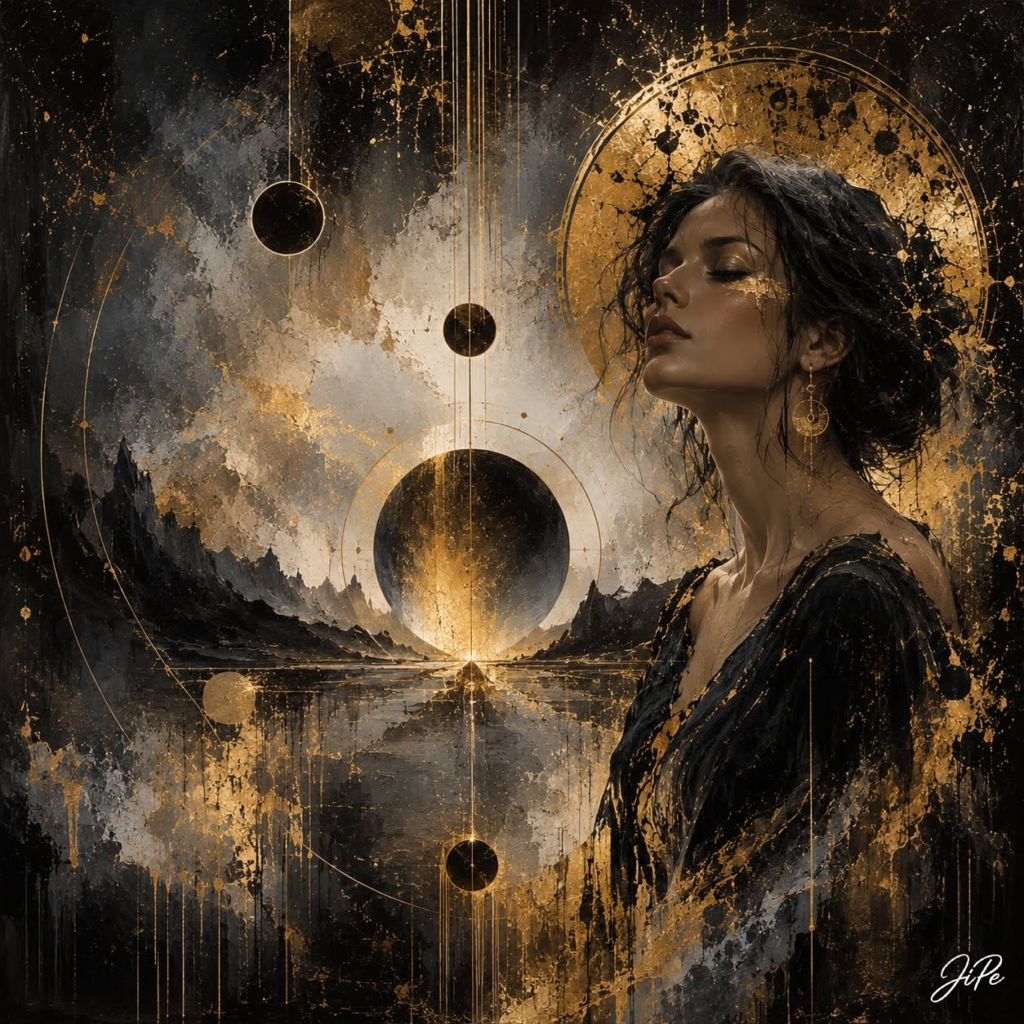
The Cosmic Orchestra is a visionary exploration of harmony, consciousness, and the invisible rhythms that bind the universe into a single living composition. Merging symbolic portraiture with celestial abstraction, the painting presents existence not as a collection of isolated events, but as an immense symphony in which every star, every landscape, and every human soul contributes to a greater universal resonance. Rather than depicting music as something heard, the work imagines music as the underlying architecture of reality itself—the silent order through which creation unfolds.

At the heart of the composition stands a solitary woman, her eyes gently closed and her face lifted toward an unseen source of light. She appears neither asleep nor detached from the world, but immersed in profound contemplation. Her expression conveys surrender rather than escape, suggesting an awareness that extends beyond ordinary perception. She becomes less an individual portrait than an archetype of the listening soul—a figure who understands that true wisdom often emerges through silence rather than speech.

Surrounding her is a carefully orchestrated universe of celestial geometry, luminous circles, and suspended planetary forms. These cosmic elements do not appear randomly dispersed; instead, they resemble musical notes arranged upon an invisible score. Every orbit, every sphere, and every delicate line contributes to a visual rhythm that evokes balance, proportion, and universal harmony. The painting proposes that the cosmos itself functions as an eternal composition, governed by relationships as elegant as those found in music, mathematics, and sacred geometry.

The title, The Cosmic Orchestra, draws upon one of humanity’s oldest philosophical ideas: the belief that the universe possesses an intrinsic harmony beyond human hearing. Ancient thinkers imagined the movements of celestial bodies as a ”music of the spheres,” where planets and stars moved according to invisible mathematical principles that reflected perfect cosmic order. This painting reinterprets that timeless concept through a contemporary visual language, transforming geometry, light, and landscape into a poetic expression of the unseen symphony that surrounds all existence.

At the center of the landscape appears a monumental dark celestial sphere resting upon the horizon like a silent conductor. Rather than symbolizing absence or eclipse alone, it represents mystery—the unknowable center around which every visible phenomenon revolves. Its deep darkness is surrounded by radiant gold, suggesting that illumination does not eliminate mystery but emerges from it. The sphere becomes the visual heart of the composition, reminding viewers that the greatest truths often remain beyond complete understanding.

The reflective landscape stretching beneath this celestial event introduces another profound symbolic layer. Water has long represented consciousness, memory, and transformation throughout the history of art. Here, its still surface mirrors both the heavens and the earth, dissolving distinctions between inner experience and external reality. Reflection becomes revelation. The world above and the world below exist not as opposites but as complementary dimensions of the same universal harmony.

The mountainous horizon anchors the composition with a sense of permanence and timelessness. Rising quietly beneath the celestial forms, these distant peaks evoke ancient landscapes untouched by history. They serve as silent witnesses to the endless cycles of creation, reminding us that while civilizations rise and fall, the deeper rhythms of existence continue uninterrupted. Their restrained presence grounds the painting’s cosmic ambition within the enduring stability of nature.

Light functions as the work’s primary expressive language. Delicate golden illumination radiates outward from the central horizon, expanding through concentric circles and subtle architectural structures that resemble astronomical diagrams. Rather than merely illuminating the scene, the light appears to organize it. It becomes the invisible conductor guiding every element into harmonious relationship. Throughout the composition, darkness is never portrayed as an opposing force. Instead, shadow provides the necessary silence through which light acquires its emotional and symbolic power, much as pauses give music its rhythm and meaning.

The restrained palette of charcoal, obsidian black, muted ivory, and radiant gold reinforces this atmosphere of contemplative elegance. Gold permeates the painting with remarkable subtlety, functioning as both physical illumination and symbolic presence. Across centuries of artistic tradition, gold has represented divinity, wisdom, and incorruptible truth. In The Cosmic Orchestra, it also suggests resonance itself—the invisible energy connecting every element into a unified whole.

Texture contributes significantly to the emotional depth of the work. Layered painterly surfaces, weathered passages, and expressive splashes of luminous pigment create the impression that the painting has evolved organically over time. These richly textured areas resemble geological formations, ancient frescoes, and celestial dust simultaneously, dissolving distinctions between landscape, architecture, and atmosphere. The result is a visual language that feels both timeless and contemporary, rooted equally in material craftsmanship and philosophical inquiry.

Compositionally, the painting demonstrates exceptional balance between structure and emotion. The portrait occupies the right side of the canvas with quiet dignity, while the expansive symbolic landscape unfolds across the left. Circular geometries establish an elegant rhythm that unifies both halves of the composition, allowing the portrait and the cosmos to appear inseparable. Every line, orbit, reflection, and atmospheric gesture contributes to a carefully orchestrated visual cadence that encourages prolonged contemplation rather than immediate interpretation.

Within the broader context of contemporary visionary art, The Cosmic Orchestra synthesizes influences from Symbolism, metaphysical painting, Romantic landscape traditions, and geometric abstraction. The emotional stillness of the portrait recalls the Symbolists’ fascination with inner consciousness, while the cosmic architecture reflects humanity’s enduring engagement with astronomy, sacred geometry, and philosophical cosmology. Yet the painting remains unmistakably contemporary, combining painterly abstraction with cinematic atmosphere to create a visual language uniquely suited to modern audiences seeking meaning within an increasingly interconnected world.

For art historians, the work may be understood as a contemporary reinterpretation of the ancient relationship between music, mathematics, and the cosmos. Philosophers from Pythagoras to Johannes Kepler envisioned the universe as an ordered harmony governed by invisible numerical relationships. The Cosmic Orchestra extends this tradition beyond scientific observation into poetic imagination, suggesting that the human spirit participates in the same universal composition as planets, stars, landscapes, and light itself.

The painting also offers a meditation on listening as an act of perception. The woman’s closed eyes remind viewers that the deepest forms of understanding often arise when external distraction gives way to inner awareness. In this sense, the orchestra is not performed for an audience—it is already unfolding everywhere. The challenge lies not in creating harmony, but in becoming quiet enough to recognize it.

Ultimately, The Cosmic Orchestra is an invitation to experience existence as a living symphony of interconnected forces. It reminds us that beneath the apparent complexity of the universe lies an extraordinary elegance, where light, matter, consciousness, and time move together according to rhythms that transcend language. Standing before this luminous convergence of portrait, landscape, geometry, and celestial symbolism, the viewer is encouraged to reflect upon their own place within that eternal composition. The painting suggests that every life, no matter how small, contributes a unique note to the vast and timeless orchestra of creation—and that true harmony begins when we recognize ourselves not as separate from the cosmos, but as participants in its endless song.

Lämna ett svar