
The Alchemy of Becoming
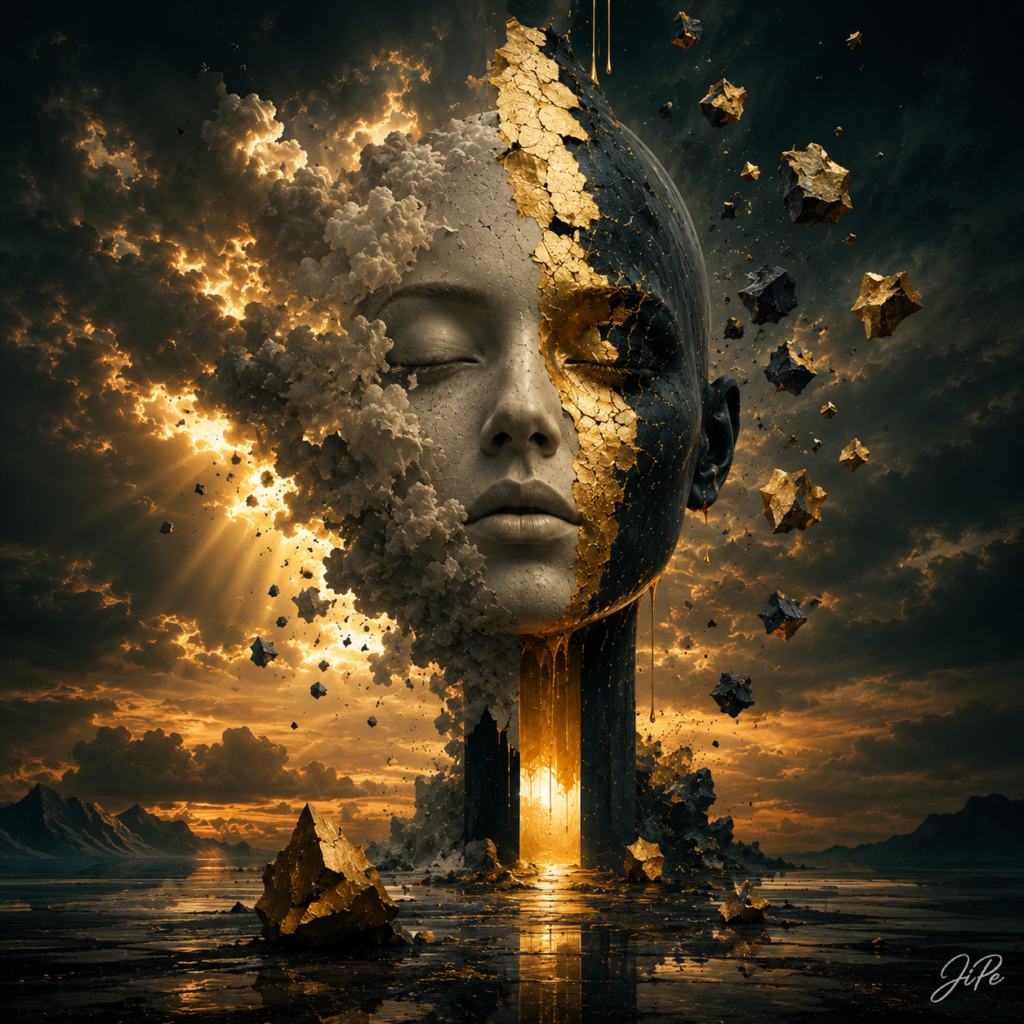
The Alchemy of Becoming is a monumental meditation on transformation—the mysterious process through which identity dissolves, fractures, and is ultimately recreated into something greater than it once was. In this extraordinary work, JiPe explores one of humanity’s oldest philosophical questions: How does a person become who they are meant to be? Rather than answering through narrative, the artist constructs a symbolic universe where matter itself appears to participate in the evolution of consciousness. Stone becomes flesh, light becomes memory, destruction becomes creation, and every fragment suspended in space becomes part of an unfolding metamorphosis.
This is not a portrait.
It is not a sculpture.
It is the visual anatomy of transformation itself.
At the centre of the composition stands a monumental human face, suspended between creation and dissolution. One side appears smooth, luminous, and complete, while the other dissolves into clouds, fractured stone, and floating fragments that drift outward into infinite space. A brilliant seam of molten gold divides these opposing realities, establishing the central metaphor of the work.
The figure is neither breaking apart…
nor being repaired.
It is becoming.
The title, The Alchemy of Becoming, immediately invokes the ancient discipline of alchemy—not merely the medieval pursuit of turning base metals into gold, but its deeper symbolic meaning as the transformation of the human spirit. Throughout history, alchemy has represented purification, integration, and the gradual refinement of consciousness. JiPe reimagines this timeless philosophy through a contemporary visual language where painterly abstraction, monumental portraiture, sacred symbolism, and cinematic atmosphere merge into a single contemplative experience.
The painting suggests that every authentic transformation follows an alchemical path.
The old self must dissolve.
Certainty must fracture.
Only then can something luminous emerge.
The central face possesses extraordinary serenity. Its closed eyes deny the drama unfolding around it. There is no expression of suffering, fear, or resistance. Instead, the figure appears entirely surrendered to the forces reshaping it. This emotional stillness becomes one of the work’s greatest strengths. Transformation is presented not as violence but as profound acceptance.
The face does not fight change.
It trusts it.
It allows itself to become something it cannot yet imagine.
Perhaps the most striking symbolic element is the luminous golden fissure running vertically through the centre of the figure. Rather than concealing fracture, JiPe celebrates it. The radiant gold immediately recalls the Japanese philosophy of kintsugi, where broken ceramics are restored using precious metals, making their fractures the most beautiful part of the object. Here, however, the principle extends beyond material restoration into the realm of human identity.
Every wound becomes illumination.
Every scar remembers growth.
Every fracture becomes a doorway through which light enters.
Gold has become one of JiPe’s defining visual languages. Across his body of work it consistently symbolizes transcendence, wisdom, memory, and the invisible presence that survives every collapse. In The Alchemy of Becoming, gold is not applied to decorate the figure; it appears to emerge organically from within it, suggesting that transformation is never imposed externally. It originates from the deepest interior of being.
The painting therefore reverses conventional ideas of perfection.
Wholeness is not the absence of brokenness.
Wholeness is what remains after brokenness has been embraced.
The left side of the face dissolves into immense clouds that merge seamlessly with the surrounding sky. Flesh becomes atmosphere. Identity becomes weather. This extraordinary visual transition erases the boundary between the individual and the cosmos, suggesting that the self is not an isolated object but part of an ever-changing universal process.
We are not separate from the world.
We are expressions of it.
We rise and dissolve with the same rhythms that shape mountains, storms, and stars.
By contrast, the right side remains darker, more sculptural, almost architectural in its solidity. Floating fragments of black stone orbit around the head like celestial bodies, suspended between destruction and reconstruction. These fragments are not falling—they are held in equilibrium, as though invisible forces have interrupted gravity itself.
Time itself seems suspended.
Matter hesitates.
Transformation unfolds outside ordinary chronology.
At the base of the monumental figure stands a glowing doorway from which brilliant golden light pours outward across the reflective ground. This small architectural element introduces a second symbolic narrative within the larger composition. The enormous head becomes not merely a portrait but a sacred structure.
The human being becomes a temple.
The heart becomes an entrance.
Consciousness becomes architecture.
The doorway suggests that every transformation begins within. The true passage toward awakening is not found in distant landscapes or transcendent heavens but inside the self. The viewer instinctively recognizes that the radiant opening does not lead into the figure—it leads deeper into consciousness itself.
Every journey outward…
begins inward.
Every revelation…
begins in silence.
The reflective surface beneath the sculpture doubles both the monument and the light, introducing another recurring motif throughout JiPe’s artistic language. Reflection represents psychological depth, memory, and self-recognition. External reality always possesses an unseen counterpart beneath its surface.
Above and below mirror one another.
Matter reflects spirit.
The visible reflects the invisible.
Compositionally, The Alchemy of Becoming demonstrates extraordinary sophistication. Monumental verticality anchors the composition while floating fragments create dynamic movement around the otherwise serene central figure. The visual tension between stability and dissolution gives the work remarkable emotional energy without sacrificing clarity or balance.
Negative space plays an equally significant role. Vast expanses of cloud and sky provide moments of visual stillness that allow the viewer’s attention to rest before returning to the intense central transformation. This careful orchestration of density and openness reflects JiPe’s mature understanding of monumental composition.
Nothing feels excessive.
Nothing feels accidental.
Every fragment contributes to the emotional rhythm of the whole.
The dramatic chiaroscuro further intensifies the symbolic dialogue between shadow and illumination. Golden light erupts through dense storm clouds, yet darkness is never portrayed as an enemy. Instead, shadow becomes the necessary environment within which revelation occurs. Without darkness, light would possess neither direction nor meaning.
Light does not destroy shadow.
It gives it purpose.
Transformation requires both.
Psychologically, the painting resonates strongly with Carl Jung’s theory of individuation—the lifelong integration of opposing aspects of the personality into a more authentic and complete self. The divided face may therefore be understood as an archetypal image of inner reconciliation. Conscious and unconscious, order and chaos, vulnerability and strength all converge within a single evolving identity.
The self is not divided.
It is unfolding.
Every contradiction becomes part of a larger harmony.
From an art historical perspective, The Alchemy of Becoming occupies a compelling intersection between Symbolism, Surrealism, contemporary visionary art, and metaphysical portraiture. Echoes of Renaissance sacred iconography, Romantic sublimity, and modern philosophical abstraction coexist within JiPe’s distinctly contemporary visual language. Yet the work resists direct imitation of historical traditions. Instead, it constructs a mythology uniquely its own—one rooted in timeless archetypes yet expressed through modern painterly techniques and cinematic visual storytelling.
Rather than illustrating transformation…
the painting becomes transformation.
Rather than depicting philosophy…
it allows philosophy to become visible.
This is one of the defining characteristics of JiPe’s artistic practice. His works rarely describe abstract ideas; they embody them. The viewer is not asked merely to understand transformation intellectually but to experience its emotional atmosphere. Standing before this monumental face, one senses both fragility and immense strength, dissolution and emergence, loss and renewal existing simultaneously.
Ultimately, The Alchemy of Becoming is a profound reflection on what it means to evolve as a human being. It reminds us that identity is never fixed, that certainty is often the first illusion to dissolve, and that the most beautiful versions of ourselves are rarely those that have never broken—but those that have learned how to transform every fracture into light.
For becoming is never a single moment.
It is an endless alchemy.
A lifelong conversation between darkness and illumination…
until the soul itself shines like gold.