
Kingdom Above the Clouds

Kingdom Above the Clouds is a monumental vision of transcendence, imagination, and the enduring human longing to reach beyond the visible world. Balancing the grandeur of epic fantasy with the contemplative silence of symbolic art, the work invites the viewer into a realm where earthly limitations dissolve and architecture, nature, and spirit coexist in sublime harmony. Rather than depicting a literal place, the painting presents a psychological and metaphysical landscape—a kingdom suspended between memory, myth, and eternity.
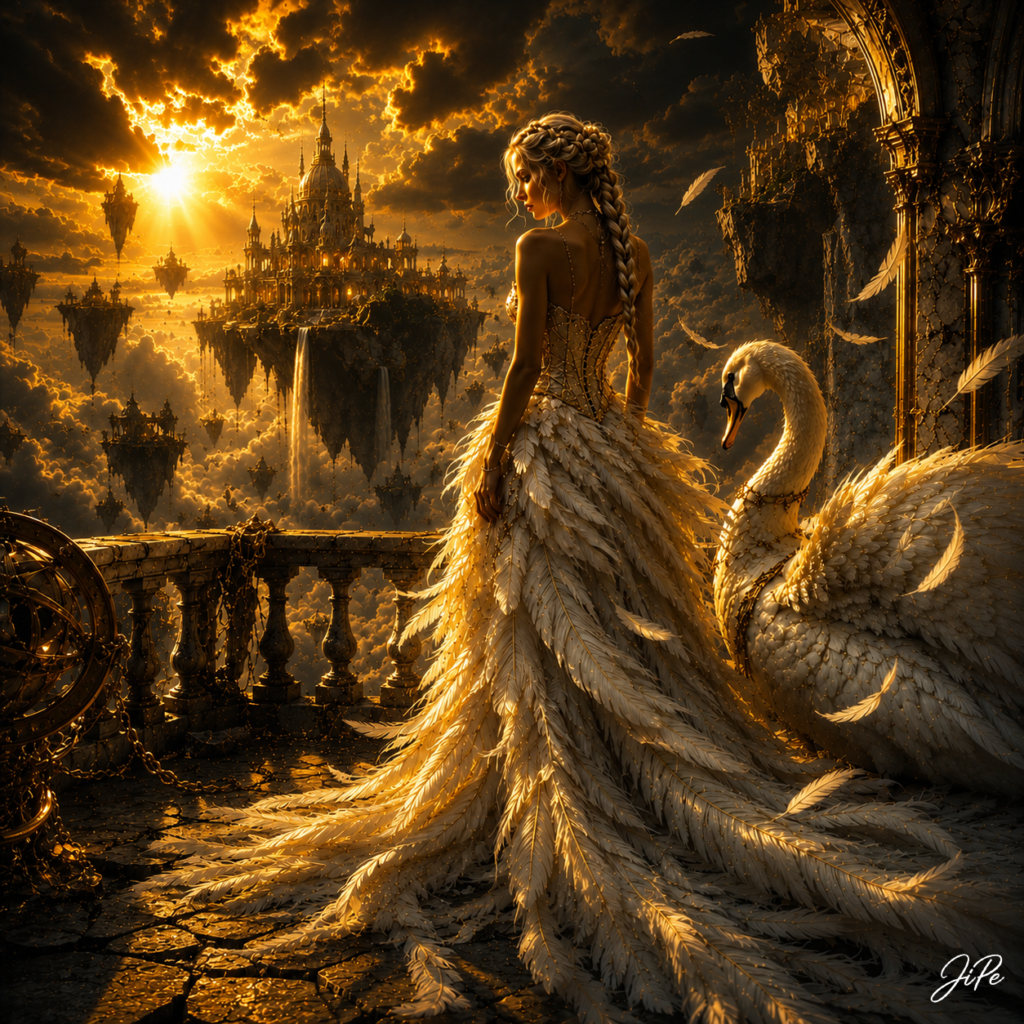
At the heart of the composition stands a majestic floating citadel, rising above an endless ocean of clouds. Illuminated by a radiant celestial sun breaking through dramatic skies, the city appears both ancient and timeless. Its soaring towers and intricate Gothic-inspired architecture evoke humanity’s eternal pursuit of perfection, wisdom, and the sacred. Suspended upon immense fragments of floating stone, the kingdom becomes a powerful metaphor for ideals that exist beyond physical reach—dreams, aspirations, faith, and the invisible worlds that shape the human spirit.
The monumental city is not presented as a destination that can simply be reached. Instead, it exists as a symbol of the highest potential within every individual. It represents the place where imagination overcomes gravity, where hope survives adversity, and where beauty itself becomes an act of resistance against darkness.
In the foreground, a solitary female figure turns her gaze toward the celestial kingdom. Her posture is quiet yet resolute, conveying contemplation rather than conquest. She does not appear as a queen ruling over this world, but as a seeker standing on the threshold of transformation. The intricate gown composed entirely of flowing white feathers blurs the distinction between humanity and nature, suggesting rebirth, purity, vulnerability, and transcendence. Each feather becomes a visual echo of flight, freedom, and spiritual elevation, emphasizing the painting’s central dialogue between the earthly and the divine.
Beside her rests a magnificent swan, one of the oldest symbolic creatures in mythology and art history. Across countless cultures, the swan has represented grace, wisdom, transformation, and the passage between worlds. Here, it functions as both guardian and companion, reinforcing the idea that true journeys toward enlightenment are never undertaken alone. The visual relationship between woman and swan creates a poetic balance—human consciousness mirrored in nature’s silent nobility.
The surrounding architecture frames the scene like the remains of an ancient sanctuary. Weathered stone columns and gilded arches hint at civilizations long vanished, reminding viewers that every culture has imagined heavens beyond the horizon. Rather than presenting ruins as symbols of decline, the painting transforms them into portals through which the eternal may still be glimpsed. Time has altered the stone, but not the light that continues to illuminate it.
Light itself is perhaps the true protagonist of the composition. Cascading rays of golden sunlight pour through monumental clouds, sculpting every architectural detail while enveloping the figures in an atmosphere of divine radiance. This dramatic interplay of brilliance and shadow recalls the traditions of Baroque painting while embracing the cinematic scale of contemporary visionary art. The illumination is not merely decorative—it becomes symbolic of revelation, hope, and the gradual emergence of inner truth. Darkness is never portrayed as evil, but rather as the necessary space from which illumination gains meaning.
The extraordinary attention to texture contributes significantly to the emotional impact of the work. Delicate feathers, polished stone, weathered architecture, luminous clouds, and reflective golden surfaces coexist within an exceptionally rich visual language. Every material possesses its own tactile identity, encouraging prolonged observation and rewarding viewers with new discoveries over time. This layered craftsmanship creates a remarkable sense of depth, allowing the painting to oscillate between intimate detail and monumental scale.
The color palette is dominated by radiant gold, warm amber, ivory, and deep charcoal tones. Gold functions not simply as a color but as a symbolic language throughout the composition. Traditionally associated with divinity, enlightenment, immortality, and sacred knowledge, it transforms ordinary forms into vessels of spiritual significance. Against the surrounding darkness, the luminous gold becomes even more powerful, embodying resilience, revelation, and the triumph of hope over uncertainty.
From an art historical perspective, Kingdom Above the Clouds exists at the intersection of several artistic traditions. Elements of Romanticism appear in its overwhelming sense of awe before nature and the sublime. Symbolist influences emerge through its rich visual metaphors and psychological narrative. Echoes of visionary art, mythological storytelling, and contemporary digital fine art expand the work beyond conventional genre boundaries. Rather than illustrating a single story, the painting constructs an open symbolic universe in which every viewer may discover personal meaning.
The composition demonstrates exceptional control over visual rhythm and spatial hierarchy. The sweeping diagonal movement created by the feathered gown guides the eye toward the floating kingdom, while the dramatic cloud formations reinforce the upward movement of the entire image. Circular rhythms found within the architecture, clouds, and organic forms soften the monumental geometry, creating harmony between structure and fluidity. This orchestration of movement gives the work both cinematic grandeur and meditative stillness.
Ultimately, Kingdom Above the Clouds is a meditation on aspiration. It explores humanity’s enduring desire to believe that beauty, wisdom, and transcendence exist beyond immediate perception. The painting reminds us that the greatest kingdoms are not always built upon earth, but within imagination, memory, and the human soul itself. It invites viewers to pause before the impossible horizon and ask whether the distant city suspended among the clouds is a place waiting to be discovered—or a reflection of the highest possibilities already carried within us.
Both visually magnificent and emotionally contemplative, Kingdom Above the Clouds exemplifies contemporary symbolic fine art at its most immersive. Through its masterful balance of myth, architecture, light, and poetic symbolism, the work offers not simply an image to admire, but an experience to inhabit—one that continues to unfold long after the viewer has turned away.
