Monumental Visionary Fine Art exploring mythology, consciousness, sacred light, and timeless visual storytelling.

Monumental Visionary Fine Art exploring mythology, consciousness, sacred light, and timeless visual storytelling.

Surreal Paintings

Fractured Divinity

Fractured Divinity
Fractured Divinity

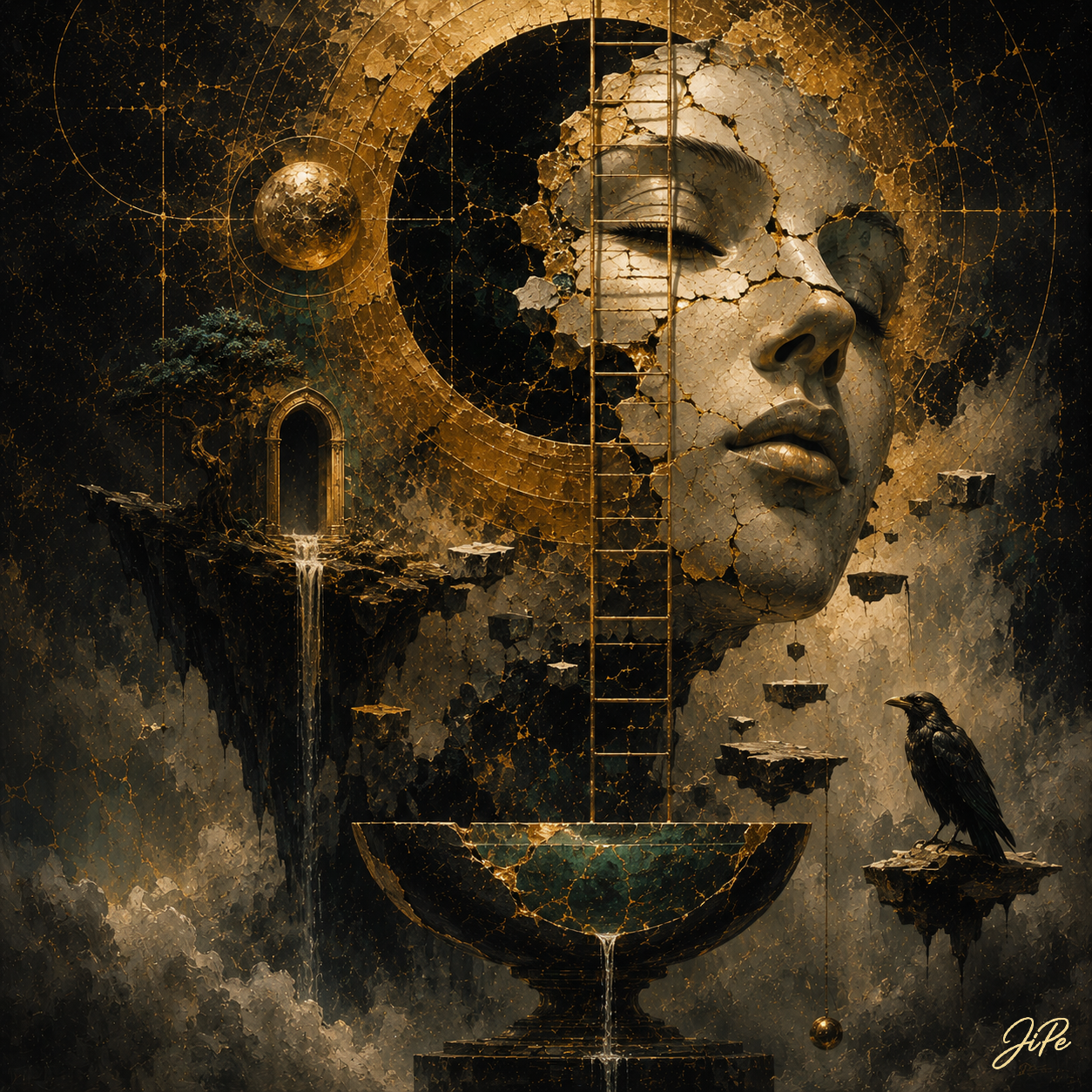
Fractured Divinity is a monumental meditation on transcendence, impermanence, and the fragile architecture of human consciousness. Situated at the intersection of symbolic realism, monumental portraiture, and contemporary visionary art, the painting explores the paradox that what appears broken may, in fact, be approaching its highest state of transformation. Rather than presenting destruction as an end, the work proposes fragmentation as an essential stage in the evolution of identity, suggesting that divinity is not diminished by fracture but revealed through it.

Dominating the composition is the colossal face of a serene female figure whose eyes remain gently closed, suspended in a state of profound stillness. Her expression is neither detached nor emotional; instead, it conveys complete inner equilibrium. She appears untouched by the dramatic disintegration unfolding around her, embodying a consciousness that exists beyond the turbulence of the material world. This remarkable contrast between external collapse and internal peace forms the emotional foundation of the painting.

The face itself resembles an immense sculptural monument carved from ancient stone. Fine networks of cracks spread delicately across its surface, recalling weathered marble, archaeological relics, and fractured ceramics restored with precious metals. These fissures are not signs of decay alone but visual metaphors for memory, experience, and spiritual resilience. Every fracture becomes evidence of a life transformed rather than diminished, reinforcing the timeless idea that true wholeness often emerges through vulnerability rather than perfection.

Behind the figure, a radiant golden disc functions simultaneously as halo, rising sun, eclipse, and celestial threshold. Unlike traditional religious iconography, this luminous circle does not declare sainthood but suggests universal consciousness. It elevates the figure beyond individual identity, transforming her into an archetype of humanity itself. The warm golden light radiating from this celestial form envelops the portrait with quiet reverence, creating an atmosphere in which the earthly and the transcendent become inseparable.

One of the painting’s most striking visual achievements lies in the extraordinary architectural forms erupting through the figure’s head. Monumental stone structures extend outward like fractured temples, crystalline pillars, or impossible constructions emerging from thought itself. These geometric forms appear simultaneously to build and dismantle the figure, dissolving conventional distinctions between body and architecture, flesh and monument, mind and environment. They suggest that consciousness is not a fixed entity but an ever-evolving structure continuously shaped by experience, memory, and transformation.

The explosive movement of these architectural fragments introduces dramatic energy into an otherwise serene composition. Stone blocks, shards, and suspended debris appear frozen between creation and collapse, producing a powerful visual tension between permanence and impermanence. Rather than depicting violent destruction, the fragmentation feels purposeful, almost ceremonial, as though rigid structures are being released to allow a more expansive form of existence to emerge. The painting quietly asks whether every apparent ending may also represent an unseen beginning.

At the base of the composition stands a solitary human figure whose diminutive scale emphasises the overwhelming monumentality of the central form. This anonymous observer becomes the viewer’s surrogate, confronting an image that far exceeds ordinary human proportions. Standing before the immense sculpture, the individual evokes feelings of humility, awe, and existential reflection. The encounter recalls humanity’s timeless relationship with sacred architecture and colossal monuments—spaces designed not merely to impress, but to awaken an awareness of our place within something immeasurably larger than ourselves.

The reflective surface beneath the monument further deepens the symbolic richness of the work. Water-like reflections subtly dissolve the boundary between solid matter and illusion, creating the impression that the colossal structure exists between dimensions rather than occupying a conventional physical landscape. Reflection here functions as a metaphor for consciousness itself, suggesting that reality is always experienced through layers of perception rather than absolute certainty.

The restrained palette of charcoal black, weathered stone, warm ivory, and radiant gold establishes an atmosphere of timeless grandeur. Gold is employed with particular sensitivity, not as decorative embellishment but as a visual language of illumination and transformation. It flows through fractures, architectural forms, and atmospheric particles, recalling ancient gilded icons, Byzantine mosaics, and the philosophy of kintsugi, where visible repair becomes a celebration of resilience rather than an attempt to conceal damage. Throughout the painting, light appears to emerge directly from brokenness, reinforcing the central philosophical premise that beauty and wisdom are often born through imperfection.

The richly textured surface enhances this narrative of transformation. Layers of expressive brushwork, weathered textures, fractured stone effects, and subtle painterly abstraction create an extraordinary tactile presence. Every visible mark contributes to the impression that the work has evolved over immense stretches of time, as though shaped by geological forces rather than merely painted. This archaeological quality encourages prolonged contemplation, revealing increasingly complex relationships between texture, light, architecture, and human form.

From an art historical perspective, Fractured Divinity draws upon multiple traditions while establishing an unmistakably contemporary visual language. Echoes of Renaissance monumentality, classical sculpture, Symbolist philosophy, and modern architectural abstraction coexist within a composition that feels both ancient and futuristic. The work refuses to belong exclusively to mythology, religion, or speculative imagination. Instead, it occupies a liminal territory where these traditions merge into a universal meditation on human existence.

Conceptually, the title Fractured Divinity serves as the philosophical key to the entire composition. It challenges the assumption that the divine must be flawless, complete, or untouched by suffering. Instead, the painting proposes that the sacred is often revealed most clearly through visible fractures—through those moments when certainty collapses, identity is reshaped, and the carefully constructed architecture of the self gives way to deeper awareness. Divinity is presented not as perfection beyond human experience, but as a presence discovered within the very process of transformation.

Ultimately, Fractured Divinity invites viewers into a profound dialogue with impermanence. It suggests that every fracture carries the possibility of renewal, every collapse contains the seeds of creation, and every broken surface may become an opening through which light enters. Standing before this monumental vision, we are reminded that the human spirit is not defined by its unbroken strength, but by its extraordinary capacity to transform, endure, and reveal unexpected beauty through the very places where it once appeared most fragile.

Lämna ett svar