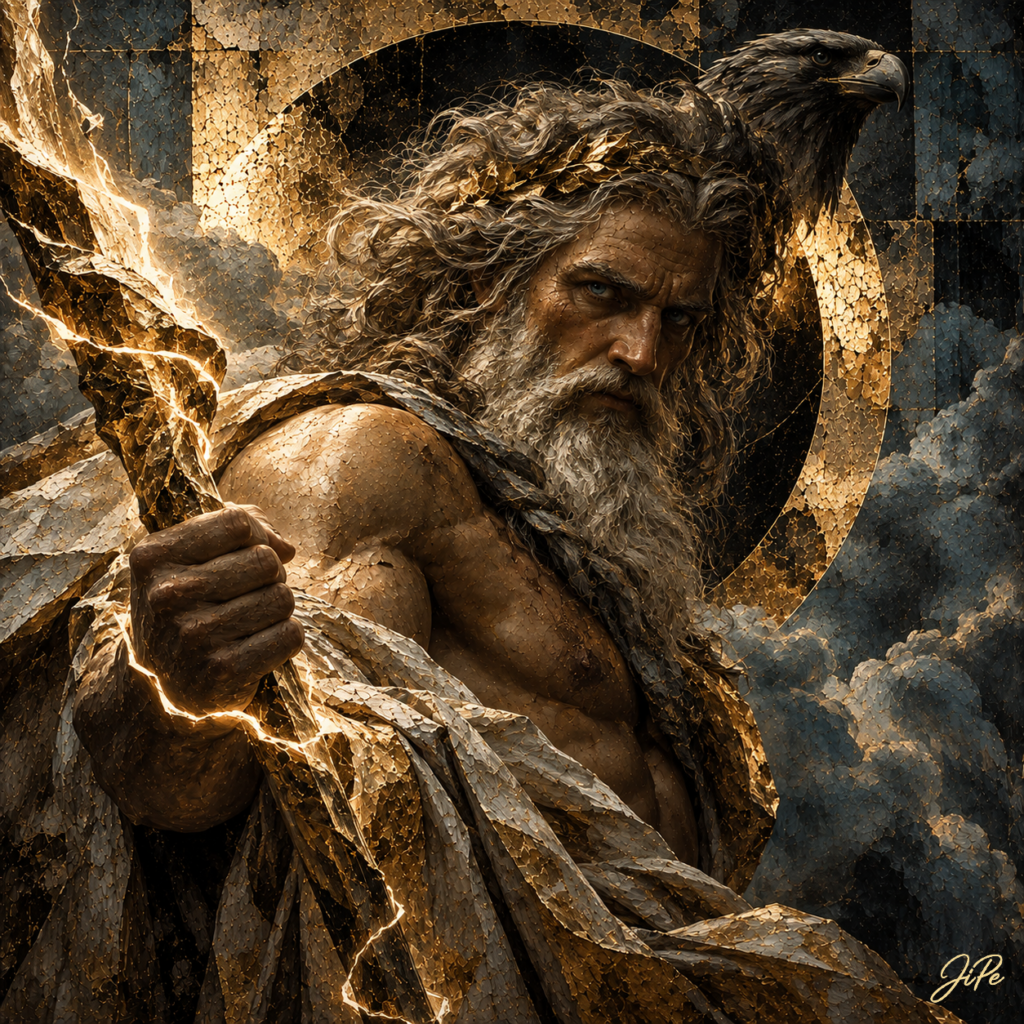
Zeus — The Fire Above the Heavens confronts the immense solitude of absolute power. The central figure emerges with an authority that seems older than the world itself, yet his presence carries an unsettling gravity. Beneath the commanding gaze lies something less easily defined: the weariness of eternity, perhaps, or the burden of possessing a force that can never be entirely restrained.
The composition holds destruction and order in a precarious equilibrium. Light moves through the surrounding darkness with an almost violent intensity, suggesting a power capable of both creation and annihilation. Yet the atmosphere remains strangely suspended, as though the universe has fallen silent in anticipation of a decision that may never come. The closeness of the figure intensifies this tension, transforming cosmic immensity into an unexpectedly personal encounter.
The title evokes a realm beyond familiar celestial hierarchies, where even divinity may confront the limits of its own authority. Strength appears inseparable from responsibility, while the distinction between justice and domination becomes increasingly uncertain. What seems eternal may nevertheless be vulnerable to the consequences of a single act.
Within this charged stillness, a deeper question emerges. If the power to shape existence rests in one hand, what governs the will behind it? And when nothing remains beyond the reach of a god, what, if anything, can still inspire fear?