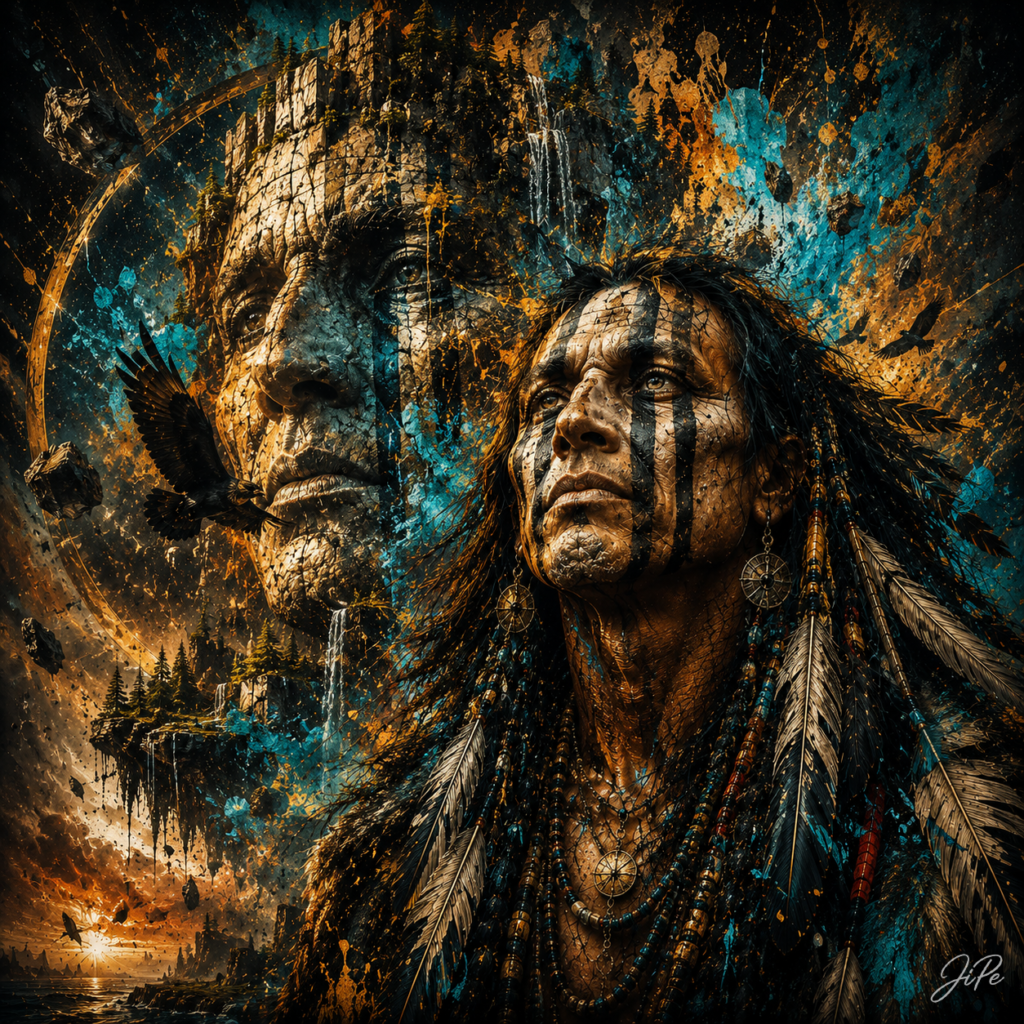
The Storm Beside the Lost Face holds two forms of presence within the same unsettled world: one immediate and living, the other monumental, distant, and strangely incomplete. Their proximity creates a tension that feels less like encounter than remembrance, as though the visible figure stands beside something that has survived only in fragments.
The surrounding turbulence intensifies this uncertainty. Space appears caught between formation and collapse, while light emerges through the disorder without restoring stability. It reveals enough to suggest continuity, yet leaves much suspended in darkness. Against this instability, the human gaze carries an unexpected stillness—an inward steadiness before forces too vast to resist or fully comprehend.
The title makes absence central. The lost face may belong to memory, ancestry, identity, or to a world whose original meaning can no longer be recovered. Its immense scale complicates the distinction between what has vanished and what continues to exert influence. Perhaps what is lost does not disappear; perhaps it becomes larger precisely because it can no longer be reached.
The storm may eventually pass. More uncertain is whether the face will remain when silence returns—or whether it existed only because the storm made remembering possible.