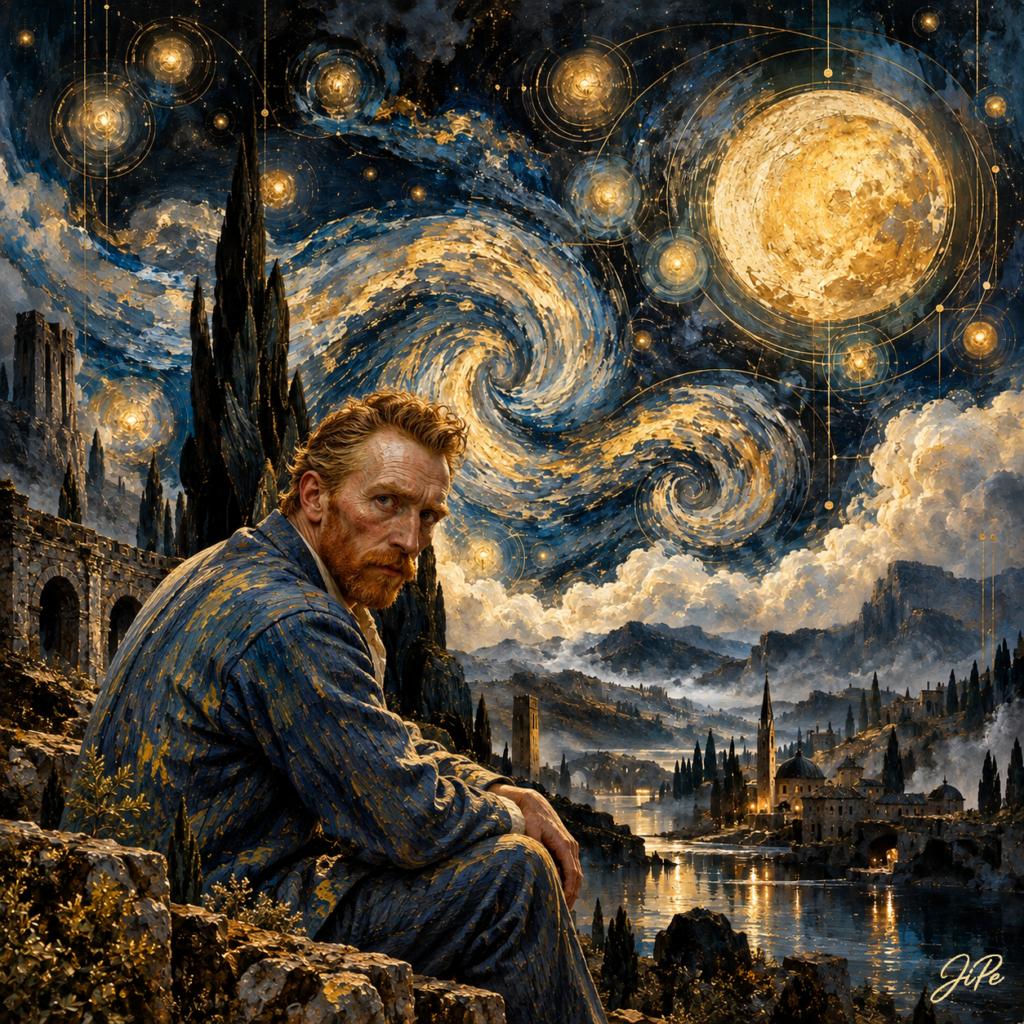
In JiPe’s reinterpretation of Vincent van Gogh’s The Starry Night, the immensity of the sky is met by the quiet weight of a seated body. Van Gogh turns towards us, interrupting our absorption in the night above him. His gaze brings the encounter back to a human scale, where attention can be exchanged but understanding remains uncertain.
The sky’s restless expansion and the figure’s contained posture establish two different experiences of time. Above, movement appears inexhaustible; below, a person inhabits a pause. The distant settlement offers another rhythm, its small lights suggesting lives continuing beyond the reach of this solitary encounter.
Gold passes through sky, clothing, and stone, making the figure seem physically implicated in the world around him. Yet this shared radiance leaves his inwardness intact. Light can connect surfaces without resolving the separateness of the person it reveals.
With the painter present inside the remembered night, the relationship between a vision and the life behind it becomes unusually intimate. We may search his face for an explanation of the heavens, though his expression supplies none. He has turned away from the spectacle to look towards us, leaving open what, in that vastness, could no longer hold his attention.