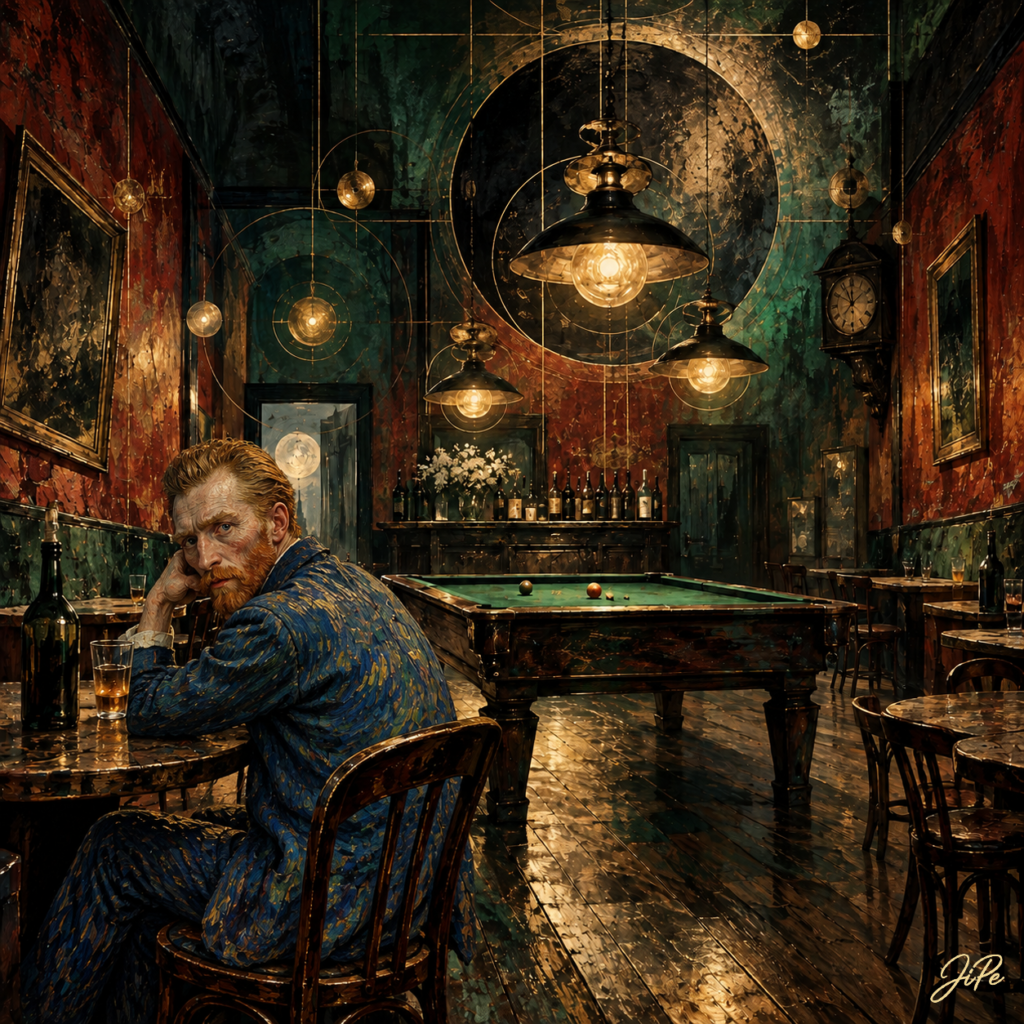
In JiPe’s reinterpretation of Vincent van Gogh’s The Night Café, wakefulness seems to have outlasted the reasons for remaining awake. The seated figure turns towards us with an attention that complicates his apparent fatigue. His presence makes the empty room feel inhabited by more than one person’s solitude, as though our arrival has disturbed an unspoken arrangement.
Behind him, the café recedes with an insistence that gives its vacant spaces psychological weight. The billiard table occupies the centre like an activity abandoned before it could provide distraction. There is room for company everywhere, yet little assurance that company would lessen the distance.
The lamps sustain a warmth that has become difficult to distinguish from exposure. Their light allows no easy retreat into darkness, while the towering interior lends an ordinary late hour an almost disproportionate gravity. Time appears plentiful here, perhaps oppressively so: something to endure after conversation and movement have fallen away.
Van Gogh’s inclusion within this remembered setting brings the act of looking into uneasy proximity with the experience of being seen. His gaze offers neither a clear appeal nor a dismissal. We remain beside a table where another person could sit, uncertain whether the silence would change if someone did.