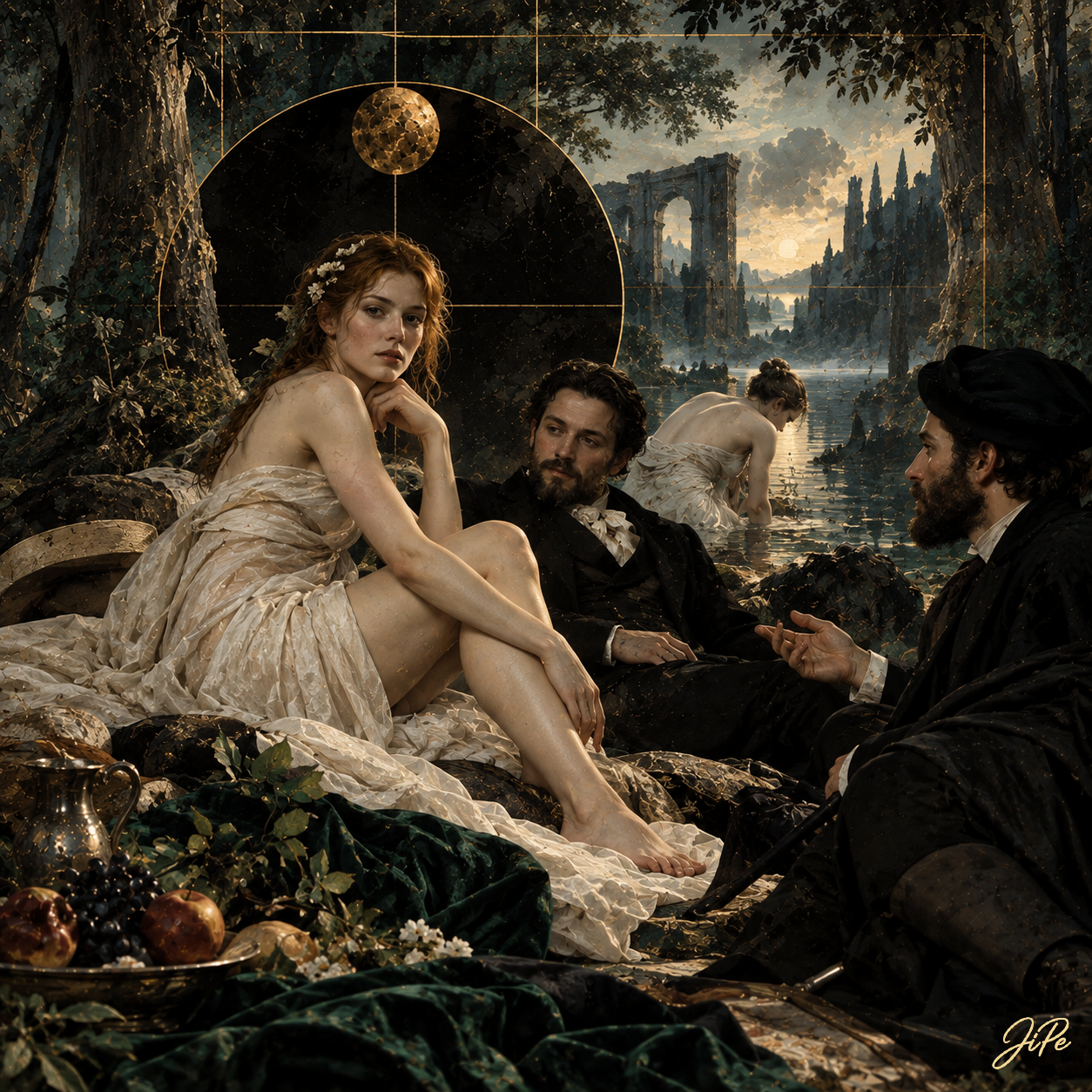

In JiPe’s reinterpretation of Diego Rodríguez de Silva Velázquez’s The Maids of Honor, a gathered court seems to pause under the pressure of an unseen presence. Attention moves through the room without finding a single destination. At its centre, the child’s stillness carries an authority that her smallness makes strangely vulnerable.
The attendants’ proximity suggests care, yet it also gives that central position the feeling of an enclosure. To be attended to is also to be watched. Beneath the room’s immense darkness, the figures appear bound by expectations that remain unspoken, their gestures held between personal feeling and public composure.
Light makes these distinctions unstable. It grants the child prominence while revealing the watchfulness around her; farther back, the illuminated doorway offers depth without promising release. The painter’s outward gaze extends the room beyond its visible limits, implicating the space we occupy. We may be observing a scene whose arrangement already depends upon our presence.
The title directs attention towards those who attend, even as the eye returns to the figure they surround. Somewhere between service, affection, and scrutiny, the gathering retains its silence. It remains uncertain who is waiting for whom to move, and whose smallest gesture might allow the room to breathe again.