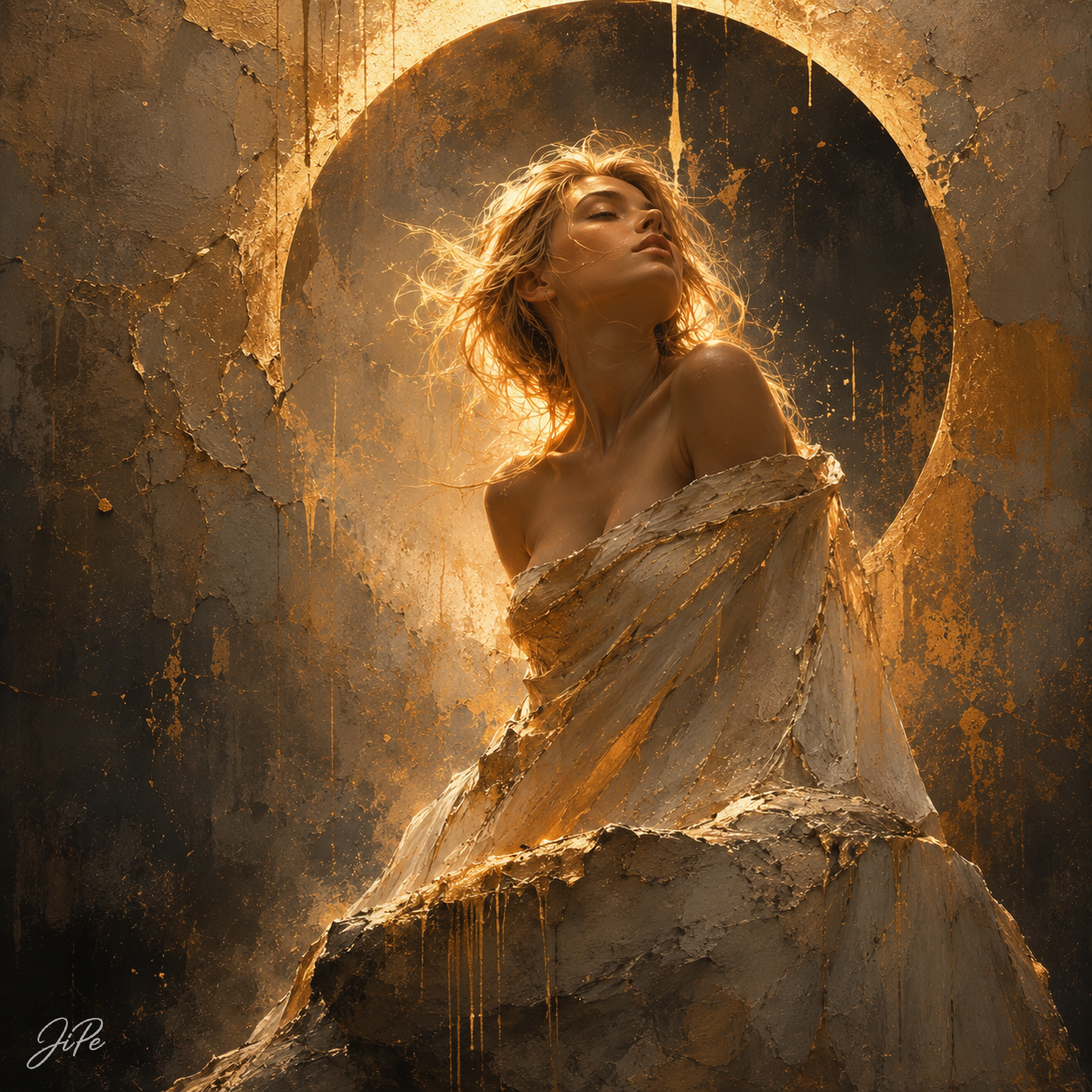

The Keeper of Forgotten Worlds occupies a state between remembrance and disappearance. The central presence feels less anchored in a single moment than suspended across many, carrying an atmosphere of immense duration. Her stillness has the gravity of something preserved beyond its natural time, while the surrounding space seems caught between formation and ruin.
Light does not simply reveal; it appears to recover fragments from darkness. What emerges feels partial, as though entire histories remain just beyond the threshold of recognition. The tension between intimacy and cosmic scale transforms memory into something almost spatial—a vast interior in which civilizations, identities, and abandoned possibilities might continue to exist after their names have vanished.
The title introduces the idea of guardianship without revealing what such a responsibility demands. To keep a forgotten world may mean protecting it from oblivion, but it may also mean carrying what can no longer return. Preservation and loss become inseparable.
Her closed eyes deepen that uncertainty. Perhaps what is guarded cannot be found through looking at all. Perhaps forgotten worlds survive only within the silence of those who still contain them—and the greater mystery is whether remembering preserves what was lost, or prevents it from ever truly disappearing.