The Eclipse Within

There are moments in every human life when the greatest darkness does not descend from the heavens but rises quietly from within. These are the unseen eclipses of the soul—periods when certainty fades, identity fractures, and the familiar light that once guided us becomes temporarily hidden beneath doubt, grief, longing, or transformation. The Eclipse Within is a visual meditation on this profoundly human experience. Rather than depicting a celestial event alone, the painting transforms the eclipse into an intimate psychological landscape, inviting viewers to contemplate the mysterious relationship between shadow and illumination that exists within every individual.
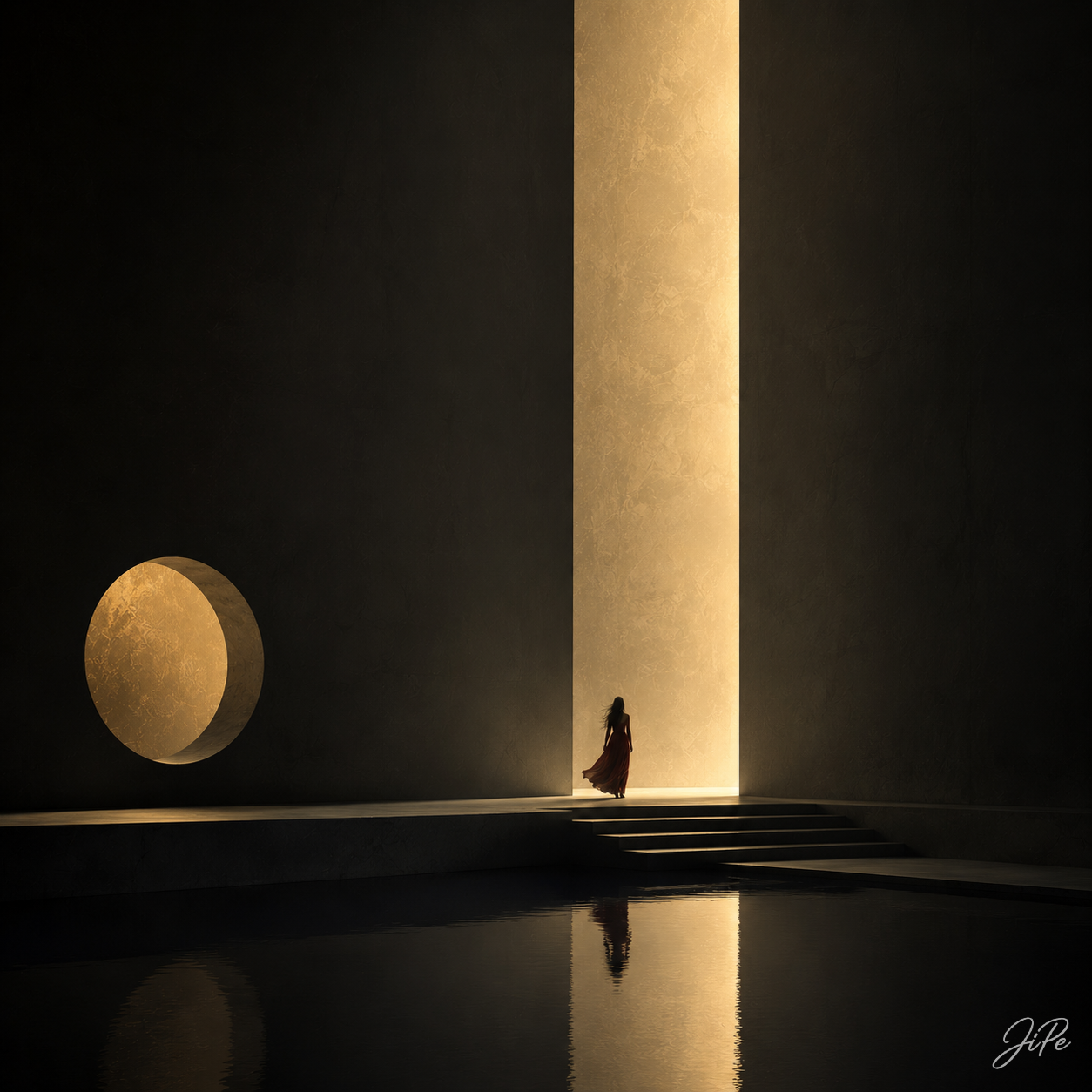
The composition unfolds as a monumental dreamscape where the boundaries between the physical world and the inner life dissolve. A solitary female figure stands beneath an immense crescent of luminous gold that curves through the composition like a cosmic tide. Around her, clouds of molten light emerge from deep darkness while subtle veils of emerald and midnight tones dissolve into textured painterly surfaces. The scene feels suspended outside measurable time, existing somewhere between memory, myth, and spiritual awakening.
At first glance, the work radiates serenity. Yet beneath its tranquil atmosphere lies a profound emotional complexity. The figure does not appear to resist the eclipse, nor does she seek to escape it. Instead, she stands in quiet acceptance, her face turned upward toward the hidden light beyond the darkness. This gesture transforms the painting into a meditation on surrender—not as defeat, but as one of the deepest forms of courage.
The title, The Eclipse Within, immediately shifts the viewer’s interpretation away from astronomy and toward psychology. The eclipse becomes an archetype rather than an event. Throughout mythology, philosophy, and spiritual traditions, eclipses have represented periods of uncertainty, revelation, and transformation. Here, however, the celestial phenomenon is internalized. Darkness no longer obscures the world—it obscures the self. Yet paradoxically, it is precisely this temporary concealment that allows deeper truths to emerge.
The female figure functions as an archetypal presence rather than an individual portrait. Her identity remains intentionally undefined, allowing her to become a universal symbol of humanity confronting its own interior landscape. Her flowing garments merge with the surrounding atmosphere, dissolving the distinction between body and environment. She appears neither separate from the universe nor overwhelmed by it. Instead, she exists as part of its continuous rhythm, carried by invisible currents of energy and light.
One of the painting’s most compelling achievements lies in its extraordinary manipulation of scale. The immense crescent dominating the composition dwarfs the solitary figure, creating a powerful dialogue between human fragility and cosmic immensity. Yet rather than diminishing the individual, this contrast elevates the emotional significance of her presence. Her stillness becomes monumental precisely because it exists within such overwhelming vastness.
The crescent itself operates on multiple symbolic levels. It recalls the moon, the cycle of becoming, feminine archetypes, spiritual rebirth, and sacred geometry. Yet its painterly execution prevents it from functioning as a literal celestial body. Built from fractured gold textures, luminous pigments, and weathered surfaces, it feels simultaneously ancient and eternal—as though it has existed not in the sky but within human consciousness across countless generations.
Gold plays a particularly significant role throughout the work. Rather than serving merely as decorative embellishment, it functions as the visual embodiment of hidden consciousness. Emerging through cracked textures and weathered painterly surfaces, the gold appears less like applied pigment and more like light slowly revealing itself beneath layers of time. This treatment recalls the philosophy of kintsugi, where fracture becomes the very place through which beauty is revealed. The eclipse therefore does not extinguish illumination—it temporarily conceals it, allowing its eventual return to possess even greater meaning.
The restrained colour palette contributes significantly to the painting’s emotional atmosphere. Deep charcoals, warm earth tones, luminous antique gold, and subtle passages of oxidized emerald establish an elegant visual harmony rooted in contrast rather than excess. The emerald passages quietly suggest hidden life beneath apparent darkness, introducing a subtle visual metaphor for hope that remains almost imperceptible until prolonged observation.
Materiality forms another essential component of the work’s expressive language. Thick painterly textures, distressed surfaces, weathered brushwork, and layered mixed-media effects create a tactile richness that recalls ancient walls, forgotten temples, and archaeological memory. These surfaces appear to preserve emotional history within the paint itself, suggesting that every layer contains traces of previous moments, previous identities, and previous awakenings.
Compositionally, the painting demonstrates remarkable sophistication. The sweeping curve of the eclipse guides the eye in a continuous circular movement, reinforcing the symbolic nature of cycles rather than endings. Unlike linear narratives that move from one event to another, the circular composition reflects transformation as an eternal process of dissolution and renewal. Every visual element participates in this movement, from the drifting clouds to the flowing garments and the subtle arc of the horizon itself.
The surrounding atmosphere plays an equally important symbolic role. Clouds do not simply occupy the background; they become emotional architecture. Their luminous forms seem to emerge directly from darkness, suggesting that illumination is born not despite uncertainty but because of it. The distinction between sky and consciousness gradually disappears, allowing the entire landscape to function as an external manifestation of an interior state.
Art historically, The Eclipse Within occupies a compelling intersection between contemporary visionary symbolism, metaphysical painting, surreal realism, and abstract expression through texture. Echoes of Romantic landscape traditions merge with contemporary mixed-media aesthetics, while the monumental simplicity of the composition recalls both sacred iconography and modern minimalist philosophy. Yet despite these resonances, the work maintains a distinctive visual identity that speaks with an unmistakably contemporary voice.
Psychologically, the painting explores one of the central paradoxes of personal growth: that genuine transformation often begins during periods when clarity appears absent. The eclipse symbolizes those seasons of life when old certainties dissolve before new understanding has fully formed. Rather than depicting darkness as something negative, the artist presents it as an essential phase within the larger rhythm of becoming. The concealed light remains present even when invisible.
This philosophical perspective resonates deeply throughout the work. The painting suggests that enlightenment is not achieved by eliminating darkness but by learning to remain present within it. The solitary figure does not attempt to illuminate the eclipse. Instead, she trusts the unseen movement beyond immediate perception. Her stillness becomes an act of profound faith—not necessarily religious faith, but trust in the hidden continuity of existence itself.
The emotional power of the painting emerges largely through what remains unspoken. No explicit narrative explains who the figure is, where she stands, or what awaits beyond the eclipse. This openness invites viewers to enter the composition through their own experiences of uncertainty, healing, longing, or transformation. Each interpretation becomes equally valid because the work refuses to dictate a singular meaning.
Ultimately, The Eclipse Within proposes that the greatest journeys are not outward but inward. The most significant eclipses occur not in the heavens but within the human heart, where fear temporarily obscures hope, where grief conceals love, and where silence prepares the ground for awakening. Yet the painting also reminds us that every eclipse is inherently temporary. Darkness can never permanently erase light; it can only alter our perception of it.
Standing before this work, viewers may gradually discover that the eclipse is not an image of loss but of profound possibility. The hidden light has never truly disappeared. It waits patiently beyond the shadow, illuminating the edges of uncertainty until the soul becomes ready to recognise what has always been present.
In that quiet revelation lies the deepest message of The Eclipse Within: transformation does not begin when darkness ends. It begins the moment we realise that even within the deepest eclipse, the light continues to exist—waiting not beyond us, but within us.