
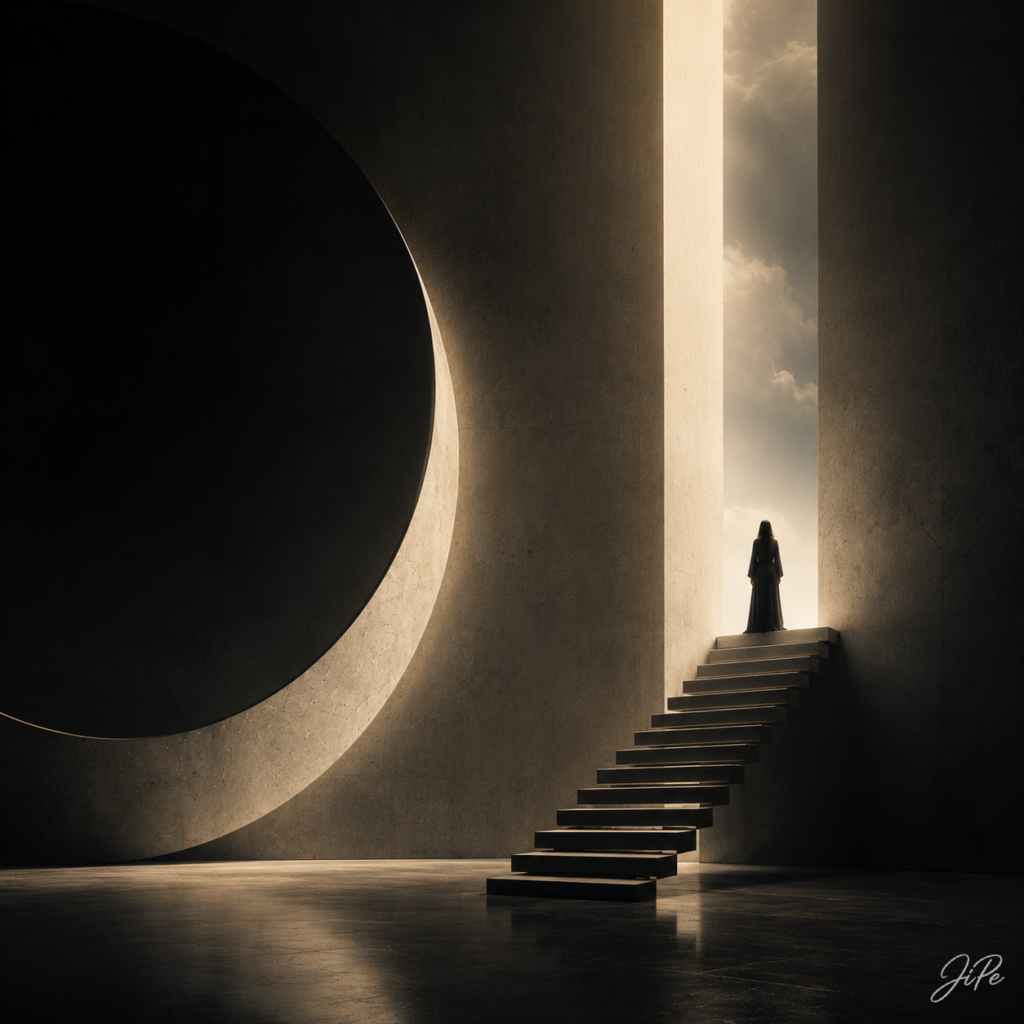
The Architecture of Becoming II holds its central presence at the edge of an immense threshold, where stillness acquires the weight of decision. Human scale is deliberately diminished, not to suggest insignificance, but to sharpen the tension between the finite self and a space that appears to exceed ordinary measure.
The composition is governed by opposing forces: enclosure and release, darkness and radiance, gravity and ascent. Yet none fully prevails. The passage toward light remains narrow, almost severe, while the surrounding darkness possesses its own quiet authority. Light becomes less a promise than a condition of uncertainty—something that reveals a possible direction without disclosing what lies beyond it.
Within this suspended moment, the title suggests becoming not as arrival, but as architecture: a structure of intervals, choices, absences, and thresholds through which identity may be continually formed. The monumental scale gives inner transformation an almost physical dimension, as though a private decision could alter the proportions of the world.
Nothing confirms whether the figure has reached a destination or merely another boundary. Perhaps becoming begins precisely there—where the familiar ends, the future remains unreadable, and one must decide whether the opening ahead is an entrance, an escape, or something for which there is not yet a name.