The Silent Call
The Silent Call occupies the charged stillness between withdrawal and awakening. The figure appears deeply contained, her lowered gaze turning attention away from…
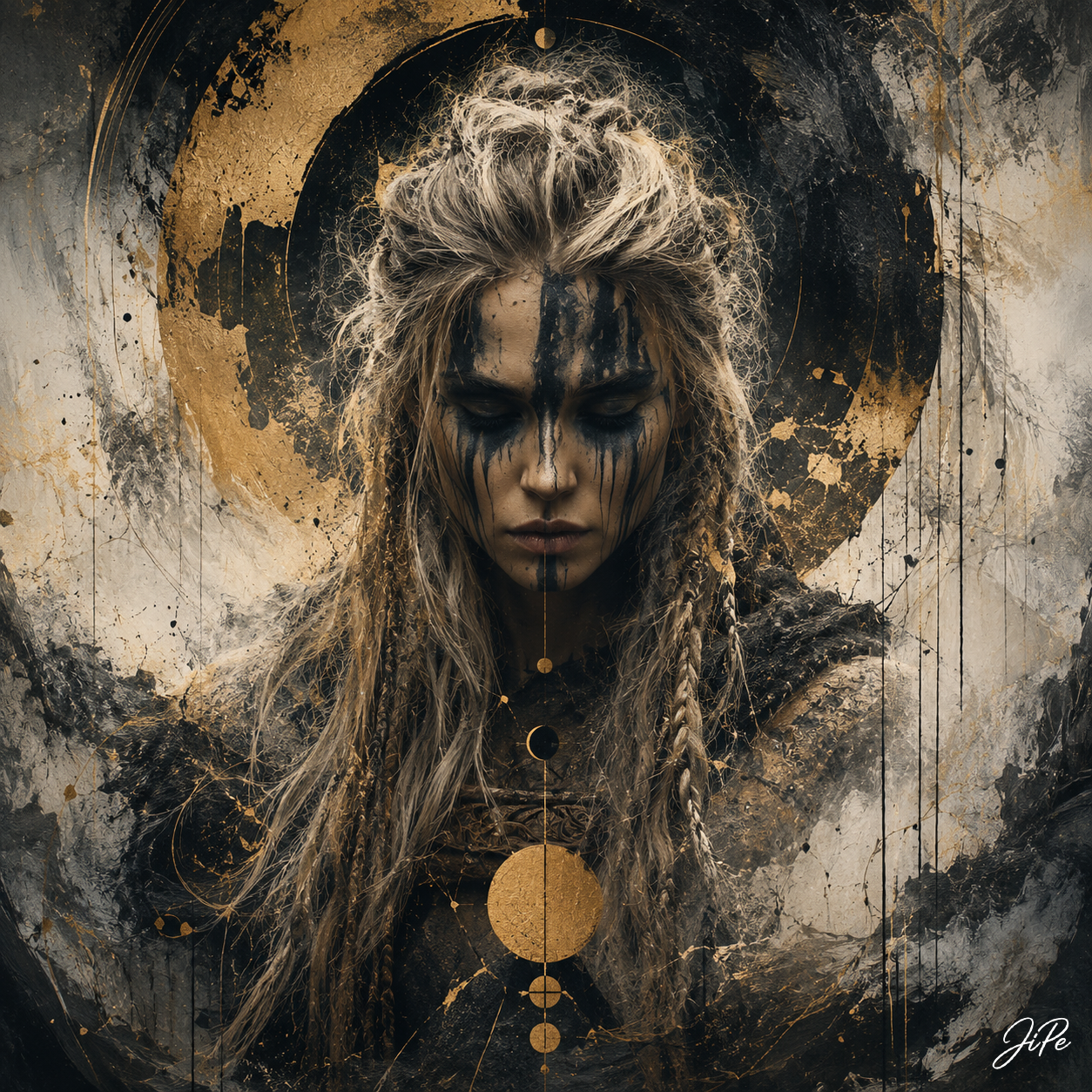

Neo-Symbolist Art brings the language of symbolism into a contemporary visual world. It explores ideas, emotions, and mysteries that exist beyond visible reality. Rather than describing life literally, the art uses images as gateways to deeper meaning.
Human figures, ancient structures, celestial forms, animals, landscapes, and light can all become symbols. Each element may carry several possible meanings. Therefore, the viewer becomes an active part of the artwork and its interpretation.
Neo-Symbolist Art draws inspiration from the historic Symbolist movement while creating a distinctly modern expression. However, it does not simply recreate the visual language of the past.
Instead, contemporary symbolism can combine realism, surrealism, mythology, abstraction, and cinematic atmosphere. These influences create visual worlds that feel both familiar and impossible.
A solitary figure may stand before a monumental gateway. Elsewhere, a mysterious sphere can suggest eternity, knowledge, or an unknown universe. Ancient ruins may symbolize memory and lost civilizations.
As a result, recognizable subjects gain meanings beyond their physical appearance.
Light plays a central role in many Neo-Symbolist artworks. It can represent hope, revelation, transformation, spiritual awakening, or the discovery of something previously hidden.
Meanwhile, darkness creates mystery and emotional depth. Shadows can suggest uncertainty, memory, silence, or the unknown.
The contrast between these forces creates visual tension. Moreover, it transforms light into something more than a technical element.
It becomes part of the story.
Gold and luminous surfaces can also suggest something precious or eternal. In contrast, weathered stone and fractured forms may represent time, mortality, and change.
Mythology provides another important source of inspiration for Neo-Symbolist Art. Ancient stories contain universal themes that remain relevant in contemporary life.
Gods, warriors, guardians, animals, temples, and cosmic forms can therefore appear in new contexts. Their original meanings may remain visible, yet new interpretations can emerge.
Similarly, circles, portals, stairs, mountains, water, and celestial objects can become powerful visual metaphors. A doorway might suggest transition. A mountain can represent struggle or ascent.
Water may symbolize reflection, renewal, memory, or the unconscious.
Through these symbols, the artwork can connect personal experiences with larger human questions.
Neo-Symbolist Art often exists somewhere between realism and surrealism. Figures and objects may appear realistic, while their surroundings follow another logic.
Scale can suddenly change. Architecture may become impossible. Landscapes can merge with dreams, while light seems to arrive from another dimension.
Consequently, reality becomes flexible.
This balance allows the artwork to remain visually accessible while still creating mystery. Viewers recognize what they see, yet they may not immediately understand what it means.
That uncertainty is important.
Rather than offering one fixed explanation, symbolic art leaves space for personal discovery.
This collection of Neo-Symbolist Art explores identity, transformation, mythology, spirituality, memory, nature, and humanity’s relationship with the unknown.
Monumental compositions create a sense of scale and presence. At the same time, atmospheric depth and dramatic light build emotional intensity.
Some works suggest journeys between different worlds. Others capture silent moments of contemplation, confrontation, or awakening.
Throughout the collection, visual storytelling remains central. Symbols are not simply decorative elements. Instead, they become part of a larger emotional and philosophical language.
Ultimately, Neo-Symbolist Art asks the viewer to look beyond appearances. Reality becomes a starting point rather than a boundary.
Explore this collection of contemporary Neo-Symbolist Art and discover a world shaped by symbolism, mythology, mystery, and imagination.
