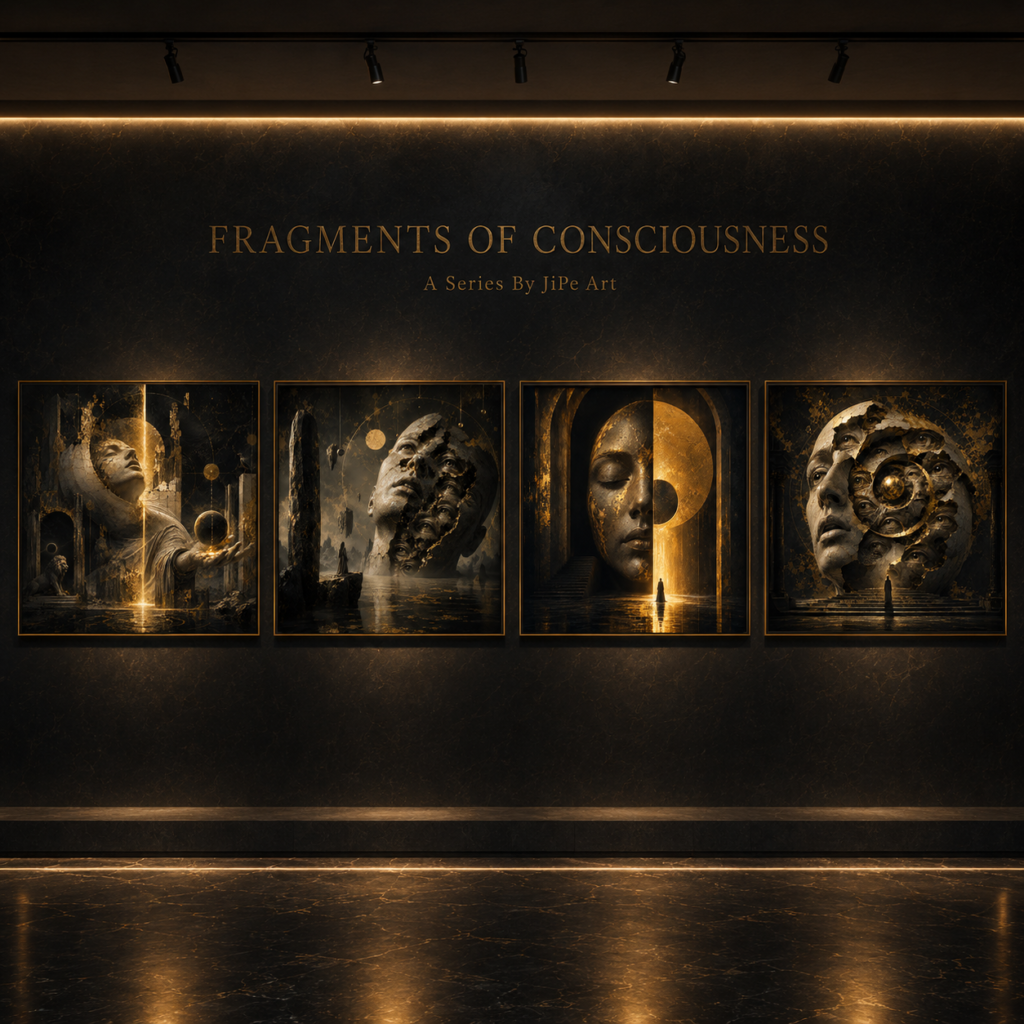
Fragments of Consciousness inhabits the unstable territory between coherence and dissolution, where identity appears less as a fixed presence than as something continually assembled. Monumental forms emerge from darkness with an almost interior scale, as though the spaces surrounding them belong equally to architecture, memory, and the mind.
Across the series, fragmentation creates a quiet psychological tension. What is divided does not necessarily feel broken; separation becomes another form of perception. Multiple presences seem to coexist within a single consciousness, suggesting states of memory, self-observation, uncertainty, or transformation without resolving into any one interpretation. The vastness surrounding these forms intensifies their solitude, while silence gives each interruption an unexpected gravity.
Light moves through this fractured world with particular authority. It does not simply reveal what darkness conceals; at times it seems to create the threshold between one state of awareness and another. Illumination becomes both promise and disturbance, exposing only enough to deepen what remains inaccessible.
The title leaves open whether consciousness has been shattered into fragments—or whether fragmentation is its natural condition. Perhaps what we experience as a unified self is only the momentary alignment of many things that never fully become one.