
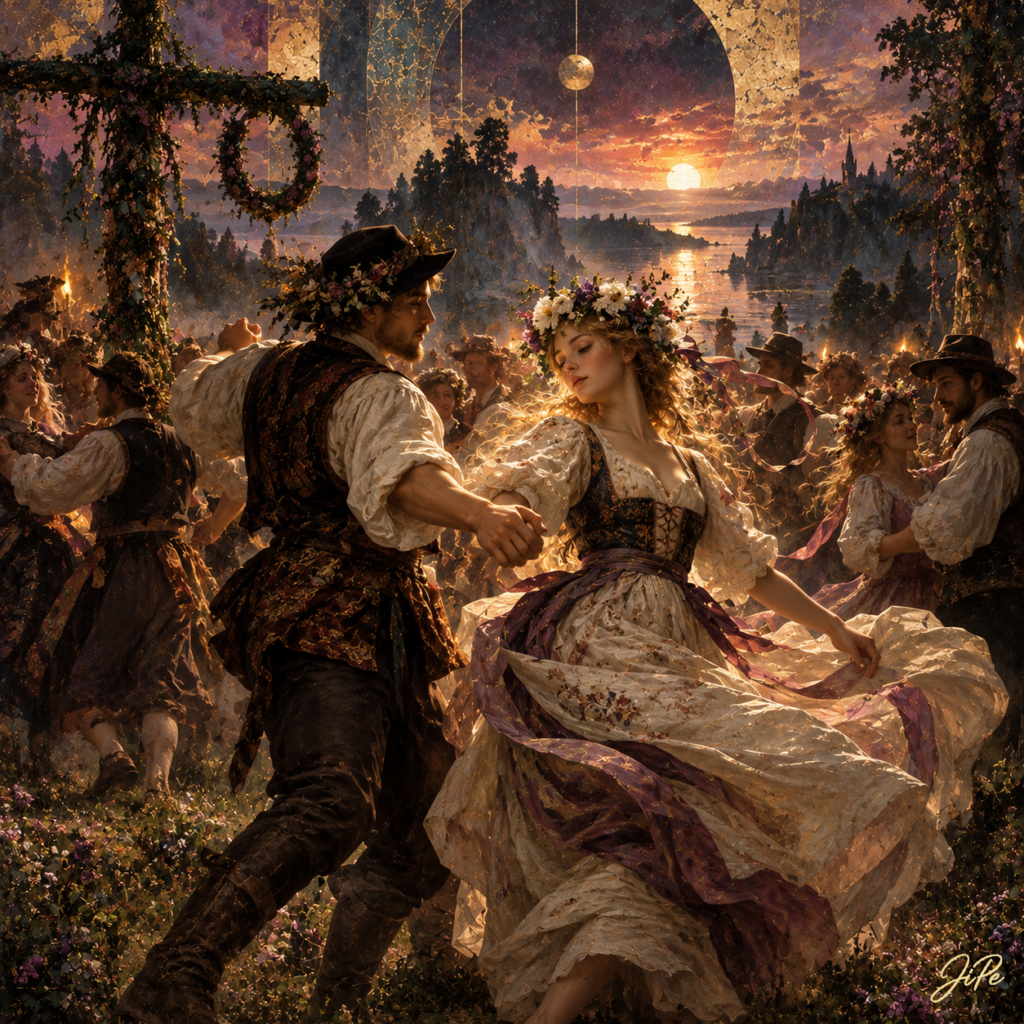
In JiPe’s reinterpretation of Anders Zorn’s Midsummer Dance, celebration unfolds with the tenderness of something already becoming memory. The central couple gives the gathering an intimate centre of gravity: their shared movement depends on a contact that feels assured yet momentary. Around them, the other dancers extend this closeness into a communal rhythm, while the distant water opens a space beyond its reach.
The scene’s expansive scale lends a private exchange an almost ceremonial weight. Yet the woman’s lowered gaze preserves a quiet inwardness within the dance. Physical accord leaves room for separate thoughts; the partners move together without becoming entirely knowable to one another.
Light gathers along their turning bodies as though lingering could delay the evening’s passage. Its warmth carries a trace of melancholy, making the fullness of the moment inseparable from its brevity. Beneath the immense sky, the gathering seems both rooted in the earth and briefly released from ordinary time.
Midsummer holds this delicate uncertainty: an evening may feel inexhaustible precisely when its passing becomes most keenly felt. The dancers remain poised within their turn, their hands joined, while beyond them the light stretches across water towards a distance no shared rhythm can quite contain.