
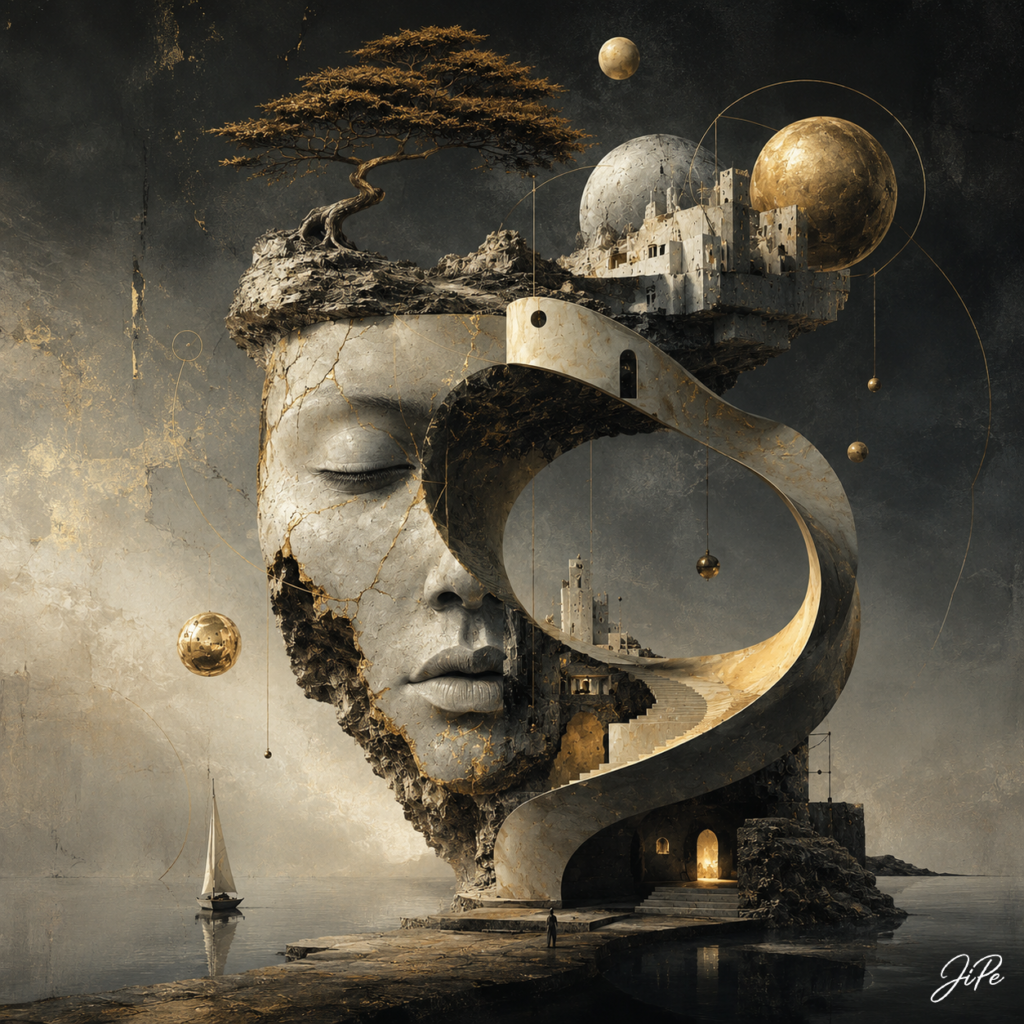
Echoes of an Inner Kingdom occupies the uncertain territory between monument and mind. A vast, inward-facing presence dominates the space, yet its closed expression creates distance rather than authority. Around it, scale becomes unstable: the intimate expands toward the architectural, while entire worlds appear small enough to belong to memory.
The composition holds itself between fragmentation and continuity. Passages seem to lead inward, upward, and elsewhere, suggesting an order whose logic can be sensed but never fully entered. Light appears sparingly, gathering at thresholds and along fractured surfaces as though consciousness itself were illuminating only what it is prepared to encounter. The surrounding silence feels inhabited by things remembered, forgotten, or not yet understood.
Echoes of an Inner Kingdom suggests a realm that may once have been whole, though the work never confirms whether its ruins belong to loss or transformation. Identity here seems less like a fixed centre than a landscape continually rebuilt from absence, desire, and recollection.
Perhaps the smallest figure stands before an unknown world. Or perhaps everything towering above has always existed within that figure, waiting for the silence in which it might finally be heard.